Question
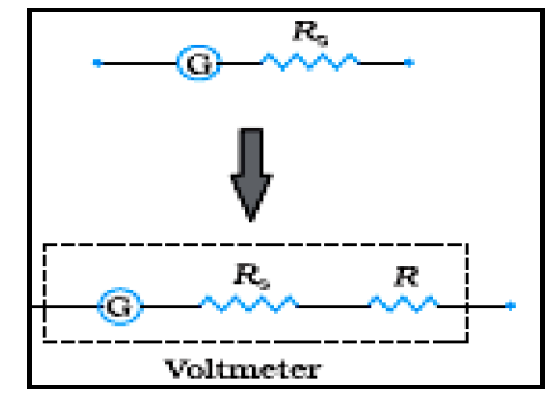
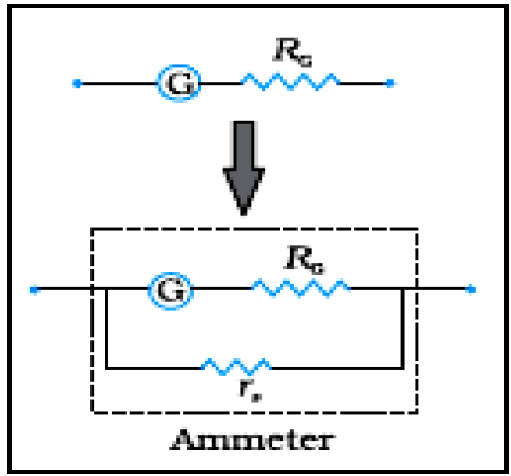
How is a galvanometer converted into a voltmeter and an ammeter? Draw the relevant diagrams and find the resistance of the arrangement in each case. Take resistance of galvanometer as G.
Answer

A galvanometer is converted into a voltmeter by connecting a high resistance ‘$R$’ in series with it. A galvanometer is converted into an ammeter by connecting a small resistance $($called shunt$)$ in parallel with it.


Resistance of voltmeter, $?_? = G + R$
Resistance for Ammeter, $\text{R}_{A} = \frac{\text{G }\text{ r}_{s}}{\text{G} + \text{r}_{s}}$.

Need a full question paper?

Generate a complete, print-ready paper with questions like this in minutes — across 16+ boards, with answer keys.
Start Generating Free

Similar questions

A battery of $10 V$ and negligible internal resistance is connected across the diagonally opposite corners of a cubical network consisting of 12 resistors each of resistance $1 \Omega$ (Fig. 3.16). Determine the equivalent resistance of the network and the current along each edge of the cube.
Image
Derive the expression for force per unit length between two long straight parallel current carrying conductors. Hence define one ampere.
Draw the circuit diagram of a common emitter amplifier using $n-p-n$ transistor. What is the phase differnece between the input signal and output voltage? State two reasons why a common emitter amplifier is preferred to a common base amplifier.
Which waves are electromagnetic waves?Which factors are responsible for their production?
  1. Draw a ray diagram depicting the formation of the image by an astronomical telescope in normal adjustment.
  2. You are given the following three lenses. Which two lenses will you use as an eyepiece and as an objective to construct an astronomical telescope? Give reason.
Lenses Power $(D)$ Aperture $(cm)$
$L_1$ $3$ $8$
$L_2$ $6$ $1$
$L_3$ $10$ $1$
Is the colour of 620nm light and 780nm light same? Is the colour of 620nm light and 621nm light same? How many colours are there in white light?
A convex lens made up of glass of refractive index 1.5 is dipped, in turn, in:
  1. Medium A of refractive index 1.65
  2. Medium B of refractive index 1.33
Explain, giving reasons, whether it will behave as a converging lens or a diverging lens in each of these two media.
Suppose the circuit in Exercise $7.18$ has a resistance of $15\Omega.$ Obtain the average power transferred to each element of the circuit, and the total power absorbed
Can we perform Young's double slit experiment with sound waves? To get a reasonable "fringe pattern", what should be the order of separation between the slits? How can the bright fringes and the dark fringes be detected in this case?
$i.$ Define the term self-inductance and write its $S.I$. unit.
$ii$. Obtain the expression for the mutual inductance of two long co $-$ axial solenoids $S_1$ and $S_2$ wound one over the other, each of length $L$ and radii $r_1$ and $r_2$ and $n_1$ and $n_2$ number of turns per unit length, when a current $I$ is set up in the outer solenoid $S _2$.