Question
Show that for a projectile the angle between the velocity and the x-axis as a function of time is given by, $\theta(\text{t})=\tan^{-1}\Big(\frac{\text{u}_\text{oy}-\text{gt}}{\text{u}_\text{ox}}\Big)$
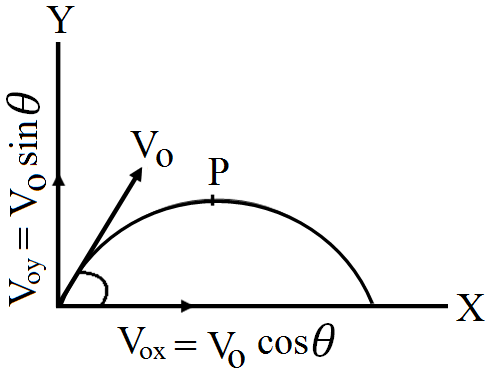
Answer

Let $v_{ox}$ and $v_{0y}$ respectively be the initial components of the velocity of the projectile along horizontal (x) and vertical (y) directions. Let $v_x$ and $v_y$ respectively be the horizontal and vertical components of velocity at a point P.
Time taken by the projectile to reach point P = t Applying the first equation of motion along the vertical and horizontal directions, we get: $v_y = v_{oy} = gt$ And $v_x = v_{ox}$
$\therefore\tan\theta=\frac{\text{v}_\text{y}}{\text{v}_\text{x}}=\frac{\text{v}_\text{oy}-\text{gt}}{\text{v}_\text{ox}}$ $\theta=\frac{\tan^{-1}(\text{v}_\text{oy}-\text{gt})}{\text{v}_\text{ox}}$

Need a full question paper?

Generate a complete, print-ready paper with questions like this in minutes — across 16+ boards, with answer keys.
Start Generating Free

Similar questions

Calculate the moment of inertia of uniform circular disc of mass 500 g , radius 10 cm about
i. diameter of the disc
ii. the axis tangent to the disc and parallel to its diameter and
iii. the axis through the centre of the disc and perpendicular to its plane.
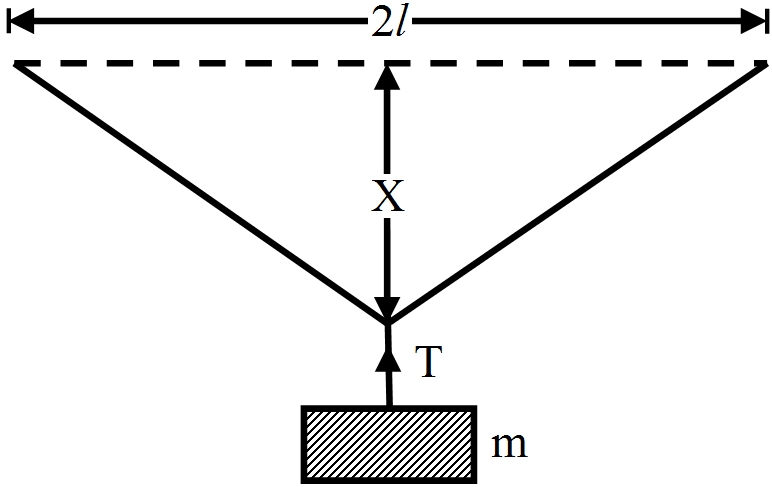
A steel wire of length 2l and cross-sectional area A is stretched within elastic limit as shown in figure. Calculate the strain and stress in the wire.
A particle executes SHM of period 8s. After what time of its passing through the mean position, will be energy be half kinetic and half potential?
Establish the formula for work in isothermal process.
A metal rod of cross sectional area $1.0 \mathrm{~cm}^2$ is being heated at one end. At one time, the temperature gradient is $5.0^{\circ} \mathrm{C} / \mathrm{cm}^{-1}$ at cross section A and is $2.5^{\circ} \mathrm{C} / \mathrm{cm}^{-1}$ at cross section B . Calculate the rate at which the temperature is increasing in the part $A B$ of the rod. The heat capacity of the part $A B=0.40 \rho^{\circ} \mathrm{C}^{-1}$, thermal conductivity of the material of the rod $=200 \mathrm{Wm}^{-1} \mathrm{C}^{-1}$. Neglect any loss of heat to the atmosphere.
A particle on a stretched string supporting a travelling wave, takes 5.0ms to move from its mean position to the extreme position. The distance between two consecutive particles, which are at their mean positions, is 2.0cm. Find the frequency, the wavelength and the wave speed.
A chain of length l and mass m lies on the surface of a smooth sphere of radius R>1 with one end tied to the top of the sphere.
  1. Find the gravitational potential energy of the chain with reference level at the centre of the sphere.
  2. Suppose the chain is released and slides down the sphere. Find the kinetic energy of the chain, when it has slid through an angle $\theta.$
  3. Find the tangential acceleration $\frac{\text{dv}}{\text{dt}}$ of the chain when the chain starts sliding down.
A disc of radius R is rotating with an angular speed $\omega_\text{o}$ about a horizontal axis. It is placed on a horizontal table. The coefficient of kinetic friction is $\mu_\text{k}{:}$
  1. What was the velocity of its centre of mass before being brought in contact with the table?
  2. What happens to the linear velocity of a point on its rim when placed in contact with the table?
  3. What happens to the linear speed of the centre of mass when disc is placed in contact with the table?
  4. Which force is responsible for the effects in (b) and (c).
  5. What condition should be satisfied for rolling to begin?
  6. Calculate the time taken for the rolling to begin.
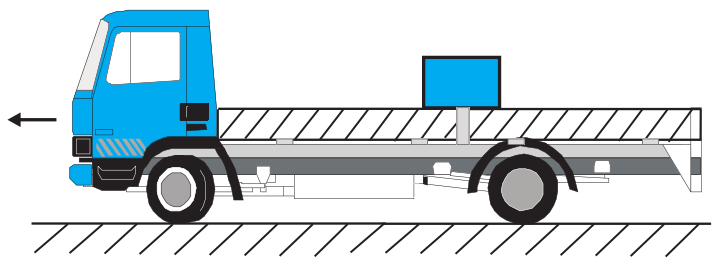
The rear side of a truck is open and a box of $40kg$ mass is placed $5m$ away from the open end as shown in Fig. The coefficient of friction between the box and the surface below it is $0.15$. On a straight road, the truck starts from rest and accelerates with $2ms^{-2}$. At what distance from the starting point does the box fall off the truck? (Ignore the size of the box).
A tunnel is dug through the centre of the Earth. Show that a body of mass ‘m’ when dropped from rest from one end of the tunnel will execute simple harmonic motion.