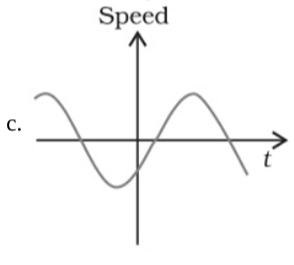
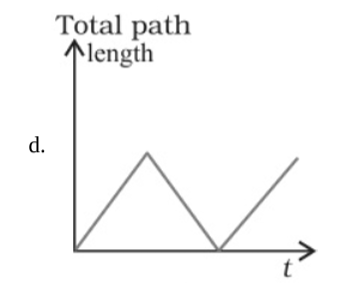
Question
Shows that the projection angle $\theta_0$ for a projectile launched from the origin is given by,
$\theta_0=\tan^{-1}\Big(\frac{4\text{h}_\text{m}}{\text{R}}\Big)$
where the symbols have their usual meaning.
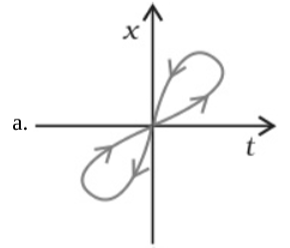
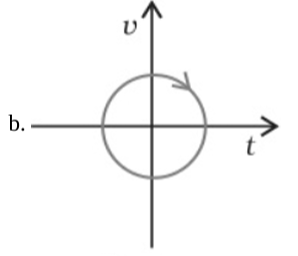
Answer

Maximum vertical height, $\text{h}_\text{m}=\frac{\text{u}_0^2\sin^2\theta}{2\text{g}}\ ...(\text{i})$
Horizontal range, $\text{R}=\frac{\text{u}_0^2\sin^22\theta}{\text{g}}\ ...(\text{ii})$
$\frac{\text{h}_\text{m}}{\text{R}}=\frac{\sin^2\theta}{2\sin^22\theta}$
$=\frac{\sin\theta\times\sin\theta}{2\times\sin\theta\cos\theta}$
$=\frac{\sin\theta}{4\cos\theta}=\frac{\tan\theta}{4}$
$\tan\theta=\frac{4\text{h}_\text{m}}{\text{R}}$
$\theta=\tan^{-1}\frac{4\text{h}_\text{m}}{\text{R}}$

Need a full question paper?

Generate a complete, print-ready paper with questions like this in minutes — across 16+ boards, with answer keys.

Start Generating Free

Similar questions

The radius of a sphere is measured as $(2.1 \pm 0.5) \text{cm}$ calculate its surface area with error limits.
A 100W light bulb is placed at the centre of a spherical chamber of radius 20cm. Assume that 60% of the energy supplied to the bulb is converted into light and that the surface of the chamber is perfectly absorbing. Find the pressure exerted by the light on the surface of the chamber.
The displacement of a particle having S.H.M. is x = 10

$\sin\Big[10\pi\text{t}+\frac{\pi}{4}\Big]\text{m}.$

  1. Amplitude.
  2. Angular frequency.
  3. Epoch.
  4. Time period.
  5. Frequency.
  6. Maximum velocity.
If several forces act on a particle, the total torque on the particle may be obtained by first finding the resultant force and then taking torque of this resultant. Prove this. Is this result valid for the forces acting on different particles of a body in such a way that their lines of action intersect at a common point?
Two small bodies of masses 10kg and 20kg are kept a distance 1.0m apart and released, Assuming that only mutual gravitational forces are acting, find the speeds of the particles when the separation decreases to 0.5m.
A body of mass 60kg is dragged with just enough force to start moving on a rough surface with coefficients of static and kinetic friction 0.5 and 0.4 respectively on applying the same force. What is the acceleration?
A calorie is a unit of heat (energy in transit) and it equals about 4.2 J where $1 J=1 kg m ^2 s^{-2}$. Suppose we employ a system of units in which the unit of mass equals $\alpha$ $kg$, the unit of length equals $\beta$ $m$, the unit of time is $\gamma$ $s$. Show that a calorie has a magnitude $4.2 \alpha^{-1} \beta^{-2} \gamma^2$ in terms of the new units.
One mole of an ideal gas requires 207J heat to raise the temperature by 10K when heated at constant pressure. Find the amount of heat required to heat the same gas to raise the temperature by same 10K under constant volume conditions. Given R = 8.3J mol-1 K-1.
$\text{ }^{197}_{80}\text{Hg}$ decay to $\text{ }^{197}_{79}\text{Au}$ through electron capture with a decay constant of 0.257 per day.
  1. What other particle or particles are emitted in the decay?
  2. Assume that the electron is captured from the K shell. Use Moseley's law $\sqrt{\text{v}}=\text{a(Z}-\text{b})$ with $\text{a}=4.95\times10^7\text{s}^{-\frac{1}{2}}$ and b = 1 to find the wavelength of the $\text{K}_{\alpha}$ X-ray emitted following the electron capture.