MCQ
$SI$ unit of pressure is
  • Pascal
  • B
    $Dynes/c{m^2}$
  • C
    $cm\,$ of $Hg$
  • D
    Atmosphere

Answer

Correct option: A.
Pascal
a
The SI unit of pressure is pascal (represented as $Pa$) which is equal to one newton per square metre $\left( N / m ^2\right.$ or $kg m ^{-1} s ^{-2}$ ). Interestingly, this name was given in $1971$ . Before that pressure in $SI$ was measured in $newtons$ $per$ $square$ $metre$.

Need a full question paper?

Generate a complete, print-ready paper with questions like this in minutes — across 16+ boards, with answer keys.
Start Generating Free

Similar questions

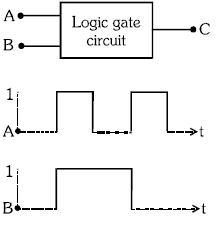
The following figure shows a $AND$ logic gate circuit with two inputs $A$ and $B$ and the output $C$. The voltage waveforms of $C$ will be
$Assertion$ : Velocity-time graph for an object in uniform motion along a straight path is a straight line parallel to the time axis.

$Reason$ : In uniform motion of an object velocity increases as the square of time elapsed.

If mass of $He$ atom is $4$ times that of hydrogen atom then mean velocity of $He$ is
The magnetic field at a point $x $ on the axis of a small bar magnet is equal to the field at a point $  y  $ on the equator of the same magnet. The ratio of the distances of $x$ and $y$  from the centre of the magnet is
A square loop of side $1\,m$ and resistance $1\,\Omega$ is placed in a magnetic field of $0.5\,T$. If the plane of loop is perpendicular to the direction of magnetic field, the magnetic flux through the loop is $\dots\dots$ webar
A block rests on a rough inclined plane making an angle of $30^o$ with the horizontal.  The coefficient of static friction between the block and the plane is $0.8.$ If the frictional   force on the block is $10\, N$, the mass of the block (in $kg$) is : (taken $g = 10 \,m/s^2)$
Three particles each of mass $M$ are placed at the three corners of an equilateral triangle of side $l$ . What is the force due to this system of particles on another particle of mass $m$ placed at the mid -point of any side?
A uniform magnetic field $\vec B\,\, = \,\,{B_0}\,\hat j$ exists in a space. A particle of mass $m$ and charge $q$ is projected towards negative $x$-axis with speed $v$ from the a point $(d, 0, 0)$. The maximum value $v$ for which the particle does not hit $y-z$ plane is
Two vectors $\overrightarrow A $ and $\overrightarrow B $ are at right angles to each other, when
A plane is revolving around the earth with a speed of $100\, km/hr $ at a constant height from the surface of earth. The change in the velocity as it travels half circle is.........$km/hr$