Question
$\sin−10 $ is equal to:
  1. $0$
  2. $ \dfrac{\pi }{6}$
  3. $ \dfrac{\pi}{2}$
  4. $ \dfrac{\pi}{3}$

Answer

  1. $0$

Solution:

As we know that $\sin{0} = 0\sin0=0\Rightarrow 0 = \sin^{-1}{\left( 0 \right)}$

Hence the value of $ \sin^{-1}{\left( 0 \right)}$ is 0.

Need a full question paper?

Generate a complete, print-ready paper with questions like this in minutes — across 16+ boards, with answer keys.
Start Generating Free

Similar questions

The probability of a bomb hitting a bridge is $\frac{1}{2}$ and two direct hits are needed to destroy it. The least number of bombs required so that the probability of the bridge beeing destroyed is greater then $0.9$, is
If $\vec{\text{a}}$ and $\vec{\text{b}}$ are unit vectors inclined at an angle $\theta,$ then the value of $\big|\vec{\text{a}}-\vec{\text{b}}\big|$ is:
  1.  $2\sin\frac{\theta}{2}$
  2. $2\sin\theta$
  3. $2\cos\frac{\theta}{2}$
  4. $2\cos\theta$
If $\left| {\,\begin{array}{*{20}{c}}a&b&0\\0&a&b\\b&0&a\end{array}\,} \right| = 0$, then
Let $R$ be the set of all real number and $f: R \rightarrow R$ be a continuous function. Suppose $|f(x)-f(y)| \geq|x-y|$ for all real number $x$ and $y$. Then,
$\int_{}^{} {\frac{{\cos {\rm{ec}}x}}{{\log \tan \frac{x}{2}}}\;dx = } $
Let $X$ have a binomial distribution $B ( n , p )$ such that the sum and the product of the mean and variance of $X$ are $24$ and $128$ respectively. If $P ( X > n -3)=\frac{ k }{2^{ n }}$, then $k$ is equal to.
If $\tan^{-1}\Big(\frac{\text{a}}{\text{x}}\Big)+\tan^{-1}\Big(\frac{\text{b}}{\text{x}}\Big)=\frac{\pi}{2},$ then x is equal to:
  1. $\sqrt{\text{ab}}$
  2. $\sqrt{2\text{ab}}$
  3. $2\text{ab}$
  4. $\text{ab}$
If l, m, n are the direction cosines of a line, then:
If $f\left( x \right) = \left\{ \begin{gathered} \,\,\,\,\,\,\,\,\left| {x - 3} \right|\,\,\,\,\,\,\,\,\,\,\,,\,\,x \geqslant 1 \hfill \\   \frac{{{x^2}}}{4} - \frac{{3x}}{2} + \frac{{13}}{4}\,\,\,\,\,,\,\,x < 1 \hfill \\ 
\end{gathered}  \right.\,\,$ then $f(x)$ is 
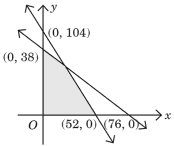
The feasible region of an LPP is given in the following figure
Image
Then, the constraints of the LPP are $x \geq 0, y \geq 0$ and