Question
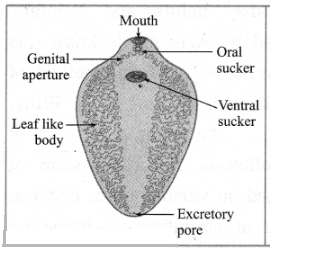
Sketch, label and classify the following organisms: Liverfluke.

Answer


Image
Classification:
Kingdom: Animalia
Division: Non-chordata
Phylum: Platyhelminthes
Example: Liverfluke

Need a full question paper?

Generate a complete, print-ready paper with questions like this in minutes — across 16+ boards, with answer keys.

Start Generating Free

Similar questions

(lungs, heart, carcinogenic, nervous, intoxicating, hazardous, addictions, peer-group)
The children fall into the trap of …………. either due to ……….. pressure or due to false symbol of high standard living. Sometimes they try to imitate their elders. The addictive substances are ………….., and they cause long term effects. Some are temporarily ………… substances obtained from the plants. While some of the chemical ingredients in them can permanently damage the human ……… system, muscular system, …………, etc. Some tobacco like substances are ………. in action especially on the mouth and ………….
Depending on electronic configuration the properties of elements vary in different periods. Explain why?
What is the exact difference between grades of organization and symmetry? Explain with examples.
Explain the process of formation of complex proteins.
If mass of a planet is eight times the mass of the earth and its radius is twice the radius of the earth, what will be the escape velocity for that planet?
The gas A is used by most of the animals to obtain energy from food by the process of respiration. When A is acted upon by radiation X , it gets converted into another gas B which is an allotrope of A but poisonous when inhaled. B forms a kind of layer C in the upper atmosphere which absorbs radiations X coming from a source Y and prevent them from reaching the earth. Some chemicals $Z$ released from the various devices on the earth are destroying the layer C slowly. In fact, a hole has already been formed in layer C over the area D of the earth.
a. What are gases (i) $A$, and (ii) $B$ ? Write their molecular formulae.
b. Name the layer $C$.
c. What are (i) X , (ii) Y , and (iii) Z ?
d. Name the area D.
e. Name any two human ailments which may be caused by $X$.
Explain with diagrams what is meant by the “series combination” and “parallel combination” of resistances. In which case the resultant resistance is:
  1. Less, and
  2. More, than either of the individual resistances?
A, B and C are three living organisms. The organism A is a unicellullar fungus which can live without air. It is used in the commercial production of an organic compound P from molasses. The organism B is a unicellular animal which lives in water and feeds and moves by using pseudopodia. It breathes through an organelle Q. The organism C is a tiny animal which acts as a carrier of malarial parasite. It breathes and respires through a kind of tiny holes R and air - tubes S in its body.
  1. What are organisms A, B and C?
  2. Name P, Q, R and S.
  3. Which organism/ organisms undergo aerobic respiration?
  4. Which organism/ organisms undergo anaerobic respiration?
What is the reaction called when oxidation and reduction take place simultaneously? Explain with one example.
Enlist the rules for drawing ray diagrams of convex lens