Question
Explain the process of formation of complex proteins.

Answer

The proteins are synthesised in following steps, viz. transcription, translation and translocation. Protein synthesis takes place according to the sequence of nucleotides present on the DNA molecule with the help of RNA molecules. This is known as central dogma of protein synthesis.

1. Transcription: In the process of transcription, mRNA is produced as per the nucleotide sequence on the DNA. For this the two strands DNA are separated. Only one strand participates in the formation of mRNA. The sequence of nucleotides which is complementary to that of present on DNA is copied on mRNA. Instead of thymine present in DNA, uracil is added on the mRNA. Transcription takes place in nucleus but the mRNA leaves nucleus, carries the genetic code and enters the cytoplasm. This genetic code is always in triplet form arid hence is known as triplet codon. The code for each amino acid always consists of three nucleotides.

2. Translation: Each mRNA may carry thousands of codons. But each codon is specific for only one amino acid. The tRNA molecule brings the required amino acid as per the code present on mRNA. There is anticodon on each tRNA which is complementary to the codon on mRNA. This process is known as translation.

3. Translocation: In translocation, the ribosome keeps on moving from one end of mRNA molecule to other end by distance of one triplet codon. While this process is taking place, rRNA, helps in joining the amino acids together by peptide bonds. The peptide chains later come together to form complex protein molecules.

Need a full question paper?

Generate a complete, print-ready paper with questions like this in minutes — across 16+ boards, with answer keys.
Start Generating Free

Similar questions

A cylindrical structure P in our body begins in continuation with medulla and extends downwards. It is enclosed in a bony cage Q and surrounded by membranes R. As many as x pairs of nerves arise from the structure P. The structure P is involved in the reflex actions of our body and conduction of nerve impulses to and from another organ S of our body with which it forms CNS.
  1. Name the structure P.
  2. Name (i) bony cage Q, and (ii) membranes R.
  3. How much is x?
  4. Name the organs S.
  5. What are the reflexes involving structure P only known as?
State and explain Maxwell’s right-hand thumb rule.
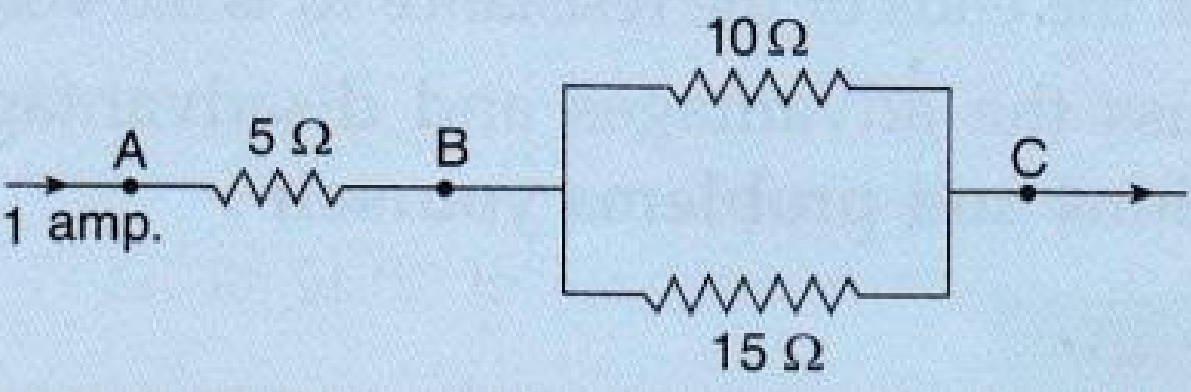
Three resistors are connected as shown in the diagram.

Through the resistor $5$ ohm, a current of $1$ ampere is flowing,
  1. What is the current through the other two resistors?
  2. What is the p.d. across $AB$ and across $AC?$
  3. What is the total resistance?
Two lamps, one rated $40W$ at $220V$ and the other $60W$ at $220V,$ are connected in parallel to the electric supply at $220V.$
  1. $10$ Draw a circuit diagram to show the connections.
  2. Calculate the current drawn from the electric supply.
  3. Calculate the total energy consumed by the two lamps together when they operate for one hour.
What are the conventions used in writing a chemical equation?
Which precautions will you take during spraying of pesticides?
What are the advantages of hydroelectric power generation? 
Write a short note.
Specific heat capacity
How will you increase the strength of magnetic field in an electromagnet?
Explain the following terms with example: Structural isomerism.