Question
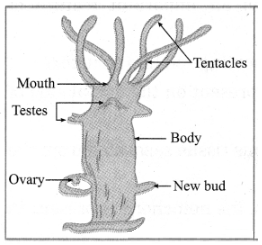
Sketch, labell and classify: Hydra.


Answer


Image
Classification:
Kingdom: Animalia
Division: Non-chordata
Phylum: Coelenterata
Example: Hydra

Need a full question paper?

Generate a complete, print-ready paper with questions like this in minutes — across 16+ boards, with answer keys.
Start Generating Free

Similar questions

Write Short note: Budding in hydra.
Balance the following equation stepwise.
Take into account the time required for following processes. Classify them into two groups and give titles to the groups.
(i) Cooking gas starts burning on ignition.
(ii) Iron article undergoes rusting.
(iii) Erosion of rocks takes place to form soil.
(iv) Alcohol is formed on mixing yeast in glucose solution under proper condition.
(v) Effervescence is formed on adding baking soda into a test tube containing dilute acid.
(vi) A white precipitate is formed on adding dilute sulphuric acid to barium chloride solution.
What is the correct reason for blinking/flickering of stars? Explain it.
(a) The blasts in the stars.
(b) Absorption of star light by the atmosphere.
(c) Motion of the stars.
(d) Changing refractive index of gases in the atmosphere.
Answer the question:
What is meant by satellite launch vehicles? Explain a satellite launch vehicle developed by ISRO with the help of a schematic diagram.
Write short note: Green revolution.
Explain the mechanism of photosynthesis.
With the help of labelled diagrams, describe an activity to show that acids produce ions only in aqueous solutions.
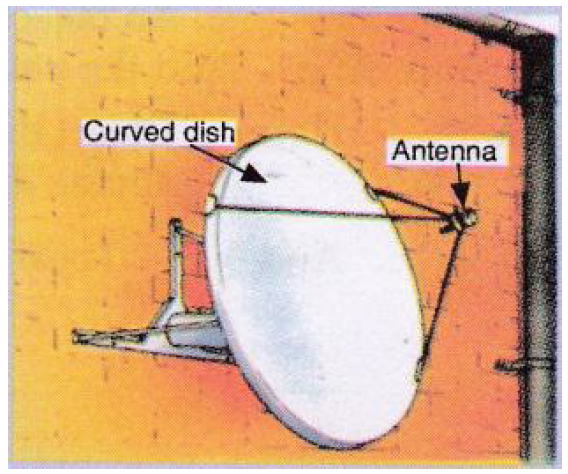
The diagram shows a dish antenna which is used to receive television signals from a satellite. The antenna (signal detector) is fixed in front of the curved dish.
  1. What is the purpose of the dish?
  2. Should it be concave or convex?
  3. Where should the antenna be positioned to receive the strongest possible signals?
  4. Explain what change you would expect in the signals if a larger dish was used.
A part of the early classification of elements has been given below:
$\text{H}\ \ \ \ \ \ \ \text{Li} \ \ \ \ \ \ \ \text{Be} \ \ \ \ \ \ \ \ \ \text{B}\ \ \ \ \ \ \ \text{C}\ \ \ \ \ \ \ \text{N}\ \ \ \ \ \ \ \text{O}\\\text{F}\ \ \ \ \ \ \ \text{Na}\ \ \ \ \ \ \text{Mg}\ \ \ \ \ \ \ \text{Al}\ \ \ \ \ \ \text{Si}\ \ \ \ \ \ \ \text{P}\ \ \ \ \ \ \ \ \text{S}$
  1. Which law of classification of element is illustrated by the above arrangement of elements?
  2. Name the scientist who proposed such a classification of elements.
  3. Why is such a classification of elements compared with a characteristics of musical scale?
  4. State one limitation of this classification of elements.
Balance the following equation stepwise.
$NaOH _{(aq)} + H_2SO_{4(aq)} \rightarrow Na_2SO_{4(aq)} +H_2O_{(l)}.$