MCQ
Solid $Ba(NO_3)_2$ is gradually dissolved in $1\times10^{-4}\, M\, Na_2CO_3$ solution. At what concentration of $Ba^{+2}$ the precipitation of $BaCO_3$ will start? (If $K_{sp}$ of $BaCO_3 = 5.1\times10^{-9}$)
  • A
    $4.1\times10^{-5}\, M$
  • $5.1\times10^{-5}\, M$
  • C
    $1.6\times10^{-4}\, M$
  • D
    $8.1\times10^{-7}\, M$

Answer

Correct option: B.
$5.1\times10^{-5}\, M$
b
$\left[\mathrm{Ba}^{+2}\right]\left(10^{-4}\right)=5.1 \times 10^{-9}$

$\boxed{\left[ {{\text{B}}{{\text{a}}^{ + 2}}} \right] = 5.1 \times {{10}^{ - 5}}{\mkern 1mu} {\text{M}}}$

Need a full question paper?

Generate a complete, print-ready paper with questions like this in minutes — across 16+ boards, with answer keys.

Start Generating Free

Similar questions

If uncertainty in the position of an electron is zero, the uncertainty in its momentum would be
The correct order in which the $O -O$ bond length increases in the following is
In which compound peroxide bond is present
Which is correct
Which of the following reactions is reversible
Which is represented by the formula ${C_n}{H_{2n - 2}}$
For hydrogen like atoms, the average distance of electron from nucleus for the orbitals belonging to the $4^{th}$ orbit, is minimum for
$p$-Amino- $N, N$-dimethylaniline is added to a strongly acidic solution of ${X}$. The resulting solution is treated with a few drops of aqueous solution of ${Y}$ to yield blue coloration due to the formation of methylene blue. Treatment of the aqueous solution of ${Y}$ with the reagent potassium hexacyanoferrate$(II)$ leads to the formation of an intense blue precipitate. The precipitate dissolves on excess addition of the reagent. Similarly, treatment of the solution of ${Y}$ with the solution of potassium hexacyanoferrate$(III)$ leads to a brown coloration due to the formation of ${Z}$.

$1.$ The compound ${X}$ is

$(A)$ $\mathrm{NaNO}_3$ $(B)$ $\mathrm{NaCl}$ $(C)$ $\mathrm{Na}_2 \mathrm{SO}_4$ $(D)$ $\mathrm{Na}_2 \mathrm{~S}$

$2.$ The compound ${Y}$ is

$(A)$ $\mathrm{MgCl}_2$ $(B)$ $\mathrm{FeCl}_2$ $(C)$ $\mathrm{FeCl}_3$ $(D)$ $\mathrm{ZnCl}_2$

$3.$ The compound ${Z}$ is

$(A)$ $\left.\mathrm{Mg}_2 \mid \mathrm{Fe}(\mathrm{CN})_6\right]$ $(B)$ $\operatorname{Fe}\left[\mathrm{Fe}(\mathrm{CN})_6\right]$

$(C)$ $\mathrm{Fe}_4\left[\mathrm{Fe}(\mathrm{CN})_6\right]_3$ $(D)$ $\mathrm{K}_2 \mathrm{Zn}_3\left[\mathrm{Fe}(\mathrm{CN})_6\right]_2$

Give the answer question $1,2$ and $3.$
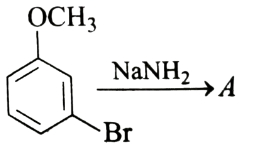
Identify $A$ and predict the type of reaction.

 $\xrightarrow{{NaN{H_2}}}\,A$

The $pH$ of water at ${25\,^o}C$ is nearly