MCQ
Solution set of the inequality $x \geq 0$ is
  • A
    half plane on the left of $Y$-axis
  • B
    half plane on the right of $Y$-axis excluding the points on $Y$-axis
  • half plane on the right of $Y$-axis including the points on $Y$-axis
  • D
    None of these.

Answer

Correct option: C.
half plane on the right of $Y$-axis including the points on $Y$-axis
(c) : Solution set of the given inequality is $\{(x, y): x \geq 0\}$ i.e., the set of all points whose abscissae are non-negative. All these points lie either on $Y$-axis or on the right of $Y$-axis.

Need a full question paper?

Generate a complete, print-ready paper with questions like this in minutes — across 16+ boards, with answer keys.
Start Generating Free

Similar questions

Let $f: R \rightarrow R$ be a function defined by $f(x)=\left\{\begin{array}{l}\frac{\sin \left(x^2\right)}{x} \text { if } x \neq 0 \\ 0 \text { if } x=0\end{array}\right\}$ Then, at $x=0, f$ is
The integral $\int_{\frac{\pi }{{12}}}^{\frac{\pi }{4}} {\frac{{8\,\cos \,2x}}{{{{\left( {\tan \,x + \cot \,x} \right)}^3}}}\,dx} $ equals
${\cot ^{ - 1}}\frac{3}{4} + {\sin ^{ - 1}}\frac{5}{{13}} = $
The solutions of the equation $\left|\begin{array}{ccc}1+\sin ^{2} x & \sin ^{2} x & \sin ^{2} x \\ \cos ^{2} x & 1+\cos ^{2} x & \cos ^{2} x \\ 4 \sin 2 x & 4 \sin 2 x & 1+4 \sin 2 x\end{array}\right|=0,(0< x< \pi), \operatorname{are}$
Let $\text{A}=\begin{bmatrix} 2 & 3 \\ 5 & -2 \end{bmatrix}$ be such that A-1 = kA, then k equals:
  1. $19$
  2. $\frac{1}{19}$
  3. $-19$
  4. $-\frac{1}{19}$
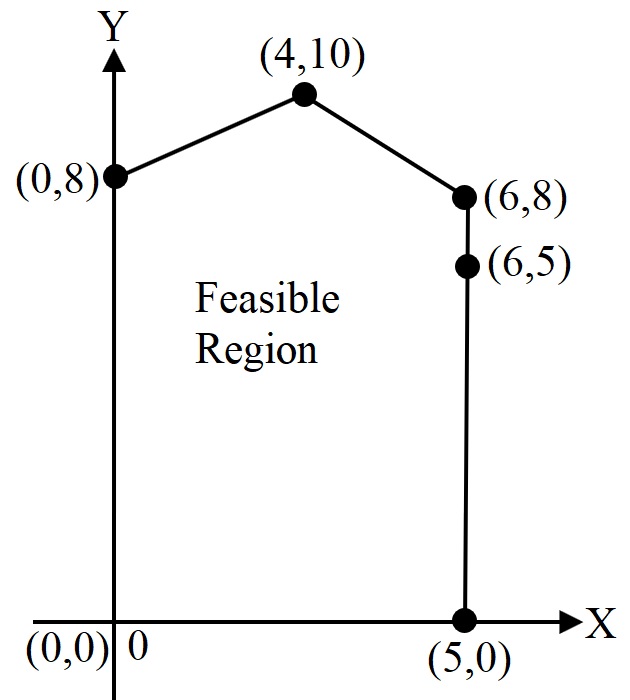
The feasible region for a LPP is shown shaded in the figure. Let Z = 3x - 4y be the objective function. Minimum of Z occurs at.

The rank of the matrix $\left[ {\begin{array}{*{20}{c}}{ - 1}&2&5\\{\,\,2}&{ - 4}&{a - 4}\\{\,\,1}&{ - 2}&{a + 1}\end{array}} \right]$is
Let $\mathrm{A}=\left[\begin{array}{ccc}1 & \sin \theta & 1 \\ -\sin \theta & 1 & \sin \theta \\ -1 & -\sin \theta & 1\end{array}\right],$ where $0 \leq \theta \leq 2 \pi$. Then
For any two vectors $a $ and  $b$ , ${(a \times b)^2}$ is equal to
Consider a matrix $A =\left[\begin{array}{ccc}\alpha & \beta & \gamma \\ \alpha^{2} & \beta^{2} & \gamma^{2} \\ \beta+\gamma & \gamma+\alpha & \alpha+\beta\end{array}\right]$, where $\alpha, \beta, \gamma$ are three distinct natural numbers. If $\frac{\operatorname{det}(\operatorname{adj}(\operatorname{adj}(\operatorname{adj}(\operatorname{adj} A))))}{(\alpha-\beta)^{16}(\beta-\gamma)^{16}(\gamma-\alpha)^{16}}=2^{32} \times 3^{16}$, then the number of such $3 -$ tuples $(\alpha, \beta, \gamma)$ is $.....$