Question
Solve graphically that the following system of equation has infinitely many solutions:
2x + 3y = 6
4x + 6y = 12

Answer

So we have 2x + 3y = 6 and 4x + 6y = 12.
Now, 2x + 3y = 5
$\text{x}=\frac{6-3\text{y}}{2}$
When y = 0 then, x = 3 when y = 2 then, x = 0
x
0
3
y
2
0
Now, 4x + 6y = 12
$\text{x}=\frac{12-6\text{y}}{4}$
When y = 0, then x = 3 When y = 2, then x = 0
Thus, we have the following table giving points on the line 4x + 6y = 12
x
0
3
y
2
0
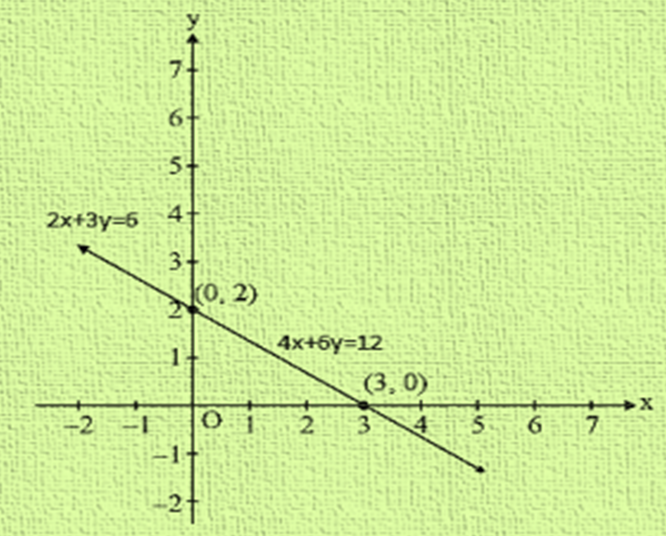
Graph of the equation 2x + 3y = 6 and 4x + 6y = 12

Thus the graphs of the two equations are coincident. Hence, the system of equations has infinitely many solutions.

Need a full question paper?

Generate a complete, print-ready paper with questions like this in minutes — across 16+ boards, with answer keys.
Start Generating Free

Similar questions

Given : In $\triangle \mathrm{ABC}$, bisector of $\angle \mathrm{C}$ interesects seg $A B$ in the point $E$.To prove : $\frac{\mathrm{AE}}{\mathrm{EB}}=\frac{\mathrm{CA}}{\mathrm{CB}}$
The difference of two natural numbers is $3$ and the difference of their reciprocals is $\frac{3}{28}.$ Find the numbers.
The curved surface area of the frustum of a cone is 180 sq cm and the circumfernce of its circular bases are 18 cm and 6 cm respectively. Find the slant height of the frustum of a cone.
Water flows at the rate of 10m/ minutes through a cylindrical pipe 5mm in diameter. How long would it take to fill a conical vessel whose diameter at the base is 40cm and depth 24cm?
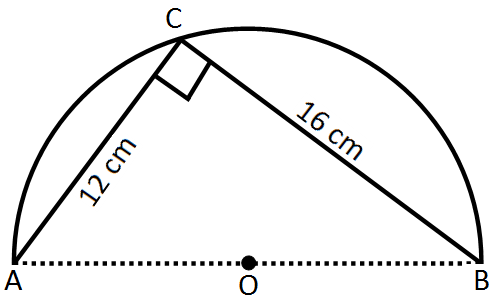
In the following figure, O is the centre of a circular arc and AOB is a straight line.
Find the perimeter and the area of the shaded region correct to one decimal place. $\big(\text{Take }\pi=3.142\big)$
The difference between the outer and inner curved surface areas of a hollow right circular cylinder $14\ cm$ long is $88\ cm^2$​​​​​​​. If the volume of metal used in making the cylinder is $176\ cm^3​​​​​​​$​​​​​​​, find the outer and inner diameters of the cylinder. $\Big(\text{use}\ \pi=\frac{22}{7}\Big)$
In $\triangle\text{ABC},\ \angle\text{ABC}=135^\circ.$ Prove that $AC^2 = AB^2 + BC^2 + 4 \text{ar}(\triangle\text{ABC}).$
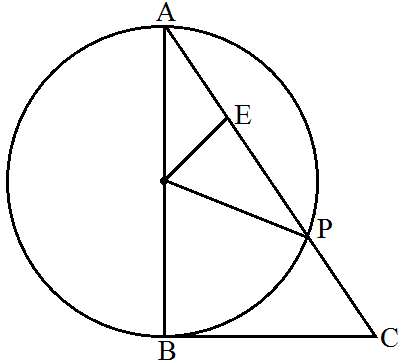
In the figure, BC is a tangent to the circle with centre O. OE bisects AP. Prove that $\triangle\text{AEO}\sim\triangle\text{ABC}.$
A container, open at the top and made up of metal sheet, is in the form of a frustum of a cone of height $16\ cm$ with diameters of its lower and upper ends as $16\ cm$ and $40\ cm$, respectively. Find the cost of metal sheet used to make the container, if it costs $₹ 10$ per $100\ cm^2.$