Question
Solve graphically that the following system of equation has infinitely many solutions:
x - 2y = 5
3x - 6y = 15

Answer

We have,
x - 2y = 5
3x - 6y = 15
Now, x - 2y = 5
⇒ x = 2y + 5
When y = -1, we have,
x = 2(-1) + 5 = 3
When y= 0, we have,
x = 2 × 0 + 5 = 5
Thus, we have the following table giving points on the line x - 2y = 5
x
3
5
y
1
0
Now, 3x - 6y = 15
⇒ 3x = 15 + 6y
$\Rightarrow\text{x}=\frac{15+6\text{y}}{3}$
When y = -2, we have,
$\text{x}=\frac{15+6(-2)}{3}=1$
When y = -3, we havce,
$\text{x}=\frac{15+6(-3)}{3}=-1$
Thus, we have the following table giving points on the line 3x - 6y = 15
x
1
-1
y
-2
-3
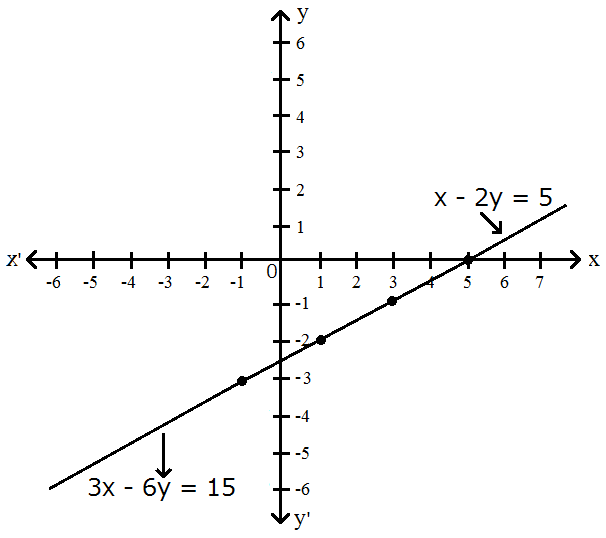
Graph of the given equations,

After plot all points observe that all points on a line so that system of equation has infinite many solution.

Need a full question paper?

Generate a complete, print-ready paper with questions like this in minutes — across 16+ boards, with answer keys.

Start Generating Free

Similar questions

Neeta saves in a 'Mahila Bachat Gat' ₹ 2 on the first day, ₹ 4 on the second day, ₹ 6 on the third day and so on. What will be her saving in the month of February 2010 ?
If $\sin\theta=\frac{\text{a}}{\text{b}},$ show that $(\sec\theta+\tan\theta)=\sqrt{\frac{\text{b}+\text{a}}{\text{b}-\text{a}}}.$
Solve the following quadratic equation: $x^2 - 4ax - b^2 + 4a^2 = 0$
A two-digit number is 3 more than 4 times the sum of its digits. If 18 is added to the number, the digits are reversed. Find the number.
Below is given frequency distribution of marks (out of 100) obtained by students.
Marks0-1010-2020-3030-4040-5050-6060-7070-8080-9090-100
No. of students35710121512628
Draw the histogram and frequency polygon on the same graph papers.
Find all the zeros of $(2x^4 - 3x^3 - 5x^2 + 9x - 3)$, if it is given that two of its zeros are $\sqrt3$ and $-\sqrt3.$
Solve : $\frac{5}{x-1}+\frac{1}{y-2}=2 ; \frac{6}{x-1}-\frac{3}{y-2}=1$
In a tree plantation programme, the number of trees planted by students of different classes is given in the following table. Draw a pie diagram showing the information.
Standard$5^{\text {th }}$$6^{\text {th }}$$7^{\text {th }}$$8^{\text {th }}$$9^{\text {th }}$$10^{\text {th }}$
No of tree405075507075
Sum of the squares of adjacent sides of a parallelogram is 130 sq.cm and length of one of its diagonals is14 cm. Find the length of the other diagonal.