Question
Solve the following differential equation:
$\text{x}\frac{\text{dy}}{\text{dx}}+2\text{y}=\text{x}\cos\text{x}$

Answer

Here, $\frac{\text{dy}}{\text{dx}}+\frac{2\text{y}}{\text{x}}=\cos\text{x}$

It is a linear differential equation. Comparing it with,

$\frac{\text{dy}}{\text{dx}}+\text{Py}=\text{Q}$

$\text{P}=\frac{2}{\text{x}},\text{Q}=\cos\text{x}$

I.F. $=\text{e}^{\int\text{Pdx}}$

$=\text{e}^{2\int\frac{1}{\text{x}}\text{dx}}$

$=\text{e}^{2\log|\text{x}|}$

$=\text{x}^2$

Solution of the equation is given by,

$\text{y}\times(\text{I.F.}=\int\text{Q}\times(\text{I.F.})\text{dx + C}$

$\text{y}(\text{x}^2)=\int\cos\text{x}(\text{x}^2)\text{dx + C}$

$\text{yx}^2=\int\text{x}^2\cos\text{xdx + C}$

$=\text{x}^2\int\cos\text{x}-\int(2\text{x}\times\int\cos\text{xdx})\text{dx + C}$

Usind integration by parts

$\text{yx}^2=\text{x}^2\sin\text{x}-\int2\text{x}\sin\text{xdx + C}$

$=\text{x}^2\sin\text{x}-2\big[\text{x}\times\int\sin\text{xdx}-\int(1\times\int\sin\text{xdx})\text{dx}\big]+\text{C}$

$=\text{x}^2\sin\text{x}+2\text{x}\cos\text{x}-2\int\cos\text{xdx + C}$

$\text{yx}^2=\text{x}^2\sin\text{x}+2\text{x}\cos\text{x}-2\sin\text{x + C}$

$\text{y}=\sin\text{x}+\frac{2}{\text{x}}\cos\text{x}-\frac{2}{\text{x}^2}\sin\text{x}+\frac{\text{C}}{\text{x}^2}$

Need a full question paper?

Generate a complete, print-ready paper with questions like this in minutes — across 16+ boards, with answer keys.
Start Generating Free

Similar questions

Prove that the function
$\text{f}\text{(x)}=\begin{cases}\frac{\text{x}}{|\text{x|+2}\text{x}^2}, &\text{ x}\neq0\\\text{k}, &\text{ x}=0\end{cases}$ 
remains discontinuous at x = 0, regardless the choice of k.
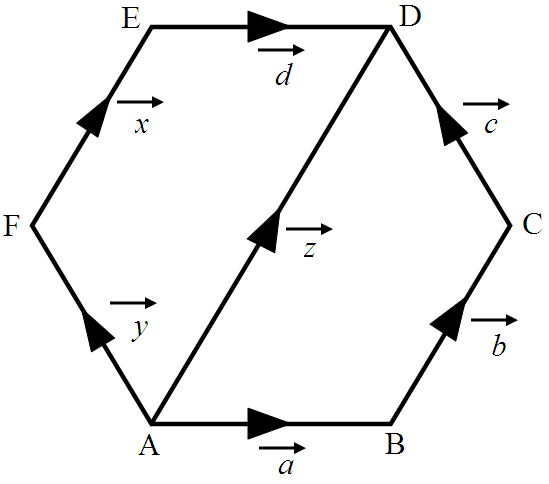
In Figure ABCD is a regular hexagon, which vectors are:
  1. Collinear.
  2. Equal.
  3. Co-initial.
  4. Collinear but not equal.

Find the intervals in which f(x) is increasing or decreasing:
$\text{f}(\text{x})=\sin\text{x}(1+\cos\text{x}),0<\text{x}<\frac{\pi}{2}$
Differentiate the following functions with respect to x:
$\cos^{-1}\Big(\frac{\text{x}+\sqrt{1-\text{x}^2}}{\sqrt{2}}\Big),-1<\text{x}<1$
 find the area of the region in the first quadrant by the x-axis, the line y = x and circle x2 + y2 = 32.
Solve the following LPP using graphical method
$
\begin{array}{ll}
\text { Minimize } & Z=600 x+400 y \\
\text { constraints } & x+2 y>12 \\
& 2 x+y<12 \\
& x+\frac{5}{4} y \geq 5 \\
& x>0, y>0
\end{array}
$
Evaluate the following integrals:

$\int\sin^{-1}\sqrt{\text{x}}\text{dx}$

Verify Rolle's theorem of the following function on the indicated interval
$\text{f}(\text{x})=\sin^4\text{x}+\cos^4\text{x}\text{ on }\Big[0,\frac{\pi}{2}\Big]$
There are three coins. One is two headed coin, another is a biased coin that comes up heads 75% of the time and third is an unbiased coin. One of the three coins is chosen at random and tossed, it shows heads, what is the probability that it was the two headed coin?
If $\text{y}=(\cos\text{x})^{\cos\text{x}^{\cos\text{x}^{.....\infty}}},$ prove that $\frac{\text{dy}}{\text{dx}}=-\frac{\text{y}^2\tan\text{x}}{(1-\text{y}\log\cos\text{x})}$