Question
Solve the following differential equation:
$(\text{x}^2-2\text{xy})\text{dy}+(\text{x}^2-3\text{xy}+2\text{y}^2)\text{dx}=0$

Answer

Here, $(\text{x}^2-2\text{xy})\text{dy}+(\text{x}^2-3\text{xy}+2\text{y}^2)\text{dx}=0$
$\Rightarrow\ \frac{\text{dy}}{\text{dx}}=\frac{\text{x}^2-3\text{xy}+2\text{y}^2}{2\text{xy}-\text{x}^2}$
It is a homogeneous equation.
Put x = vy
and $\frac{\text{dy}}{\text{dx}}=\text{v + x}\frac{\text{dv}}{\text{dx}}$
So,
$\text{v + x}\frac{\text{dv}}{\text{dx}}=\frac{\text{x}^2-3\text{xvx}+2\text{v}^2\text{x}^2}{2\text{xvx}-\text{x}^2}$
$\text{x}\frac{\text{dv}}{\text{dx}}=\frac{1-3\text{v}+2\text{v}^2}{2\text{v}-1}-\text{v}$
$\text{x}\frac{\text{dv}}{\text{dx}}=\frac{1-3\text{v}+2\text{v}^2-2\text{v}^2+\text{v}}{2\text{v}-1}$
$\text{x}\frac{\text{dv}}{\text{dx}}=\frac{1-2\text{v}}{2\text{v}-1}$
$\frac{2\text{v}-1}{1-2\text{v}}\text{dv}=\frac{\text{dx}}{\text{x}}$
$\frac{1-2\text{v}}{1-2\text{v}}\text{dv}=-\int\frac{\text{dx}}{\text{x}}$
$\int\text{dv}=-\int\frac{\text{dx}}{\text{x}}$
$\text{v}=-\log|\text{x}|+\text{C}$
$\frac{\text{y}}{\text{x}}+\log\text{x}=\text{C}$

Need a full question paper?

Generate a complete, print-ready paper with questions like this in minutes — across 16+ boards, with answer keys.
Start Generating Free

Similar questions

Find the intervals in which the following functions are increasing or decreasing. $f(x) = 2x^2 - 24x + 7$
Solve the following differential equation
$\text{x}(\text{x}^{2} - 1)\frac{\text{dy}}{\text{dx}} = 1, \text{y}(2) = 0$
On R − {1}, a binary operation * is defined by a * b = a + b − ab. Prove that * is commutative and associative. Find the identity element for * on R − {1}. Also, prove that every element of R − {1} is invertible.
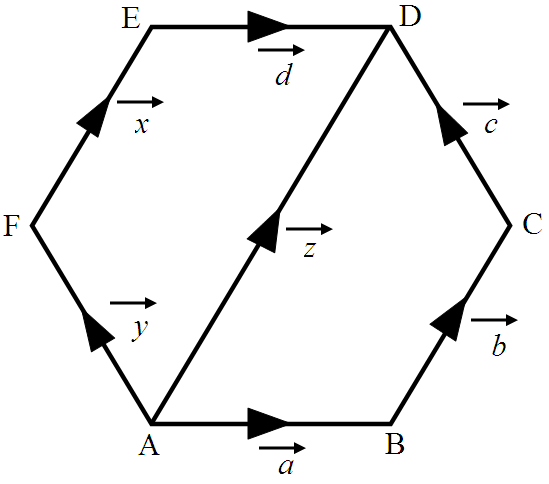
In Figure ABCD is a regular hexagon, which vectors are:
  1. Collinear.
  2. Equal.
  3. Co-initial.
  4. Collinear but not equal.
Write the following in the simplest form:
$\tan^{-1}\sqrt{\frac{\text{x}}{\text{a}+\sqrt{\text{a}^2-\text{x}^2}}},-\text{a}<\text{x}<\text{a}$
$A$ and $B$ take turns in throwing two dice, the first to throw $10$ being awarded the prize, show that if $A$ has the first throw, their chance of winning are in the ratio $12 : 11.$
If f(x) is a continuous function defind on [-a, a], then prove that:
$\int\limits^{\text{a}}_{-\text{a}}\text{f(x)}\text{dx}=\int\limits^{\text{a}}_0\big\{\text{f(x)}+\text{f}(-\text{x})\big\}\text{dx}$ 
A merchant plans to sell two types of personal computers- a desktop model and a portable model that will cost Rs 25000 and Rs 40000 respectively. He estimates that the total monthly demand of computers will not exceed 250 units. Determine the number of units of each type of computers which the merchant should stock to get maximum profit if he does not want to invest more than Rs 70 lakhs and if his profit on the desktop model is Rs 4500 and on portable model is Rs 5000.
Differentiate the following functions with respect to x:
$\cos^{-1}\Big\{\frac{\cos\text{x}+\sin\text{x}}{\sqrt{2}}\Big\},-\frac{\pi}{4}<\text{x}<\frac{\pi}{4}$
A factory makes tennis rackets and cricket bats. A tennis racket takes $1.5$ hours of machine time and $3$ hours of craftman's time in its making while a cricket bat takes $3$ hours of machine time and $1$ hour of craftman's time. In a day, the factory has the availability of not more than $42$ hours of machine time and $24$ hours of craftman's time. If the profit on a racket and on a bat is $Rs. 20$ and $Rs. 10$ respectively, find the number of tennis rackets and cricket bats that the factory must manufacture to earn the maximum profit. Make it as an $\text{LPP}$ and solve it graphically.