Question
Solve the following system of equations graphically:
2x + 3y = 8,
x - 2y + 3 = 0

Answer

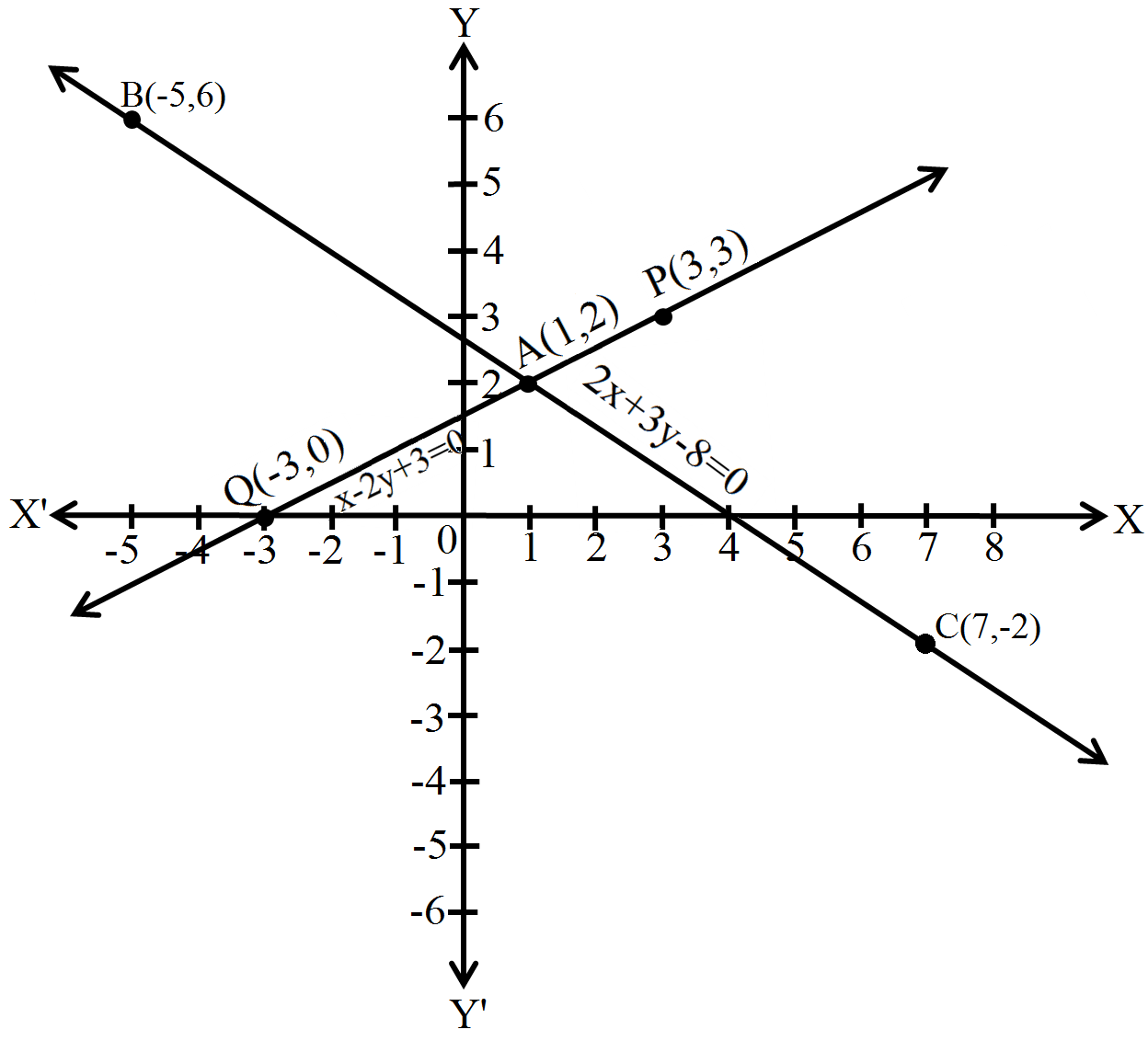
On a graph paper, draw a horizontal line X'OX and a vertical line YOY' representing the x-axis and y-axis, respectively. Given equations are 2x + 3y = 8 and x - 2y + 3 = 0 Graph of 2x + 3y = 8: 2x + 3y = 8 $\Rightarrow\text{y}=\frac{8-\text{2x}}{3}\ \dots(1)$ Thus we have the following table for 2x + 3y = 8
x:
1
-5
7
y:
2
6
-2
On the graph paper plot the points A(1, 2), B(-5, 6) and C(7, -2). Join AB and AC to get the graph line BC. Thus, the line AC is the equation of 2x + 3y = 8. Graph of x - 2y + 3 = 0: For graph of x - 2y + 3 = 0 $\Rightarrow\text{y}=\frac{\text{x}+3}{2}\ \dots(2)$ Thus, we have the following table for x - 2y + 3 = 0
x:
1
3
-3
y:
2
3
0
Now, on the same graph paper plot the points P(3, 3) and Q(-3, 0). The point A(1, 2) has already been plotted. Join PA and QA to get the line PQ. Thus, line PQ is the graph of the equation x - 2y + 3 = 0.
The two graph lines intersect at A(1, 2). $\therefore$ x = 1, y = -2 is the solution of the given system of equations.

Need a full question paper?

Generate a complete, print-ready paper with questions like this in minutes — across 16+ boards, with answer keys.
Start Generating Free

Similar questions

A chord of a circle of radius 30cm makes an angle of 60° at the centre of the circle. Find the area of the minor and major segments. $\big[\text{Take }\pi=3.14\text{ and }\sqrt{3}=1.732\big]$
If $\angle\text{A}$ and $\angle\text{B}$ are acute angles such that $\sin\text{A}=\sin\text{B}$ then prove that $\angle\text{A}=\angle\text{B}.$
Solve the following systems of equations by using the method of cross multiplication:
$2ax + 3by = (a + 2b),$
$3ax + 2by = (2a + b).$
Solve for x and y:
$\frac{\text{x}-\text{y}-8}{2}=\frac{\text{x}+\text{2y}-14}{3}=\frac{\text{3x}+\text{y}-12}{11}$
Hint: a = b = c ⇒ a = b and b = c.
Solve the following systems of equations by using the method of cross multiplication:
$\frac{\text{x}}{6}+\frac{\text{y}}{15}=4,$
$\frac{\text{x}}{3}-\frac{\text{y}}{15}=\frac{\text{19}}{4}$
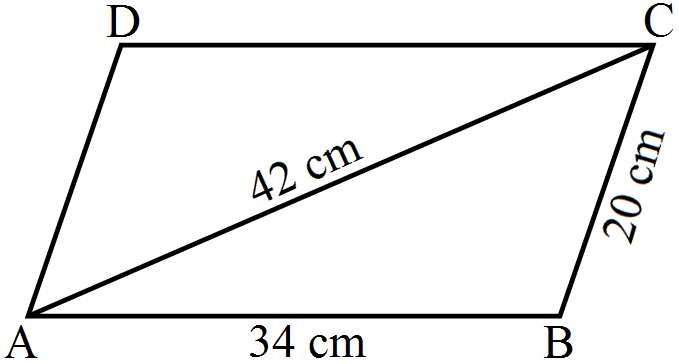
The adjacent sides of a $||^{gm} ABCD$ measure $34\ cm$ and $20\ cm$ the diagonal $AC$ is $42\ cm$ long. Find the area of the $||^{gm}.$
​​​​​​​
Find the sum of first forty positive intergers divisible by 6.
Write the step of construct the tangents to a circle from an external point.
Solve the following quadratic equation:
$\frac{\text{1}}{\text{x}+1}+\frac{\text{2}}{\text{x}+2}=\frac{5}{\text{x}+4},$ $\text{x}\neq-1,-2,-4$
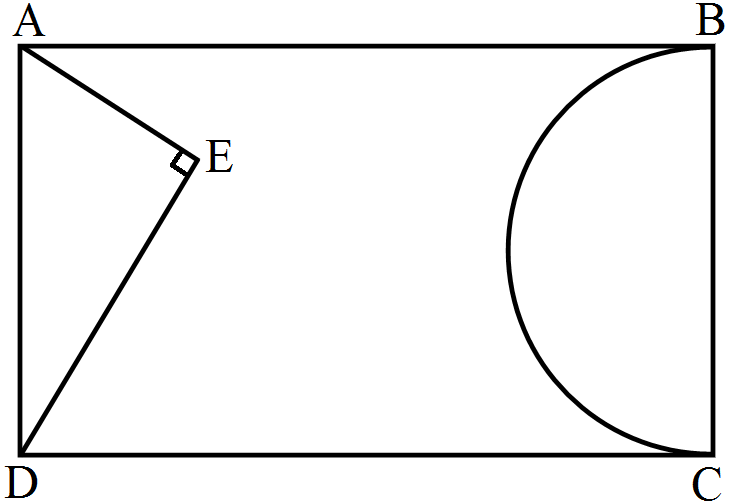
In the given figure, $ABCD$ is a rectangle with $\text{AB}=80\text{cm}$ and $\text{BC}=70\text{cm},$ $\angle\text{AED}=90^\circ$ and $\text{DE}=42\text{cm}$ A semicircle is dn wn, taking BC as diameter. Find the area o the shaded region.