Questions · Page 1 of 3

5 Marks Question

🎯

Test yourself on this topic

50 questions · timed · auto-graded

Question 15 Marks
A lending library has a fixed charge for the first three days and an additional charge for each day thereafter. Mona paid ₹ 27 for a book kept for 7 days, while Tanvy paid ₹ 21 for the book she kept for 5 days. Find the fixed charge and the charge for each extra day.
Answer
Let the fixed charge be ₹ x and the extra charge per day be ₹ y.
Given that,
Mona paid ₹ 27 for a book kept for 7 days,
⇒ x + 4y = 27 ...(i)
Given that,
Tanvy paid ₹ 21 for a book kept for 5 days,
⇒ x + 2y = 21 ...(ii)
Subtracting (ii) from (i), we get
⇒ 2y = 6
⇒ y = 3
Substituting y = 3 in (ii), we get
⇒ x = 15.
Hence, the fixed charge is ₹ 15 and the charge per day is ₹ 3.
View full question & answer
Question 25 Marks
The larger of the two supplementary angles exceeds the smaller by 18°. Find them.
Answer
Let the two supplementary angles be x and y,
where x is the larger angle.
Accroding to the given condition,
x = y + 18°
⇒ x - y = 18° ...(i)
Since the angles are supplementary,
⇒ x + y = 180° ...(ii)
Adding (i) and (ii), we get
⇒ 2x = 198
⇒ x = 99
Substituting x = 99 in (i), we get
⇒ y = 81.
Hence, the angles are 99° and 81°
View full question & answer
Question 35 Marks
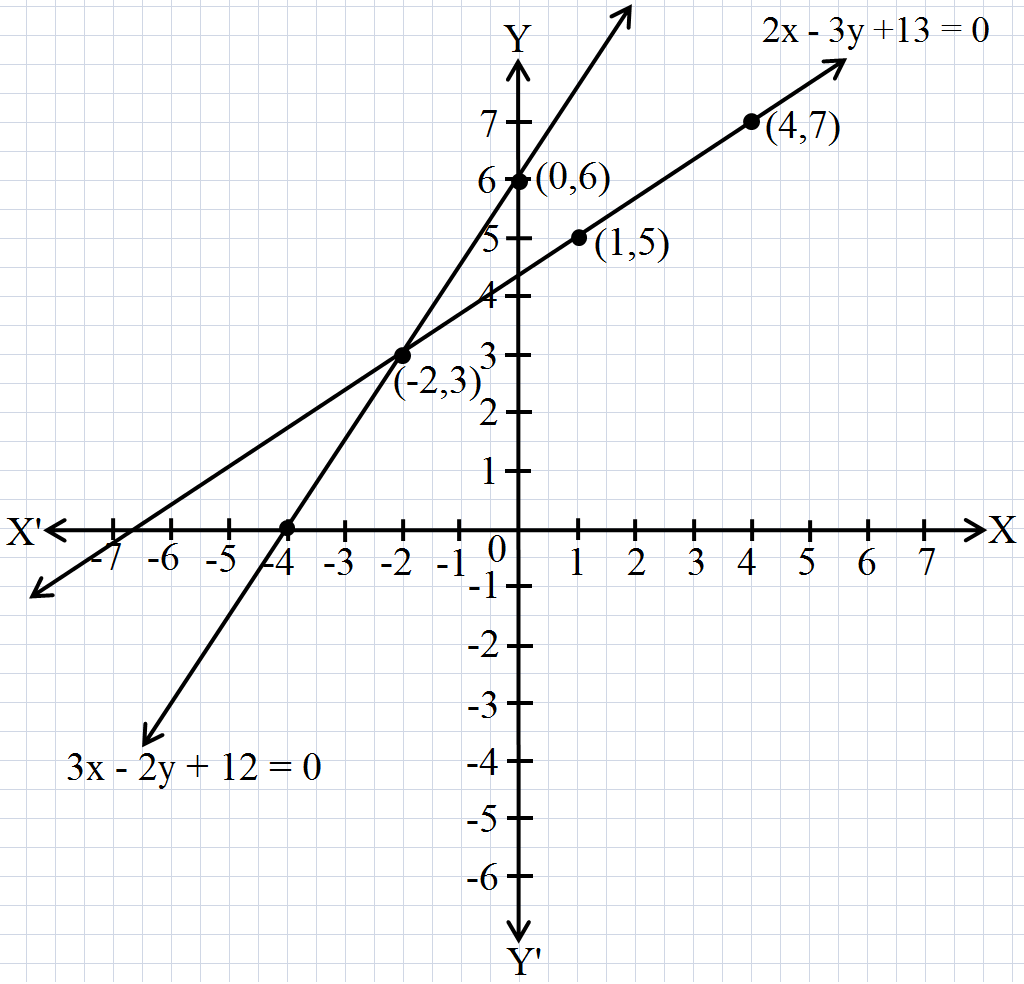
Solve the following system of equations graphically:
2x - 3y + 13 = 0,
3x - 2y + 12 = 0
Answer
$\text{2x}-\text{3y}+13=0$ $\Rightarrow\text{y}=\frac{13+\text{2x}}{3}$
x:
1
4
y:
5
7
$\text{3x}-\text{2y}+12=0$ $\Rightarrow\text{y}=\frac{\text{12}+\text{3x}}{2}$
x:
0
-4
y:
6
0

Since the two graph intersect at (-2, 3), x = -2 and y = 3
View full question & answer
Question 45 Marks
A man sold a chair and a table together for ₹1520, thereby making a profit of 25% on chair and 10% on table. By selling them together for ​₹1535, he would would have made a profit of 10% on the chair and 25% on the table. Find the cost of each.
Answer
Let the CP of the chair and the table be Rs. x and Rs. y respectively.
Then, selling price of the chair + selling price of the table = 1520
$\Rightarrow\frac{100+25}{100}\text{x}+\frac{100+10}{100}\text{y}=1520$
$\Rightarrow\frac{125}{100}\text{x}+\frac{110}{100}\text{y}=1520$
$\Rightarrow\text{25x}+\text{22y}=30400\ \dots(\text{i})$
Given that by selling them together for Rs. 1535, he would have made a profit of 10% on the chair and 25% on the table.
$\Rightarrow\frac{100+10}{100}\text{x}+\frac{100+25}{100}\text{y}=1535$
$\Rightarrow\frac{110}{100}\text{x}+\frac{125}{100}\text{y}=1535$
$\Rightarrow\text{22x}+\text{25y}=30700\ \dots(\text{ii})$
Adding (i) and (ii), we get
47x + 47y = 61100
⇒ x + y = 1300 ...(iii)
Subtracting (ii) from (i), we get
3x - 3y = -300
x - y = -100 ...(iv)
Adding (iii) and (iv), we get
⇒ 2x = 1200
⇒ x = 600
Substituting x = 600 in (iii), we get y = 700
Hence, cost of the chair is Rs. 600 and cost of the table is Rs. 700
View full question & answer
Question 55 Marks
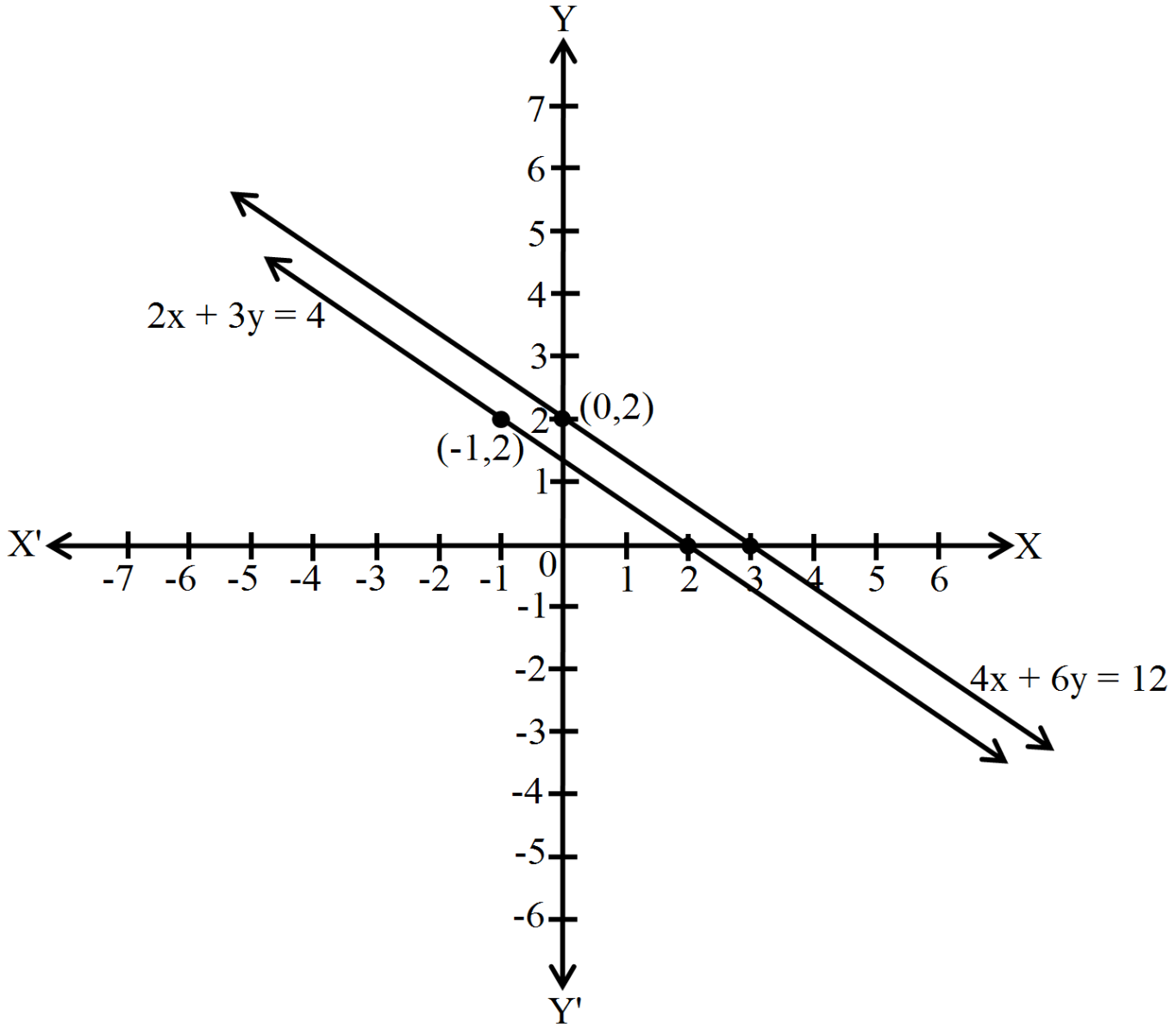
Show graphically that each of the following given systems of equations is inconsistent, i.e., has no solutions:
2x + 3y = 4, 4x + 6y = 12
Answer
$2\text{x}+\text{3y}=4$ $\Rightarrow\text{y}=\frac{-2\text{x}+\text{4}}{3}$
x: 2 -1
y: 0 2
$\text{4x}+\text{6y}=12$ $\Rightarrow\text{y}=\frac{-4\text{x}+12}{6}$
x: 3 0
y: 0 2

Since the two graph of the system of equations is parallel lines, the system has no solution and hence is inconsistent.
View full question & answer
Question 65 Marks
A train covered a certain distance at a uniform speed. If the train had been 5 kmph faster, it would have taken 3 hours less than the scheduled time. And, If the train were slower by 4 kmph, it would have taken 3 hours more than the scheduled time. Find the length of the journey.
Answer
Let the original speed be x km/h and time taken be y hours Then, length of journey = xy kmCase I:
Speed = (x + 5)km/h and time taken = (y - 3)hour Distance covered = (x + 5)(y - 3)km $\therefore$ (x + 5)(y - 3) = xy ⇒ xy + 5y - 3x - 15 = xy ⇒ 5y - 3x = 15 ...(1)Case II:
Speed (x - 4)km/hr and time taken = (y + 3)hours Distance covered = (x - 4)(y + 3)km $\therefore$ (x - 4)(y + 3) = xy ⇒ xy - 4y + 3x - 12 = xy ⇒ 3x - 4y = 12 ...(2) Multiplying (1) by 4 and (2) by 5, we get 20y - 12x = 60 ...(3) -20y + 15x = 60 ...(4) Adding (3) and (4), we get 3x = 120 or x = 40 Putting x = 40 in (1), we get 5y - 3 × 40 = 15 ⇒ 5y = 135 ⇒ y = 27 Hence, length of the journey is (40 × 27)km = 1080km.
View full question & answer
Question 75 Marks
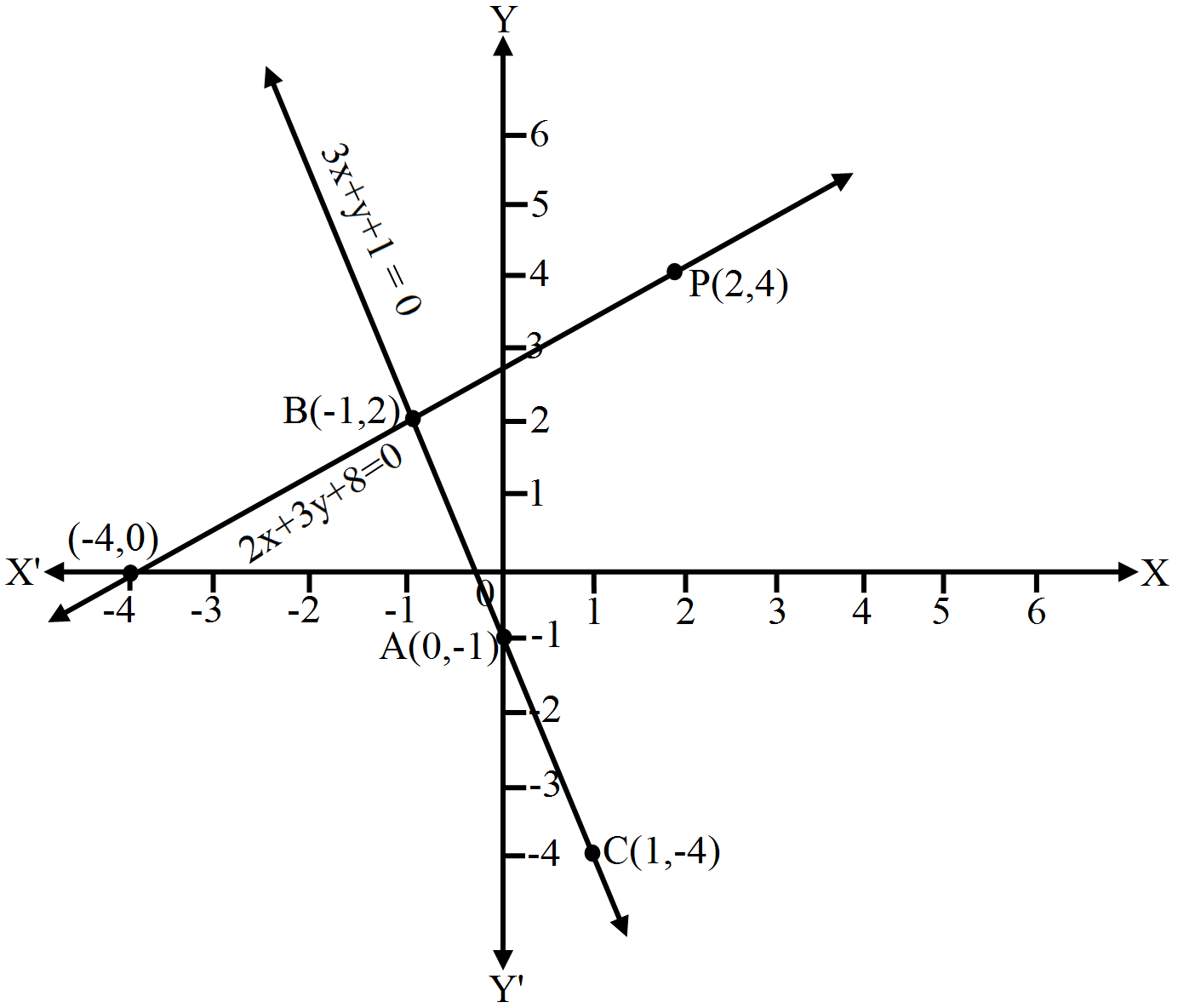
Solve the following system of equations graphically:
3x + y + 1 = 0,
2x - 3y + 8 = 0
Answer
On a graph paper, draw a horizontal line X'OX and a vertical line YOY' representing the x-axis and y-axis, respectively. Given equations are 3x + y + 1 = 0 and 2x - 3y + 8 = 0 Graph of 3x + y + 1 = 0: 3x + y + 1 = 0 ⇒ y = -3x - 1 ...(1) Thus, we have the following table for 3x + y + 1 = 0
x:
0
-1
1
y:
-1
2
-4
On the graph paper plot the points A(0, -1), B(-1, 2) and C(1, -4). Join AB and AC to get the graph line BC. Thus, the line BC is the graph of the equation of 3x + y + 1 = 0. Graph of 2x - 3y + 8 = 0: For graph of 2x - 3y + 8 = 0 $\Rightarrow\text{y}=\frac{\text{2x}+8}{3}\ \dots(2)$ Thus, we have the following table for equation (2)
x:
-1
2
-4
y:
2
4
0
Now, on the same graph paper plot the points P(2, 4) and Q(-4, 0). The point B(-1, 2) has already been plotted. Join PB and BQ to get the line PQ. Thus, line PQ is the graph of the equation 2x - 3y + 8 = 0.
The two graph lines intersect at B(-1, 2). $\therefore$ x = -1, y = 2 is the solution of the given system of equations.
View full question & answer
Question 85 Marks
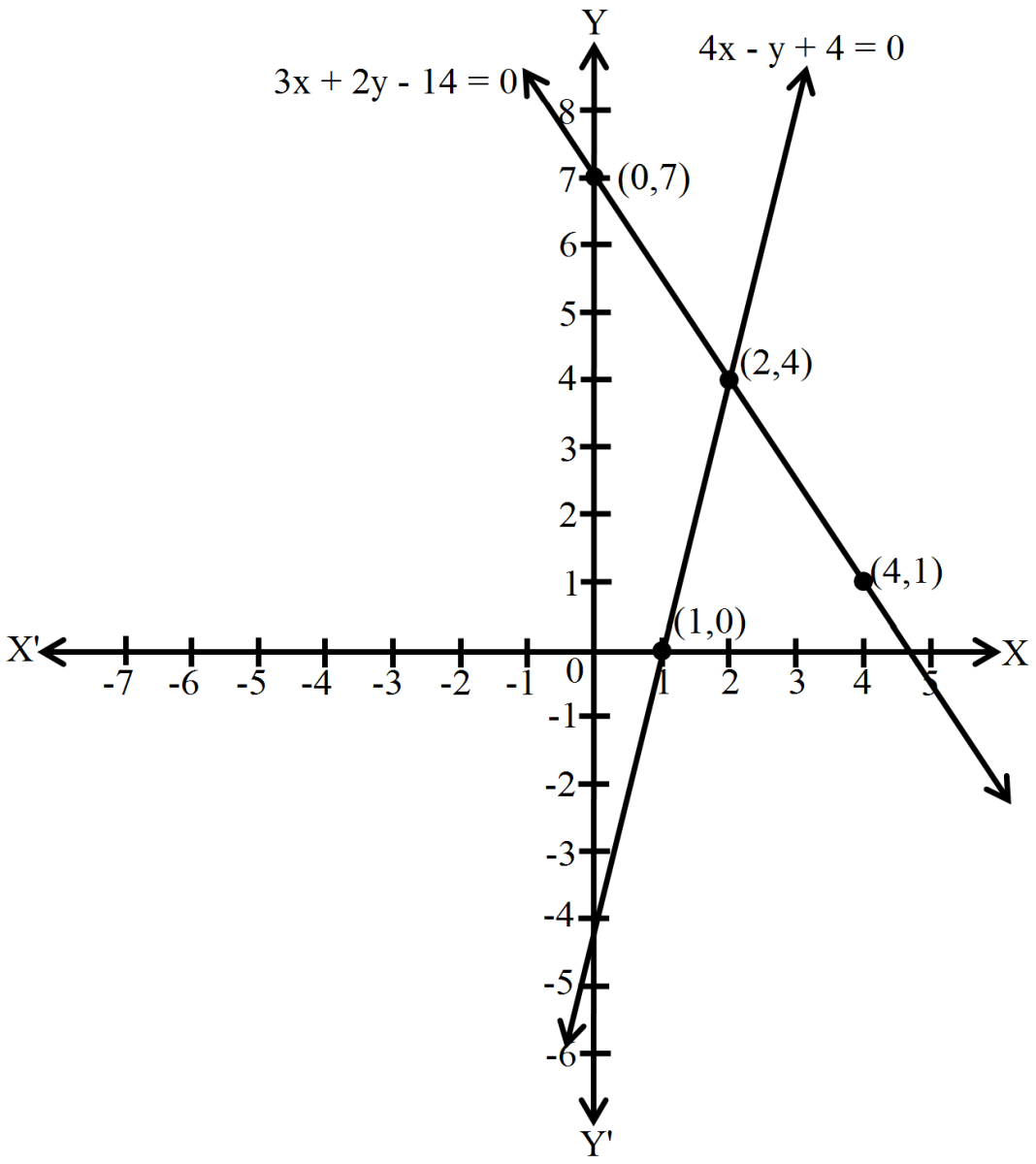
Solve each of the following given systems of equations graphically and find the vertices and area of the triangle formed by these lines and the y-axis:
4x - y - 4 = 0, 3x + 2y - 14 = 0
Answer
$4\text{x}-\text{y}-4 = 0$ $\Rightarrow\text{y}=\text{4x}-4$
x: 1 2
y: 0 4
$3\text{x} + 2\text{y} -14 = 0$ $\Rightarrow\text{y}=\frac{14-\text{3x}}{2}$
x: 0 4
y: 7 1

Since the two graph intersect at (2, 4), x = 2 and y = 4 The vertices of the triangle formed by these lines and the y-axis are (2, 4), (0, 7) and (0, -4). So, height of the triangle = distance from (2, 4) to y-axis = 2 units Base = 11 units Area of triangle $=\frac{1}{2}\times$ base × height $=\frac{1}{2}\times11\times2$ $=11\ \text{sq. units}$
View full question & answer
Question 95 Marks
Solve for x and y:
4x + 6y = 3xy,
8x + 9y = 5xy $(\text{x}\neq0,\ \text{y}\neq0).$
Answer
$\text{4x}+\text{6y}=\text{3xy}$ $\Rightarrow\frac{\text{4x}+\text{6y}}{\text{xy}}=3$ $\frac{4}{\text{y}}+\frac{6}{\text{x}}=3\ \dots(1)$ $\Rightarrow\frac{\text{8x}+\text{9y}}{\text{xy}}=5$ $\frac{8}{\text{y}}+\frac{9}{\text{x}}=4\ \dots(2)$ Putting $\frac{1}{\text{x}}=\text{u}$ and $\frac{1}{\text{y}}=\text{v}$ in (1) and (2), we get 4v + 6u = 3 ...(3) 8v + 9u = 5 ...(4)Multiplying (3) by 9 and (4) by 6, we get
36v + 54u = 27 ...(5)
48v + 54u = 30 ...(6)
Subtracting (3) from (4), we get
$\text{12v}=3$ $ \text{v}=\frac{3}{12}=\frac{1}{4}$Putting $\text{v}=\frac{1}{4}$ in (3), we get
$4\times\frac{1}{4}+\text{6u}=3$ $1+\text{6u}=3 $ $\text{6u}=3-1=2$ $\text{u}=\frac{2}{6}=\frac{1}{3}$Now, $\text{u}=\frac{1}{\text{x}}$
$\Rightarrow\frac{1}{\text{x}}=\frac{1}{3}$ $\Rightarrow\text{x}=3$and $\text{v}=\frac{1}{\text{y}}$
$\Rightarrow\frac{1}{\text{y}}=\frac{1}{4}$ $\Rightarrow\text{y}=4$$\therefore$ the solution is x = 3, y = 4
View full question & answer
Question 105 Marks
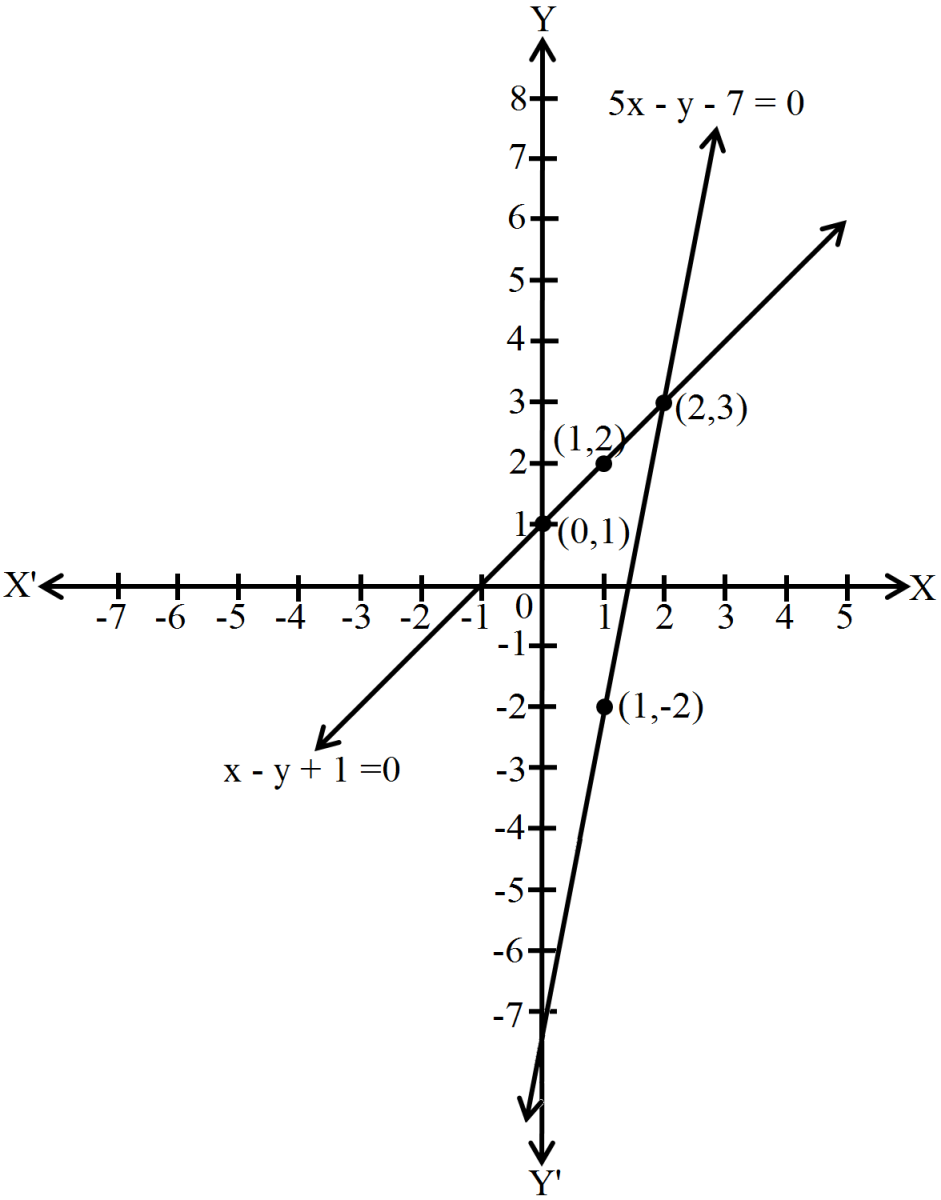
Solve each of the following given systems of equations graphically and find the vertices and area of the triangle formed by these lines and the y-axis:
5x - y - 7 = 0, x - y + 1 = 0
Answer
5x - y - 7 = 0 ⇒ y = 5x - 7
x: 2 1
y: 3 -2
x - y + 1 = 0 ⇒ y = x + 1
x: 0 1
y: 1 2

Since the two graph intersect at (2, 3), x = 2 and y = 3 The vertices of the triangle formed by these lines and the y-axis are (2, 3), (0, 1) and (0, -7). So, height of the triangle = distance from (2, 3) to y-axis = 2 units Base = 8 units Area of triangle $=\frac{1}{2}\times$ base × height $=\frac{1}{2}\times8\times2$ $=8\ \text{sq. units}$
View full question & answer
Question 115 Marks
2 men and 5 boys can finish a piece of work in 4 days, while 3 men and 6 boys can finish it in 3 days. Find the time taken by one man alone to finish the work and that taken by one boy alone to finish the work.
Answer
Let man's 1 day's work be $\frac{1}{\text{x}}$ and 1 boy's day's work be $\frac{1}{\text{y}}$ Also let $\frac{1}{\text{x}}=\text{u}$ and $\frac{1}{\text{y}}=\text{v}$ Then, $\frac{2}{\text{x}}+\frac{5}{\text{y}}=\frac{1}{4}$ $\Rightarrow\text{2u}+\text{5v}=\frac{1}{4}\ \dots(1)$ and $\frac{3}{\text{x}}+\frac{6}{\text{y}}=\frac{1}{3}$ $\Rightarrow\text{3u}+\text{6v}=\frac{1}{3}\ \dots(2)$ Multiplying (1) by 6 and (2) by 5, we get $12\text{u}+\text{30v}=\frac{6}{4}\ \dots(3)$ $15\text{u}+\text{30v}=\frac{5}{3}\ \dots(4)$ Subtracting (3) from (4), we get $\text{3u}=\frac{5}{3}-\frac{6}{4}$ $\Rightarrow\text{3u}=\frac{20-18}{12}$ $\Rightarrow\text{3u}=\frac{2}{12}$ $\Rightarrow\text{3u}=\frac{1}{6}$ $\Rightarrow\text{u}=\frac{1}{18}$ Putting $\text{u}=\frac{1}{18}$ in (1), we get $2\times\frac{1}{18}+\text{5v}=\frac{1}{4}$ $\Rightarrow\frac{1}{9}+\text{5v}=\frac{1}{4}$ $\Rightarrow\text{5v}=\frac{1}{4}-\frac{1}{9}$ $\Rightarrow\text{5v}=\frac{5}{36}$ $\Rightarrow\text{v}=\frac{1}{36}$Now, $\text{u}=\frac{1}{18}$
$\Rightarrow\text{x}=\frac{1}{\text{u}}=18$and $\text{v}=\frac{1}{36}$
$\Rightarrow\text{y}=\frac{1}{\text{v}}=36$$\therefore$ x = 18, y = 36
The man will finish the work in 18 days and the boy will finish the work in 36 days when they work alone.
View full question & answer
Question 125 Marks
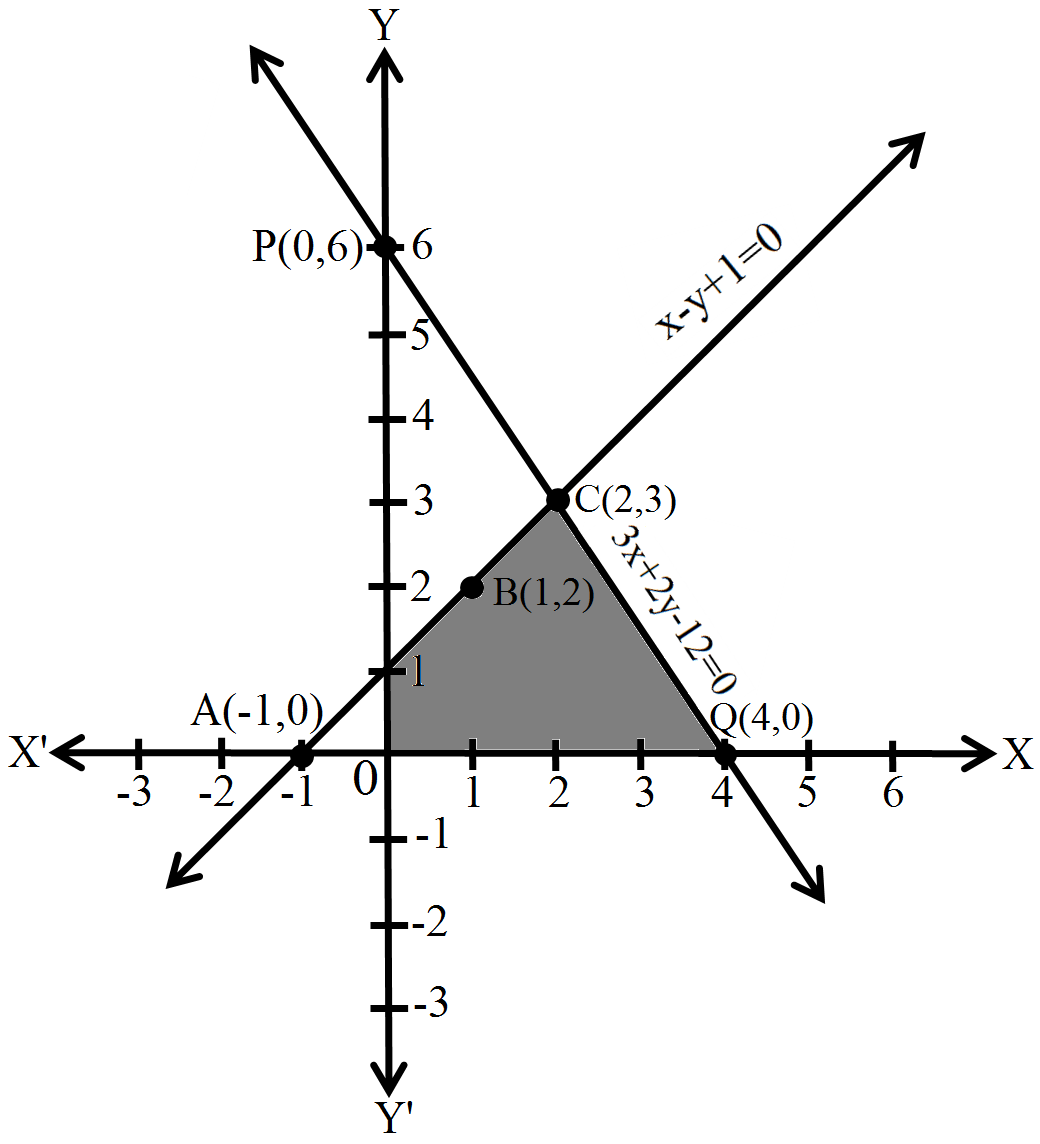
Solve each of the following given systems of equations graphically and find the vertices and area of the triangle formed by these lines and the x-axis:
x - y + 1 = 0, 3x + 2y - 12 = 0
Answer
On a graph paper, draw a horizontal line X'OX and a vertical line YOY' representing the x-axis and y-axis, respectively. The given system equations is x - y + 1 = 0, 3x + 2y - 12 = 0 Graph of x - y + 1 = 0: x - y + 1 = 0 y = x + 1 ...(1) Thus, we have the following table for equation (1)
x:
-1
1
2
y:
0
2
3
On the graph paper plot the points A(-1, 0), B(1, 2) and C(2, 3). Join AB and BC to get the graph line AC. Thus, the line AC is the graph of the equation of x - y + 1 = 0. Graph of 3x + 2y - 12 = 0: For graph of 3x + 2y - 12 = 0 $\Rightarrow\text{y}=\frac{-\text{3x}+12}{2}\ \dots(2)$ Thus, we have the following table for equation (2)
x:
0
2
4
y:
6
3
0
Now, on the same graph paper plot the points P(0, 6) and Q(4, 0). The third point C(2, 3) has already been plotted. Join PC and CQ to get the line PQ. Thus, line PQ is the graph of the equation 3x + 2y - 12 = 0.
The two graph lines intersect at C(2, 3). $\therefore$ x = 2, y = 3 is the solution of the given system of equations. Clearly, the vertices of $\triangle\text{ACQ}$ formed by these lines and the x-axis are A(-1, 0), C(2, 3) and Q(4, 0) Consider the triangle $\triangle\text{ACQ}:$ Height of the triangle = 3 units and base (AQ) = 5 units Area of triangle $\triangle\text{ACQ}:$ Area of $\triangle\text{ACQ}=\Big(\frac{1}{2}\times\text{Base}\times\text{height}\Big)$ $$ $=\Big(\frac{1}{2}\times3\times5\Big)\text{sq. units}$ Area of $\triangle\text{ACQ}=7.5\text{sq. }\text{units}$
View full question & answer
Question 135 Marks
The sum of the digits of a two-digit number is 12. The number obtained by interchanging its digits exceeds the given number by 18. Find the number.
Answer
Let the ten's digit be x and units digit be y respectively.
Then,
x + y = 12 ...(1)
$\therefore$ Required number = 10x + y
$\therefore$ Number obtained on reversing digits = 10y + x
According to the question:
10y + x - (10x + y) = 18
10y + x - 10x - y = 18
9y - 9x = 18
y - x = 2 ...(2)
Adding (1) and (2), we get
2y = 14
$\text{y}=\frac{14}{2}$
y = 7
Putting y = 7 in (1), we get
⇒ x + 7 = 12
⇒ x = 5
$\therefore$ Number = 10x + y
= 10 × 5 + 7
= 50 + 7
= 57
Hence, the number is 57.
View full question & answer
Question 145 Marks
Solve for x and y:
23x - 29y = 98,
29x - 23y = 110
Answer
The given equations are: 23x - 29y = 98 ...(i) 29x - 23y = 110 ...(ii) Adding (i) and (ii), we get 52x + 52y = 208 ⇒ x + y = 4 ...(iii) Subtract (i) from (ii), we get 6x - 6y = 12 ⇒ x - y = 2 ...(iv) Adding (iii) and (iv), we get 2x = 6 ⇒ x = 3 Substituting x = 3 in (iii), we get y = 1Hence, x = 3 and y = 1
View full question & answer
Question 155 Marks
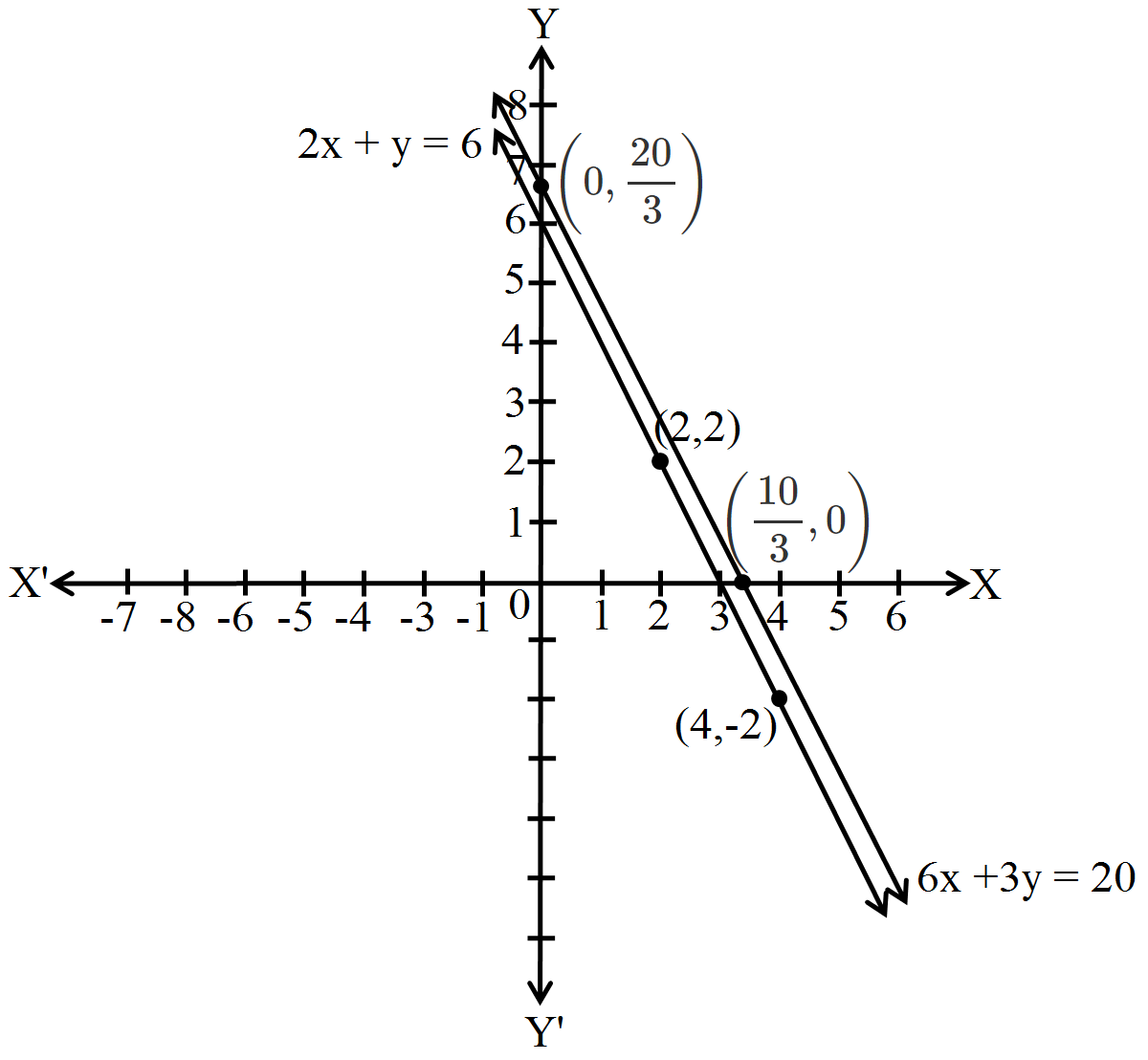
Show graphically that each of the following given systems of equations is inconsistent, i.e., has no solutions:
2x + y = 6, 6x + 3y = 20
Answer
$2\text{x}+\text{y}=6$ $\Rightarrow\text{y}=6-\text{2x}$
x: 2 4
y: 2 -2
$\text{6x}+\text{3y}=20$ $\Rightarrow\text{y}=\frac{20-\text{6x}}{3}$
x: 0 $\frac{10}{3}$
y: $\frac{20}{3}$ 0

Since the two graph of the system of equations is parallel lines, the system has no solution and hence is inconsistent.
View full question & answer
Question 165 Marks
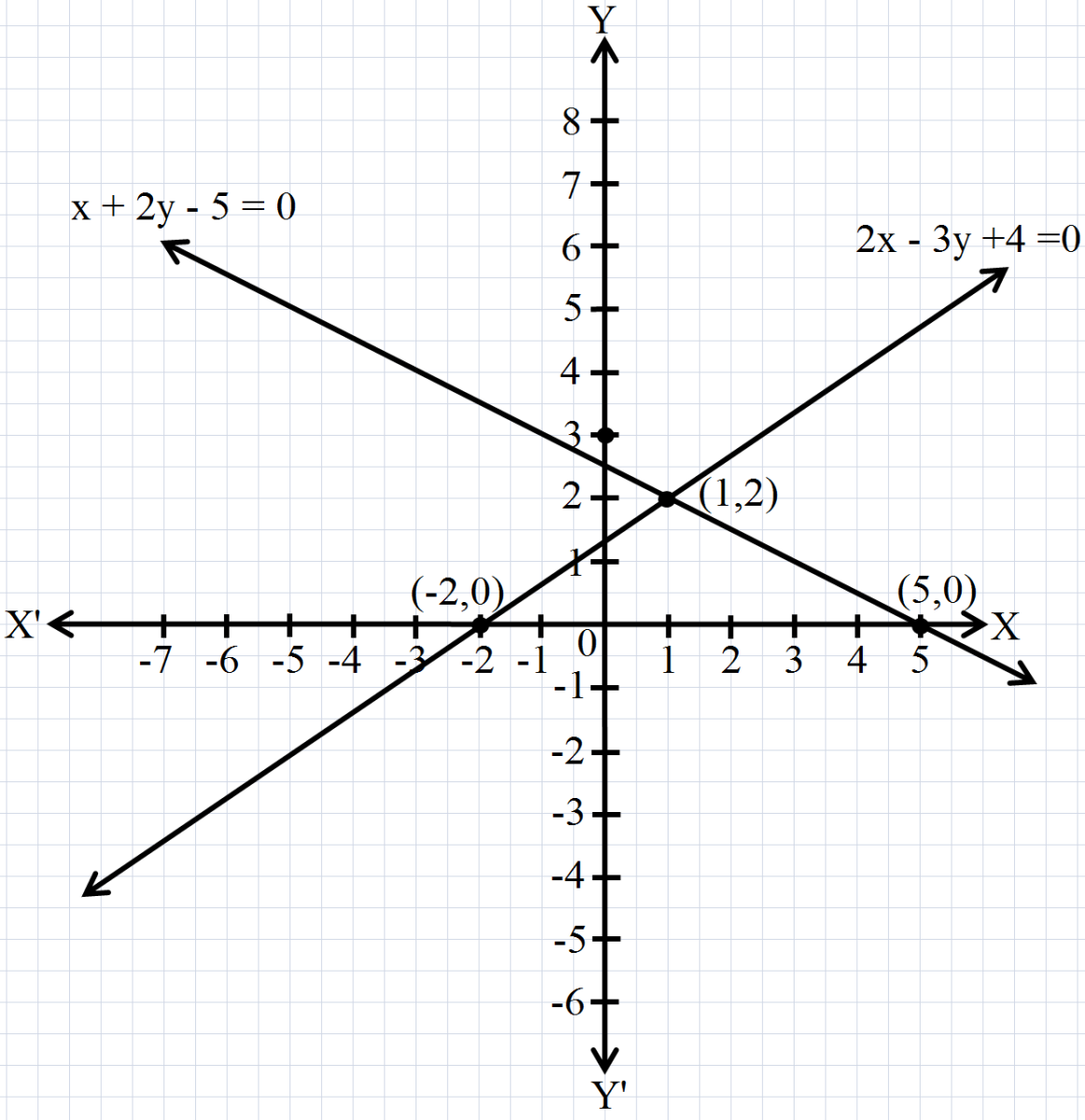
Solve each of the following given systems of equations graphically and find the vertices and area of the triangle formed by these lines and the x-axis:
2x - 3y + 4 = 0, x + 2y - 5 = 0
Answer
$2\text{x}-3\text{y}+ 4 = 0$ $\Rightarrow\text{y}=\frac{\text{2x}+4}{3}$
x: -2 1
y: 0 2
$\text{x} + 2\text{y} - 5 = 0$ $\Rightarrow\text{y}=\frac{4-\text{2x}}{3}$
x: 1 5
y: 2 0

Since the two graph intersect at (1, 2), x = 1 and y = 2 The vertices of the triangle formed by these lines and the x-axis are (-2, 0), (1, 2) and (5, 0). So, height of the triangle = distance from (1, 2) to x-axis = 2 units Base = 7 units Area of triangle $=\frac{1}{2}\times$ base × height $=\frac{1}{2}\times7\times2$ $=7\ \text{sq. units}$
View full question & answer
Question 175 Marks
The sum of two numbers is 137 and their difference is 43. Find the numbers.
Answer
Let the two numbers be x and y respectively.
Given:
x + y = 137 ...(i)
x - y = 43 ...(ii)
Adding (i) and (ii), we get
2x = 180
$\text{x}=\frac{180}{2}=90$
Putting x = 90 in (i), we get
90 + y = 137
y = 137 - 90
y = 47
Hence, the two numbers are 90 and 47.
View full question & answer
Question 185 Marks
Solve for x and y:
$\frac{1}{\text{2x}}+\frac{1}{\text{3y}}=2,$
$\frac{1}{\text{3x}}+\frac{1}{\text{2y}}=\frac{13}{6}$ $(\text{x}\neq0,\ \text{y}\neq0).$
Answer
$\frac{1}{\text{2x}}+\frac{1}{\text{3y}}=2,$ $\frac{1}{\text{3x}}+\frac{1}{\text{2y}}=\frac{13}{6}$ Putting $\frac{1}{\text{x}}=\text{u}$ and $\frac{1}{\text{y}}=\text{v}$ the given equations become $\frac{1}{2}\text{u}+\frac{1}{3}\text{v}=2$ and $\frac{1}{3}\text{u}+\frac{1}{2}\text{v}=\frac{13}{6}$ $\Rightarrow\text{3u}+\text{2v}=12\ \dots(\text{i})$ and $\text{2u}+\text{3v}=13\ \dots(\text{ii})$Multiplying (i) by 3 and (ii) by 2, we get
v = 3
$\Rightarrow\frac{1}{\text{x}}=2$ and $\Rightarrow\frac{1}{\text{y}}=3$ $\Rightarrow\text{x}=\frac{1}{2}$ and $\Rightarrow\text{y}=\frac{1}{3}$
View full question & answer
Question 195 Marks
If 2 is added to each of two given numbers, their ratio becomes 1 : 2. However, if 4 is subtracted from each of the given numbers, the ratio becomes 5 : 11. Find the numbers.
Answer
Let the required numbers be x and y respectively.
Then,
$\frac{\text{x}+2}{\text{y}+2}=\frac{1}{2}$
$\Rightarrow2\text{x}+4=\text{y}+2$
$\Rightarrow2\text{x}-\text{y}=-2$
$\frac{\text{x}-4}{\text{y}-4}=\frac{5}{11}$
$\Rightarrow11\text{x}-44=5\text{y}-20$
$\Rightarrow11\text{x}-5\text{y}=24$
Therefore,
2x - y = 2 ...(1)
11x - 5y = 24 ...(2)
Multiplying (1) by 5 and (2) by 1
10x - 5y = -10 ...(3)
11x - 5y = 24 ...(4)
Subtracting (3) and (4),
We get:
x = 34
Putting x = 34 in (1), we get
2 × 34 - y = -2
⇒ 68 - y = -2
⇒ -y = -2 - 68
⇒ y = 70
Hence, the required numbers are 34 and 70.
View full question & answer
Question 205 Marks
There are two classrooms A and B. If 10 students are sent from A to B, the number of students in each room becomes the same. If 20 students are sent from B to A, the number of students in A becomes double the number of students in B. Find the number of students in each room.
Answer
Let the number of student in class room A and B be x and y respectively.
When 10 students are transferred from A to B:
x - 10 = y + 10
x - y = 20 ...(1)
When 20 students are transferred from B to A:
2(y - 20) = x + 20
⇒ 2y - 40 = x + 20
⇒ -x + 2y = 60 ...(2)
Adding (1) and (2), we get
⇒ y = 80
Putting y = 80 in (1), we get
⇒ x - 80 = 20
⇒ x = 100
Hence, number of students of A and B are 100 and 80 respectively.
View full question & answer
Question 215 Marks
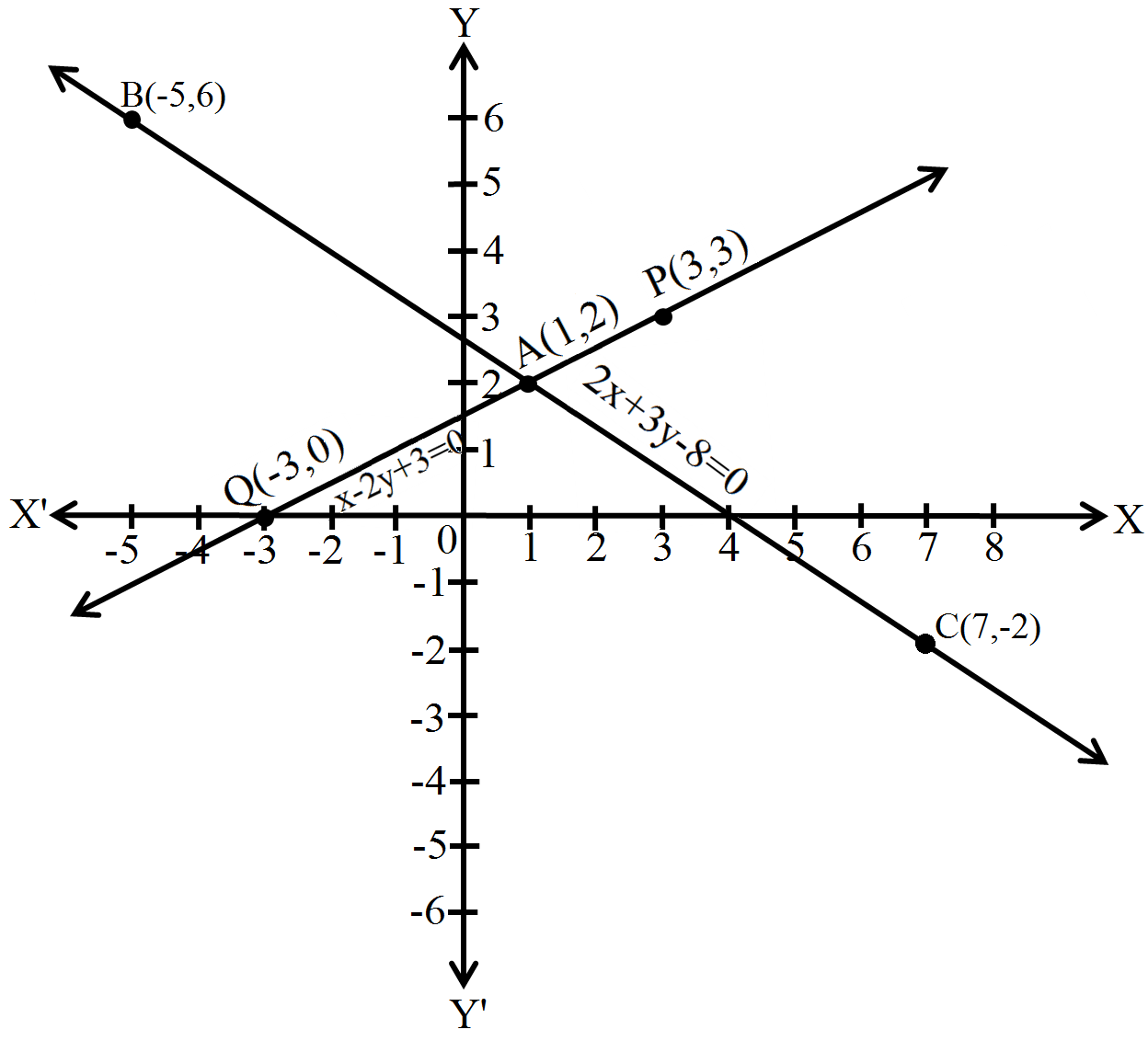
Solve the following system of equations graphically:
2x + 3y = 8,
x - 2y + 3 = 0
Answer
On a graph paper, draw a horizontal line X'OX and a vertical line YOY' representing the x-axis and y-axis, respectively. Given equations are 2x + 3y = 8 and x - 2y + 3 = 0 Graph of 2x + 3y = 8: 2x + 3y = 8 $\Rightarrow\text{y}=\frac{8-\text{2x}}{3}\ \dots(1)$ Thus we have the following table for 2x + 3y = 8
x:
1
-5
7
y:
2
6
-2
On the graph paper plot the points A(1, 2), B(-5, 6) and C(7, -2). Join AB and AC to get the graph line BC. Thus, the line AC is the equation of 2x + 3y = 8. Graph of x - 2y + 3 = 0: For graph of x - 2y + 3 = 0 $\Rightarrow\text{y}=\frac{\text{x}+3}{2}\ \dots(2)$ Thus, we have the following table for x - 2y + 3 = 0
x:
1
3
-3
y:
2
3
0
Now, on the same graph paper plot the points P(3, 3) and Q(-3, 0). The point A(1, 2) has already been plotted. Join PA and QA to get the line PQ. Thus, line PQ is the graph of the equation x - 2y + 3 = 0.
The two graph lines intersect at A(1, 2). $\therefore$ x = 1, y = -2 is the solution of the given system of equations.
View full question & answer
Question 225 Marks
Solve for x and y:
$\frac{5}{\text{x}+\text{1}}-\frac{2}{\text{x}-\text{1}}=\frac{1}{2}$
$\frac{10}{\text{x}+\text{1}}+\frac{2}{\text{y}-\text{1}}=\frac{5}{2}$
Answer
The given equations are: $\frac{5}{\text{x}+\text{1}}-\frac{2}{\text{x}-\text{1}}=\frac{1}{2}$ and $\frac{10}{\text{x}+\text{1}}+\frac{2}{\text{y}-\text{1}}=\frac{5}{2}$ Putting $\frac{1}{\text{x}+\text{1}}=\text{u}$ and $\frac{1}{\text{y}-\text{1}}=\text{v}$ $\text{5u}-\text{2v}=\frac{1}{2}\ \dots(1)$ $\text{10u}+\text{2v}=\frac{5}2{}\ \dots(2)$ Adding (1) and (2)$\text{15u}=\frac{1}{2}+\frac{5}{2}=\frac{5+1}{2}=3$
$\therefore\text{u}=\frac{3}{15}=\frac{1}{5}=\frac{1}{\text{x}+1}$
$\therefore\text{x}+1=5$ or $\text{x}=4$
Putting value of u in (1)$5\times\frac{1}{5}-\text{2v}=\frac{1}{2}$ or $-\text{2v}=\frac{1}{2}-1=-\frac{1}2{}$
$\therefore\text{v}=\frac{1}{4}=\frac{1}{\text{y}-1}$ or y - 1 = 4 or y = 5
Hence the required solution is x = 4 and y = 5
View full question & answer
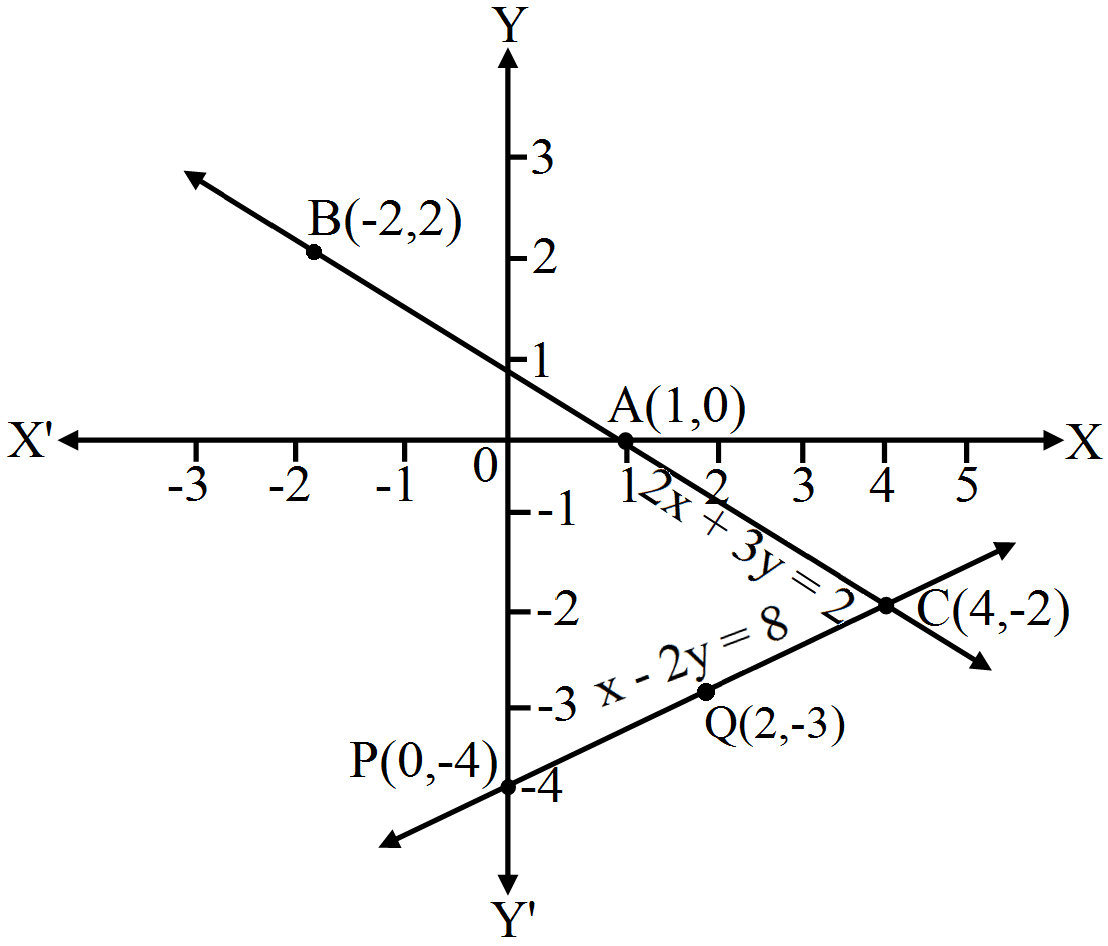
Question 235 Marks
Solve the following system of equations graphically:
2x + 3y = 2,
x - 2y = 8
Answer
On a graph paper, draw a horizontal line X'OX and a vertical line YOY' representing the x-axis and y-axis, respectively.
Graph of 2x + 3y = 2:
$\text{y}=\frac{2(1-\text{x})}{3}$
Putting x = 1, we get y = 0
Putting x = -2, we get y = 2
Putting x = 4, we get y = -2
$\therefore$ Table for 2x + 3y = 2 is
x:
1
-2
4
y:
0
2
-2
Plot the points A(1, 0), B(-2, 2) and C(4, -2) on the graph paper.
Join AB and AC to get the graph line BC.
Extend it on both ways.
Thus, the line BC is the graph of x + 3y = 2.
Graph of x - 2y = 8:
$\text{y}=\frac{\text{x}-8}{2}$
Putting x = 2, we get y = -3
Putting x = 4, we get y = -2
Putting x = 0, we get y = -4
Table for x - 2y = 8 is
x:
2
4
0
y:
-3
-2
-4
Now, on the same graph paper plot the points P(0, -4) and Q(2, -3). The point C(4, -2) has already been plotted.
Join PQ and QC and extend it on both ways.
Thus, line PC is the graph of x - 2y = 8.

The two graph lines intersect at C(4, -2).
$\therefore$ x = 4, y = -2 is the solution of the given system of equations.
View full question & answer
Question 245 Marks
The present age of a woman is 3 years more than three times the ages of her daughter. Three years hence, the woman's age will be 10 years more than twice the age of her daughter. Find their present ages.
Answer
Let the present ages of woman and daughter be x and y respectively.
Then,
Their present ages:
x = 3y + 3
⇒ x - 3y = 3 ...(1)
Three years later:
(x + 3) = 2(y + 3) + 10
⇒ x + 3 = 2y + 6 + 10
⇒ x - 2y = 13 ...(2)
Subtracting (2) from (1), we get
⇒ y = 10
Putting y = 10 in (1), we get
x - 3 × 10 = 3
⇒ x = 33
$\therefore$ x = 33, y = 10
Hence, present ages of woman and daughter are 33 and 10 years.
View full question & answer
Question 255 Marks
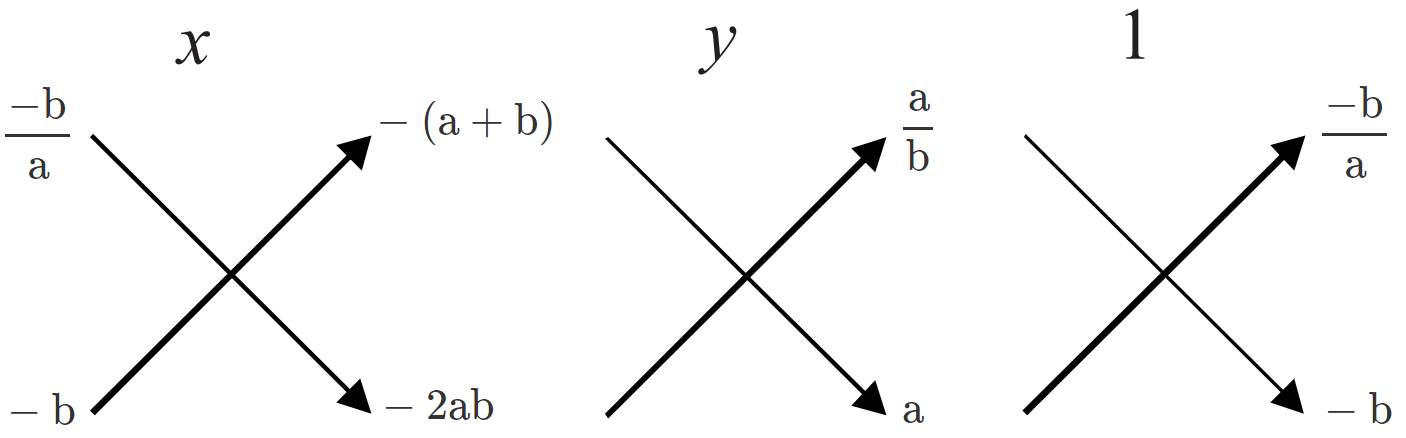
Solve the following systems of equations by using the method of cross multiplication:
$\frac{5}{(\text{x}+\text{y})}-\frac{2}{(\text{x}-\text{y})}+1=0,$
$\frac{15}{(\text{x}+\text{y})}+\frac{7}{(\text{x}-\text{y})}-10=0$ $(\text{x}\neq\text{y},\ \text{x}\neq-\text{y}).$
Answer
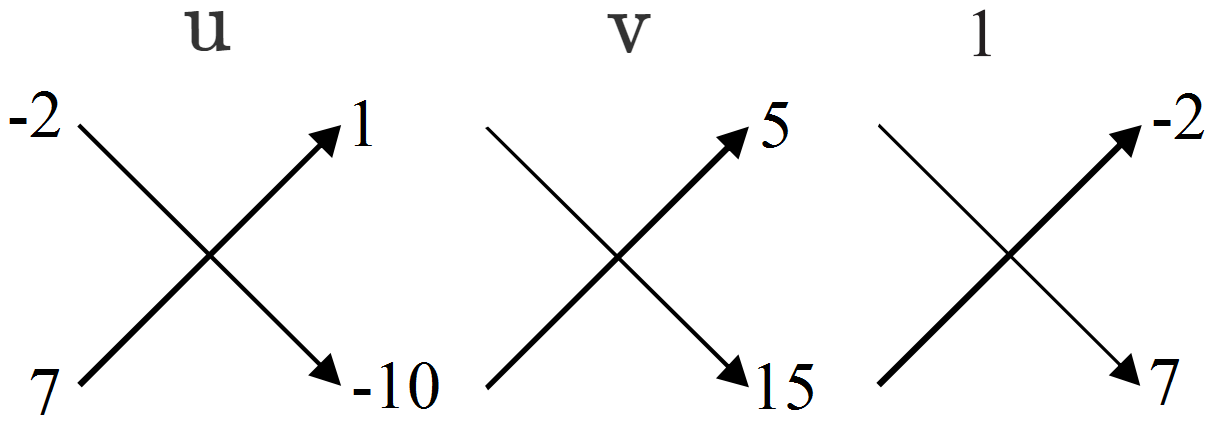
Taking $\frac{1}{\text{x}+\text{y}}=\text{u}$ and $\frac{1}{\text{x}-\text{y}}=\text{v},$ the given equations become:
$5u - 2v + 1 = 0 ...(i) 15u + 7v - 10 = 0 ...(ii)$
Here, $a_1 = 5, b_1 = -2, c_1 = 1, a_2 = 15, b_2 = -7$ and $c_2 = -10$ By cross multiplication, we have:


$\therefore\frac{\text{u}}{[-2\times(-10)-1\times7]}=\frac{\text{v}}{[1\times15-(-10)\times5]}=\frac{1}{[35+30]}$
$\Rightarrow\frac{\text{u}}{20-7}=\frac{\text{v}}{15+50}=\frac{1}{65}$
$\Rightarrow\frac{\text{u}}{13}=\frac{\text{v}}{65}=\frac{1}{65}$
$\Rightarrow\text{u}=\frac{13}{65}=\frac{1}{5},\ \text{v}=\frac{65}{65}=1$
$\Rightarrow\frac{1}{\text{x}+\text{y}}=\frac{1}{5},\ \frac{1}{\text{x}-\text{y}}=1$
So, $(x + y) = 5 ...(iii)$ and $(x - y) = 1 ...(iv)$
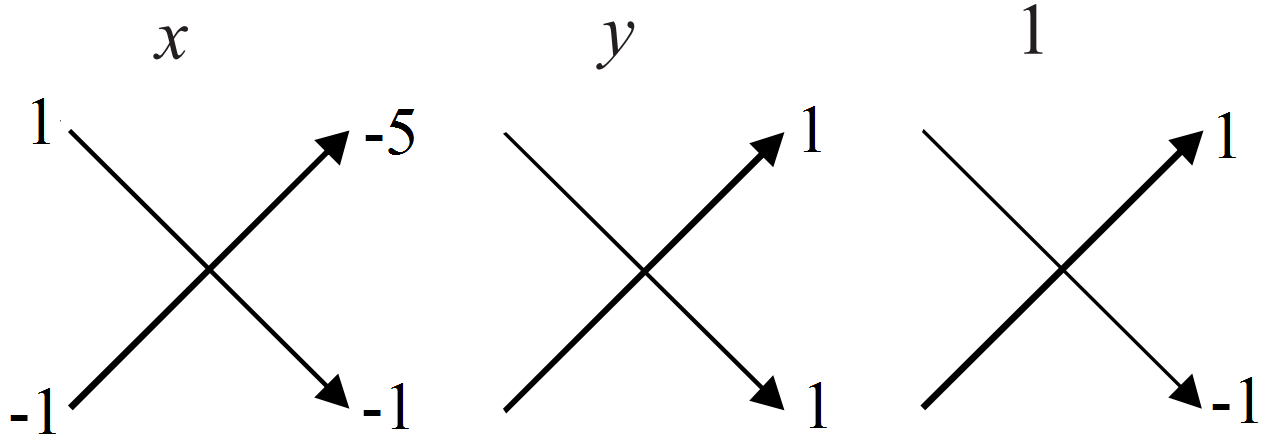
Again, the above equations (iii) and (iv) may be written as: $x + y - 5 = 0 ...(v) x - y - 1 = 0 ...(vi)$
Here, $a_1 = 1, b_1 = 1, c_1 = -5, a_2 = 1, b_2 = -1$ and $c_2 = -1$ By cross multiplication, we have:

$\therefore\frac{\text{x}}{[1\times(-1)-(-5)\times(-1)]}=\frac{\text{y}}{(-5)\times1-(-1)\times1}=\frac{1}{[1\times(-1)-1\times1]}$
$\Rightarrow\frac{\text{x}}{(-1-5)}=\frac{\text{y}}{(-5+1)}=\frac{1}{(-1-1)}$
$\Rightarrow\frac{\text{x}}{-6}=\frac{\text{y}}{-4}=\frac{1}{-2}$
$\Rightarrow\text{u}=\frac{-6}{-2}=3,\ \text{y}=\frac{-4}{-2}=2$
Hence, $x = 3$ and $y = 2$ is the required solution.
View full question & answer
Question 265 Marks
Abdul travelled 300km by train and 200km by taxi taking 5 hours 30 minutes. But, if he travels 260km by train and 240km by taxi, he takes 6 minutes longer. Find the speed of the train and that of the taxi.
Answer
Let the speeds of the train and taxi be x km/h and y km/h respectively.
Then, time taken to cover 300km by the train $=\frac{300}{\text{x}}\ \text{hours}$
and time taken to cover 200km by the taxi $=\frac{200}{\text{y}}\ \text{hours}$
Total time taken $=5\frac{30}{60}\ \text{hours}=5\frac{1}{2}\ \text{hours}=\frac{11}{2}\ \text{hours}$
$\therefore\frac{300}{\text{x}}+\frac{200}{\text{y}}=\frac{11}{2}$
$\Rightarrow\frac{600}{\text{x}}+\frac{400}{\text{y}}=11$
Put $\frac{1}{\text{x}}=\text{u}$ and $\frac{1}{\text{y}}=\text{v}$
⇒ 600u + 400v = 11 ...(i)
Again, time taken to cover 260km by the train $=\frac{260}{\text{x}}\ \text{hours}$
and time taken to cover 240km by the taxi $=\frac{240}{\text{y}}\ \text{hours}$
Total time taken $=5\frac{36}{60}\ \text{hours}=5\frac{3}{5}\ \text{hours}=\frac{28}{5}\ \text{hours}$
⇒ 1300u + 1200v = 28 ...(ii)
Multiplying (i) by 3 and subtracting (ii) from it, we get
500u = 5
$\Rightarrow\text{u}=\frac{5}{500}$
$\Rightarrow\text{u}=\frac{1}{100}$
Substituting $\text{u}=\frac{1}{100}$ in (i), we get $\text{v}=\frac{1}{80}$
Now,
$\text{u}=\frac{1}{100}$
$\Rightarrow\frac{1}{\text{x}}=\frac{1}{100}$
$\Rightarrow\text{x}=100$
$\text{v}=\frac{1}{80}$
$\Rightarrow\frac{1}{\text{y}}=\frac{1}{80}$
$\Rightarrow\text{y}=80$
$\therefore$ Speed of the train = 100km/hr
and speed of the taxi = 80km/hr
View full question & answer
Question 275 Marks
A part of monthly hostel charges in a college hostel are fixed and the remaining depends on the number of days one has taken food in the mess. When a student A takes food for 25 days, he has to pay ₹ 4500, whereas a student B who takes food for 30 days, he has to pay ₹ 5200. Find the fixed charges per month and the cost of the food per day.
Answer
Let the fixed charges be ₹ x and other charges be ₹ y per km.
According to the given condition,
x + 25y = 4500 ...(i)
x + 30y = 5200 ...(ii)
Subtracting (i) from (ii), we get
5y = 700
⇒ y = 140
Substituting y = 140 in (i), we get
x = 1000.
Hence, the fixed charges is ₹ 1000 and the cost of food per day is ₹ 140
View full question & answer
Question 285 Marks
Solve for x and y:
$\frac{2}{(3\text{x}+\text{2y)}}+\frac{3}{(3\text{x}-\text{2y)}}=\frac{17}{5},$
$\frac{5}{(3\text{x}+\text{2y)}}+\frac{1}{(3\text{x}-\text{2y)}}=2$
Answer
$\frac{2}{(3\text{x}+\text{2y)}}+\frac{3}{(3\text{x}-\text{2y)}}=\frac{17}{5},$ $\frac{5}{(3\text{x}+\text{2y)}}+\frac{1}{(3\text{x}-\text{2y)}}=2$ Putting $\frac{1}{\text{3x}+\text{2y}}=\text{u}$ and $\frac{1}{\text{3x}-\text{2y}}=\text{v}$ so, we get $\text{2u}+\text{3v}=\frac{17}{5}\ \dots(\text{i})$and $\text{5u}+\text{v}=2\ \dots(\text{ii})$ Multiplying (ii) by 3 and subtract it from (i). $\Rightarrow\text{15u}+\text{3v}=6$ and $\text{2u}+\text{3v}=\frac{17}{5}$ $\Rightarrow-13\text{u}=\frac{17}{5}-6$ $\Rightarrow-13\text{u}=-\frac{13}{5}$ $\Rightarrow\text{u}=\frac{1}{5}$ Substituting $\text{u}=\frac{1}{5}$ in (i), we get v = 1 $\Rightarrow\frac{1}{\text{3x}+\text{2y}}=\frac{1}{5}$ and $\frac{1}{\text{3x}-\text{2y}}=1$ $\Rightarrow\text{3x}+\text{2y}=5\ \dots(\text{iii})$ and $\text{3x}-\text{2y}=1\ \dots(\text{iv})$ Adding (iii) and (iv), we get 6x = 6 x = 1 Substituting x = 1 in (iii), we get y = 1Hence, x = 1 and y = 1
View full question & answer
Question 295 Marks
If 45 is subtracted from twice the greater of two numbers, it result in the other number. If 21 is subtracted from twice the smaller number, it results in the greater number. Find the numbers.
Answer
Let the greater number be x and y resoectively.
According to the question:
2x - 45 = y
⇒ 2x - y = 45 ...(1)
and
2y - x = 21
⇒ -x + 2y = 21 ...(2)
Multiplying (1) by 2 and (2) by 1
4x - 2y = 90 ...(3)
-x + 2y = 21 ...(4)
Adding (3) and (4), we get
3x = 111
$\Rightarrow\text{x}=\frac{111}{3}=37$
Putting x = 37 in (1), we get
2 × 37 - y = 45
⇒ 74 - y = 45
⇒ y = 29
Hence, the greater and the smaller numbers are 37 and 29.
View full question & answer
Question 305 Marks
Solve for x and y:$\frac{5}{\text{x}+\text{y}}-\frac{2}{\text{x}-\text{y}}=-1,$
$\frac{15}{\text{x}+\text{y}}+\frac{7}{\text{x}-\text{y}}=10$
Answer
$\frac{5}{\text{x}+\text{y}}-\frac{2}{\text{x}-\text{y}}=-1,$$\frac{15}{\text{x}+\text{y}}+\frac{7}{\text{x}-\text{y}}=10$
Put $\frac{1}{\text{x}+\text{y}}=\text{u}$ and $\frac{1}{\text{x}-\text{y}}=\text{v}$
So, we get
5u - 2v = -1 ...(i) and 15u + 7v = 10 ...(ii)
Multiply (i) by 3 and subtract (ii) it from.
⇒ 15u - 6v = -3 and 15u + 7v = 10
⇒ -13v = -13
⇒ v = 1
Substituting v = 1 in (i), we get $\text{u}=\frac{1}{5}$
$\Rightarrow\frac{1}{\text{x}+\text{y}}=\frac{1}{5}$ and $\frac{1}{\text{x}-\text{y}}=1$
⇒ x + y = 5 ...(iii) and x - y = 1 ...(iv)
Adding (iii) and (iv), we get
2x = 6
⇒ x = 3
Substituting x = 3 in (iii), we get y = 2
So, x = 3 and y = 2
View full question & answer
Question 315 Marks
Solve for $x$ and $y:$
$\frac{\text{bx}}{\text{a}}-\frac{\text{ay}}{\text{b}}+\text{a}+\text{b}=0,$
$\text{bx}-\text{ay}+\text{2ab}=0$
Answer
$\frac{\text{bx}}{\text{a}}-\frac{\text{ax}}{\text{b}}+\text{a}+\text{b}=0$
By taking L.C.M., we get
$\frac{\text{b}^2\text{x}-\text{a}^2\text{y}+\text{a}^2\text{b}+\text{b}^2\text{a}}{\text{ab}}=0$
$b^2x - a^2y = -a^2b - b^2a ...(1)$
$bx - ay = - 2ab ...(2)$
Multiplying (1) by 1 and (2) by a
$b^2x - a^2y = -a^2b - b^2a ...(3)$
$abx - a^2b = - 2a^2b ...(4)$
Subtracting (3) from (4)
$(ab - b^2)x = -2a^2b + a^2b + ab^2$
$b(a - b)x = -a^2b + ab^2 = -ab(a - b)$
$\therefore\ \text{x}=\frac{-\text{ab}(\text{a}-\text{b})}{\text{b}(\text{a}-\text{b})}$
$x = -a$
Putting $x = -a,$ in (1), we get
$b^2(-a) - a^2y = -a^2b - b^2a$
$-ab^2 - a^2y = -a^2b - b^2a$
$-a^2y = -a^2b - b^2a + ab^2$
$-a^2y = -a^2b$
$\Rightarrow\text{y}=\frac{-\text{a}^2\text{b}}{-\text{a}^2}=\text{b}$
$\therefore$ solution is $x = -a, y = b$
View full question & answer
Question 325 Marks
Solve the following systems of equations by using the method of cross multiplication:
$6x - 5y - 16 = 0,$
$7x - 13y + 10 = 0$
Answer
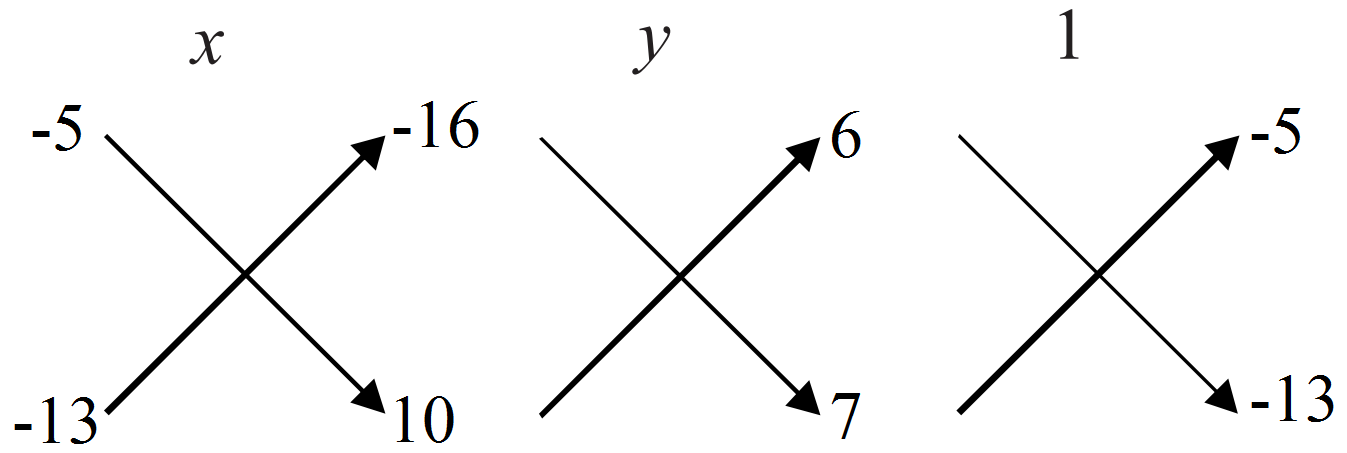
The given equations are: $6x - 5y - 16 = 0 ...(i)$
$7x - 13y + 10 = 0 ...(ii)$
Here, $a_1 = 6, b_1 = -5, c_1 = -16, $
$a_2 = 7, b_2 = -13$ and $c_2 = 10$
By cross multiplication, we have:

$\therefore\frac{\text{x}}{[(-5)\times10-(-16)\times(-13)]}=\frac{{\text{y}}}{[(-16)\times7-10\times6]}=\frac{1}{[6\times(-13)-(-5)\times7]}$
$\Rightarrow\frac{\text{x}}{(-50-208)}=\frac{\text{y}}{(-112-60)}=\frac{1}{(-78+35)}$
$\Rightarrow\frac{\text{x}}{(-258)}=\frac{\text{y}}{(-172)}=\frac{1}{(-43)}$
$\Rightarrow\text{x}=\frac{-258}{-43}=6,\ \text{y}=\frac{-172}{-43}=4$
Hence, $x = 6$ and $y = 4$ is the required solution.
View full question & answer
Question 335 Marks
Find two numbers such that the sum of twice the first and thrice the second is 92, and four times the first exceeds seven times the second by 2
Answer
Let the first and second number be x and y respectively.
According to the question:
2x + 3y = 90 ...(i)
4x - 7y = 2 ...(ii)
Multiplying (i) by 7 and (ii) by 3, we get
14x + 21y = 644 ...(iii)
12x + 21y = 6 ...(iv)
Adding (3) and (4), we get
26x = 650
$\Rightarrow\text{x}=\frac{650}{26}=25$
Putting x = 25 in (i),
We get:
2 × 25 + 3y = 92
50 + 3y = 92
⇒ 3y = 92 - 50
$\Rightarrow\text{y}=\frac{42}{3}= 14$
⇒ y = 14
Hence, the first number is 25 and second is 14
View full question & answer
Question 345 Marks
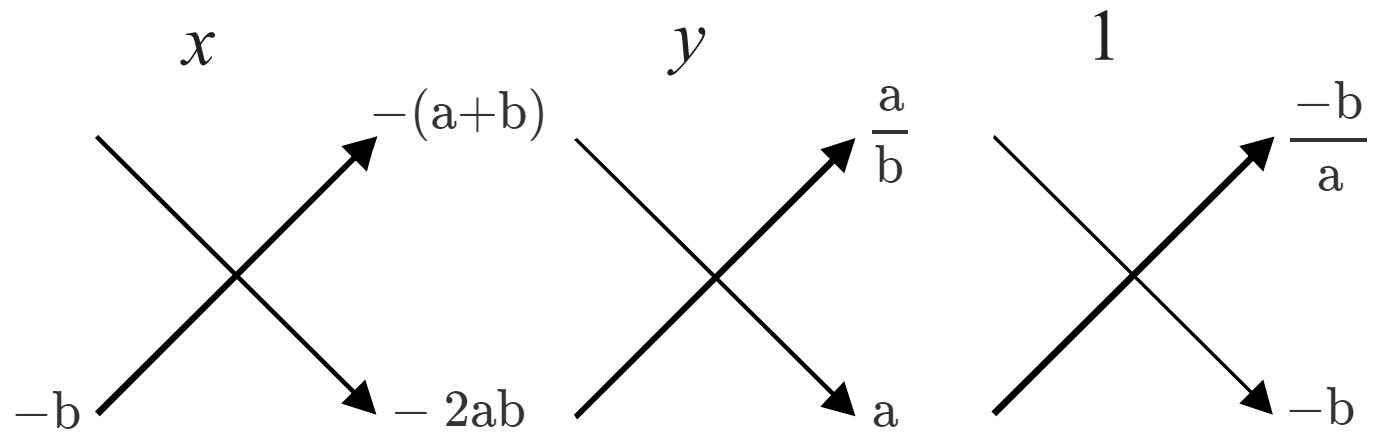
Solve the following systems of equations by using the method of cross multiplication:
$\frac{\text{ax}}{\text{b}}-\frac{\text{by}}{\text{a}}=\text{a}+\text{b},$
$\text{ax}-\text{by}=\text{2ab}$
Answer
The given equations may be written as: $\frac{\text{ax}}{\text{b}}-\frac{\text{by}}{\text{a}}-(\text{a}+\text{b})=0\ \dots(\text{i})$
$\text{ax}-\text{by}-\text{2ab}=0\ \dots(\text{ii})$
Here, $\text{a}_1=\frac{\text{a}}{\text{b}},\ \text{b}_1=\frac{-\text{b}}{\text{a}},$
$c_1 = -(a + b), a_2 = a, b_2 = -b$ and $c_2 = -2ab$
By cross multiplication, we have:

$\therefore\frac{\text{x}}{\big(-\frac{\text{b}}{\text{a}}\big)\times(-\text{2ab})-(-\text{b})\times(-(\text{a}+\text{b}))}=\frac{\text{y}}{-(\text{a}+\text{b})\times\text{a}-(-\text{2ab})\times\frac{\text{a}}{\text{b}}}$
$=\frac{1}{\frac{\text{a}}{\text{b}}\times(-\text{b})-\text{a}\times\big(-\frac{\text{b}}{\text{a}}\big)}$
$\Rightarrow\frac{\text{x}}{\text{2b}^2-\text{b}(\text{a}+\text{b})}=\frac{\text{y}}{-\text{a}(\text{a}+\text{b})+\text{2a}^2}=\frac{1}{-\text{a}+\text{b}}$
$\Rightarrow\frac{\text{x}}{\text{2b}^2-\text{ab}+\text{b}^2}=\frac{\text{y}}{-\text{a}^2-\text{ab}+\text{2a}^2}=\frac{1}{-\text{a}+\text{b}}$
$\Rightarrow\frac{\text{x}}{(\text{b}^2-\text{ab})}=\frac{\text{y}}{(\text{a}^2-\text{ab})}=\frac{1}{-(\text{a}-\text{b})}$
$\Rightarrow\frac{\text{x}}{-\text{b}(\text{a}-\text{b})}=\frac{\text{y}}{\text{a}(\text{a}-\text{b})}=\frac{1}{-(\text{a}-\text{b})}$
$\Rightarrow\text{x}=\frac{-\text{b}(\text{a}-\text{b})}{-(\text{a}-\text{b})}=\text{b},\ \text{y}=\frac{\text{a}(\text{a}-\text{b})}{-(\text{a}-\text{b})}=-\text{a}$
 Hence, $x = b$ and $y = -a$ is the required solution.
View full question & answer
Question 355 Marks
A lady has only 25-paisa and 50-paisa coins in her purse. If she has 50 coins in all totalling ₹ 19.50, how many coins of each kind does she have?
Answer
Let the number of 25-paisa coins be × and the number of 50-paisa coins be y.
Then, x + y = 50 ...(i)
Since she has a total of ₹ 19.50,
25x + 50y = 19.50(100)
⇒ 25x + 50y = 1950
⇒ x + 2y = 78 ...(ii)
Subracting (i) from (ii), we get
y = 28
Substituting y = 28 in (i), we get
x = 22
So, the number of 25-paisa coins is 22 and the number of 50-paisa coins is 28.
View full question & answer
Question 365 Marks
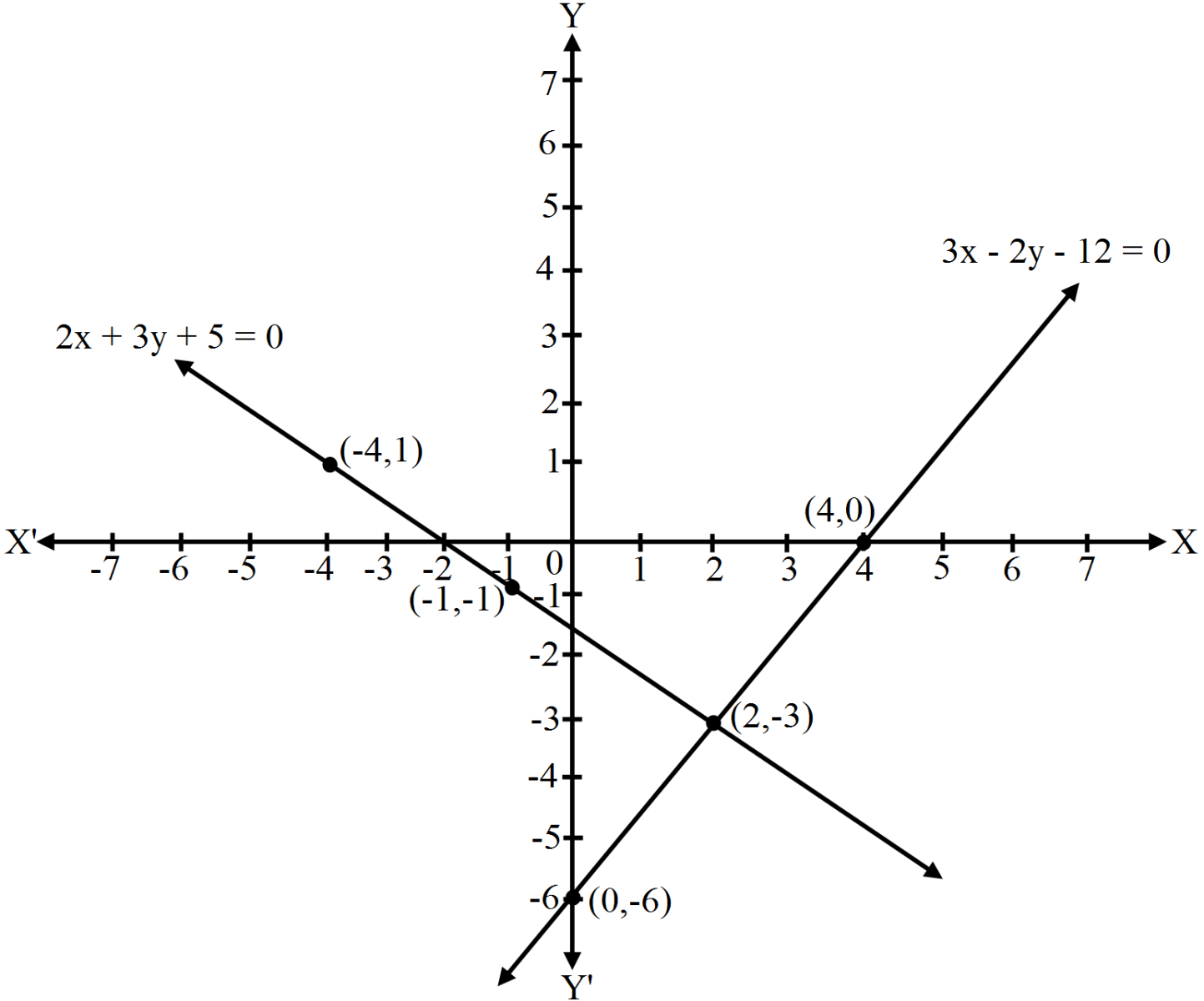
Solve the following system of equations graphically:
2x + 3y + 5 = 0,
3x - 2y - 12 = 0
Answer
$\text{2x}+\text{3y}+5=0$ $\Rightarrow\text{y}=\frac{-5-\text{2x}}{3}$
x:
-4
-1
y:
1
-1
$\text{3x}-\text{2y}-12=0$ $\Rightarrow\text{y}=\frac{\text{3x}-12}{2}$
x:
0
4
y:
-6
0

Since the two graph intersect at (2, -3), x = 2 and y = -3
View full question & answer
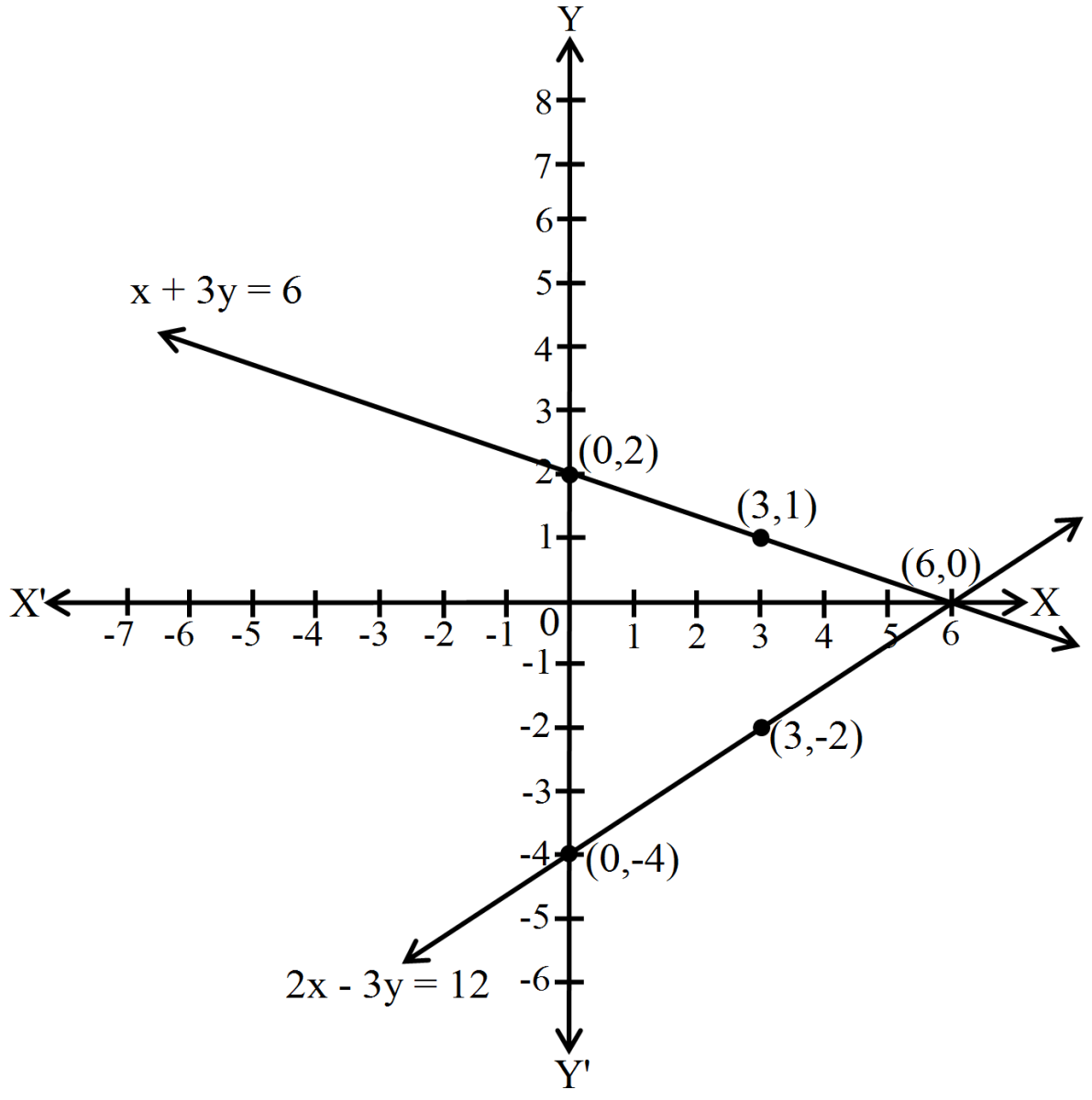
Question 375 Marks
Solve each of the following given systems of equations graphically and find the vertices and area of the triangle formed by these lines and the y-axis:
2x - 3y = 12, x + 3y = 6
Answer
$\text{2x}-\text{3y}=12,$ $\Rightarrow\text{y}=\frac{\text{2x}-12}{3}$
x: 0 3
y: -4 -2
$\text{x}+\text{3y}=6$ $\Rightarrow\text{y}=\frac{6-\text{x}}{3}$
x: 0 3
y: 2 1

Since the two graph intersect at (6, 0), x = 6 and y = 0 The vertices of the triangle formed by these lines and the y-axis are (6, 0), (0, -4) and (0, 2). So, height of the triangle = distance from (6, 0) to y-axis = 6 units Base = 6 units Area of triangle $=\frac{1}{2}\times$ base × height $=\frac{1}{2}\times6\times6$ $=18\ \text{sq. units}$
View full question & answer
Question 385 Marks
Two years ago, a man was five times as old as his son. Two years later, his age will be 8 more than three times the ago of the son. Find their present ages.
Answer
Let the present ages of the man and his son be x years and y years respectively.
Then,
Two years ago:
(x - 2) = 5(y - 2)
⇒ x - 2 = 5y - 10
⇒ x - 5y = -8 ...(1)
Two years later:
(x + 2) = 3(y + 2) + 8
⇒ x + 2 = 3y + 6 + 8
⇒ x - 3y = 12 ...(2)
Subtracting (2) from (1), we get
-2y = -20
⇒ y = 10
Putting y = 10 in (1), we get
x - 5 × 10 = -8
⇒ x - 50 = -8
⇒ x = 42
Hence the present ages of the man and the son are 42 years and 10 respectively.
View full question & answer
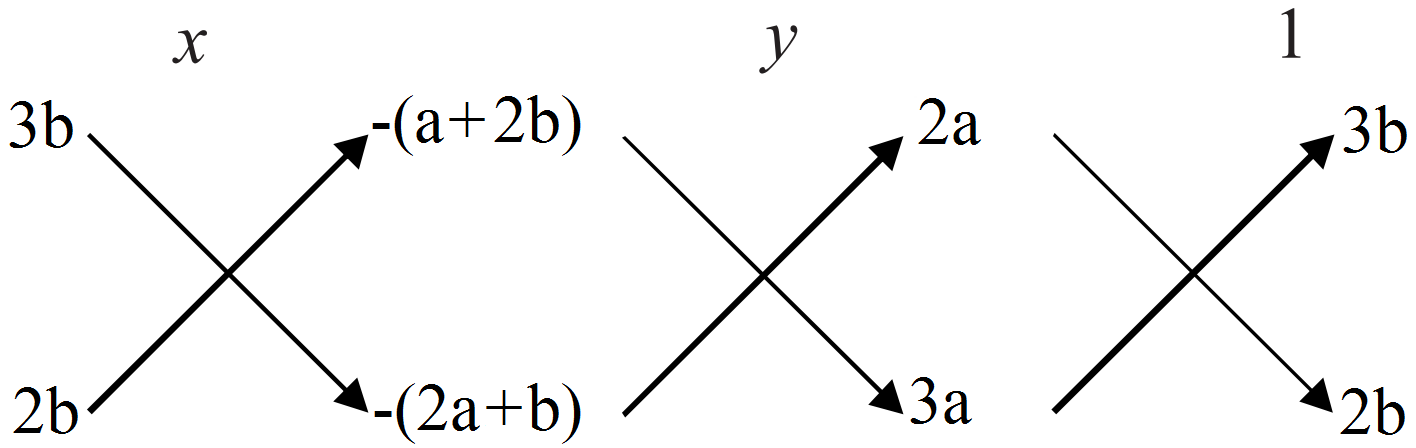
Question 395 Marks
Solve the following systems of equations by using the method of cross multiplication:
$2ax + 3by = (a + 2b),$
$3ax + 2by = (2a + b).$
Answer
The given equations may be written as:
$2ax + 3by = (a + 2b) ...(i)$
$ 3ax + 2by = (2a + b) ...(ii) $ Here,
​​​​​​​$a_1 = 2a, b_1 = 3b, c_1 = -(a + 2b), $
$​​​​​​​a_2 = 3a, b_2 = 2b$ and $c_2 = -(2a + b) $
By cross multiplication, we have:
​​​​​​​
$\therefore\frac{\text{x}}{[\text{3b}\times(-(\text{2a}+\text{b}))-2\text{b}\times(-(\text{a}+2\text{b}))]}=\frac{\text{y}}{[-(\text{a}+2\text{b})\times3\text{a}-\text{2a}\times(-(\text{2a}+\text{b}))]}$
$=\frac{1}{[\text{2a}\times2\text{b}-3\text{a}\times\text{3b}]}$
$\Rightarrow\frac{\text{x}}{\big(-\text{6ab}-\text{3b}^2+\text{2ab}+\text{4b}^2\big)}=\frac{\text{x}}{\big(-\text{3a}^2-\text{6ab}+\text{4a}^2+\text{2ab}\big)}=\frac{1}{\text{4ab}-\text{9ab}}$
$\Rightarrow\frac{\text{x}}{\text{b}^2-\text{4ab}}=\frac{\text{y}}{\text{a}^2-\text{4ab}}=\frac{1}{-\text{5ab}}$
$\Rightarrow\frac{\text{x}}{-\text{b}(\text{4a}-\text{b})}=\frac{\text{y}}{-\text{a}(4\text{b}-\text{a})}=\frac{1}{-5\text{ab}}$
$\Rightarrow\text{x}=\frac{-\text{b}(\text{4a}-\text{b})}{-5\text{ab}}=\frac{(\text{4a}-\text{b})}{\text{5a}},$
$\text{y}=\frac{-\text{a}(\text{4b}-\text{a})}{-\text{5ab}}=\frac{(\text{4b}-\text{a})}{\text{5b}}$ Hence, $\text{x}=\frac{(\text{4a}-\text{b})}{\text{5a}}$ and $\text{y}=\frac{(\text{4a}-\text{b})}{\text{5b}}$ is the required solution.
View full question & answer
Question 405 Marks
A number consisting of two digits is seven times the sum of its digits. When 27 is subtracted from the number, the digits are reversed. Find the number.
Answer
Let the ten's digit of required number be x and its unit's be y respectively
Required number = 10x + y
$\therefore$ 10x + y = 7(x + y)
10x + y = 7x + 7y
3x - 6y = 0 ...(1)
Number found on reversing the digits = 10y + x
$\therefore$ (10x + y) - 27 = 10y + x
⇒ 10x - x + y - 10y = 27
⇒ 9x - 9y = 27
⇒ (x - y) = 27
x - y = 3 ...(2)
Multiplying (1) by 1 and (2) by 6
3x - 6y = 0 ...(3)
6x - 6y = 18 ...(4)
Subracting (3) from (4), We get
⇒ 3x = 18
$\Rightarrow\text{x}=\frac{18}{3}$
⇒ x = 6
Putting x = 6 in (1), we get
⇒ 3 × 6 - 6y = 0
⇒ 18 - 6y = 0
⇒ -6y = -18
$\Rightarrow\text{y}=\frac{-18}{-6}$
⇒ y = 3
Number = 10x + y
= 10 × 6 + 3
= 60 + 3
= 63
Hence, the number is 63.
View full question & answer
Question 415 Marks
Solve: $\frac{\text{ax}}{\text{b}}-\frac{\text{by}}{\text{a}}=\text{a}+\text{b},$ $\text{ax}-\text{by}=\text{2ab}.$
Answer
The given equation may be written as follows: $\frac{\text{ax}}{\text{b}}-\frac{\text{by}}{\text{a}}-(\text{a+b})=0\ ...(\text{i})$ ax - by - 2ab = 0 ...(ii) Here, $\text{a}_1=\frac{\text{a}}{\text{b}},\ \text{b}_1=\frac{\text{b}_1}{\text{a}},$ $\text{c}_1=-(\text{a+b}),\ \text{a}_2=\text{a},$ $\text{b}_2= -\text{b},\ \text{c}_2=-2\text{ab}$ By cross multiplying, we have:
$\therefore\frac{\text{x}}{\big(-\frac{\text{b}}{\text{a}}\big)\times(-2\text{ab})-(-\text{b})\times(-(\text{a+b}))}\\\ \ \ =\frac{\text{y}}{-(\text{a+b})\times\text{a}-(-2\text{ab})\times\frac{\text{a}}{\text{b}}}\\\ \ \ =\frac{1}{\frac{\text{a}}{\text{b}}\times(-\text{b})-\text{a}\times\big(-\frac{\text{b}}{\text{a}}\big)}$ $\Rightarrow\frac{\text{x}}{2\text{b}^2-\text{b}(\text{a+b})}=\frac{\text{y}}{-(\text{a+b})+2\text{a}^2}=\frac{1}{-\text{a+b}}$ $\Rightarrow\frac{\text{x}}{2\text{b}^2-\text{ab}-\text{b}^2}=\frac{\text{y}}{-\text{a}^2-\text{ab}+2\text{a}^2}=\frac{1}{-\text{a+b}}$ $\Rightarrow\frac{\text{x}}{\text{b}^2-\text{ab}}=\frac{\text{y}}{\text{a}^2-\text{ab}}=\frac{1}{-(\text{a}-\text{b})}$ $\Rightarrow\frac{\text{x}}{-\text{b}(-\text{a}-\text{b})}=\frac{\text{y}}{\text{a}(\text{a}-\text{b})}=\frac{1}{-(\text{a}-\text{b})}$ $\Rightarrow\text{x}=\frac{-\text{b}(\text{a}-\text{b})}{-(\text{a}-\text{b})}=\text{b},\ \text{y}=\frac{\text{a}(\text{a}-\text{b})}{-(\text{a}-\text{b})}=-\text{a}$ Hence, x = b and y = -a is the required solution.
View full question & answer
Question 425 Marks
On selling a tea at 5% loss and a lemon set at 15% gain, a crockery seller gains ₹7. If he sells the tea set at 5% gain and the lemon set at 10% gain, he gains ₹13. Find the actual price of each of the tea set and the lemon set.
Answer
Let the CP of the tea-set and the lemon-set be ₹ x and ₹ y respectively.
Then, loss on the tea-set $=₹\ \frac{\text{5x}}{100}$
$=₹\ \frac{\text{x}}{20}$
and gain on the lemon-set $=₹\ \frac{15\text{y}}{100}$
$=₹\ \frac{\text{3y}}{20}$
$\therefore$ Net gain $=₹\ \Big(\frac{\text{3y}}{20}-\frac{\text{x}}{20}\Big)$
$\therefore\frac{\text{3y}}{20}-\frac{\text{x}}{20}=7$
$\Rightarrow\text{3y}-\text{x}=140\ \dots(\text{i})$
Again, gain on the tea-set $=₹\ \frac{\text{5x}}{100}$
$=₹\ \frac{\text{x}}{20}$
and loss on the lemon-set $=₹\ \frac{\text{10y}}{100}$
$=₹\ \frac{\text{y}}{10}$
Total gain $=₹\ \Big(\frac{\text{x}}{20}+\frac{\text{y}}{10}\Big)$
$\therefore\frac{\text{x}}{20}+\frac{\text{y}}{10}=13$
$\text{x}+\text{2y}=260\ \dots(\text{ii})$
Adding (1) and (ii), we get
5y = 400
⇒ y = 80
Substituting y = 80 in (ii), we get
⇒ x = 100
Hence, actual price of the tea-set is ₹ 100 and that of the lemon-set is ₹ 80
View full question & answer
Question 435 Marks
23 spoons and 17 forks together cost ₹ 1770, while 17 spoons and 23 forks together cost ₹ 1830. Find the cost of a spoon and that of a fork.
Answer
Let each spoon cost ₹ x and each fork cost ₹ y
According to the first condition,
23x + 17y = 1770 ...(i)
According to the second condition,
17x + 23y = 1830 ...(ii)
Adding (i) and (ii), we get
40x + 40y = 3600
⇒ x + y = 90 ...(iii)
Subract (ii) from (i), we get
6x - 6y = -60
⇒ x - y = -10 ...(iv)
Adding (iii) and (iv), we get
2x = 80
⇒ x = 40
Substituting x = 40 in (iii), we get
y = 50
Hence, the cost of each spoon is ₹ 40 and the cost of each fork is ₹ 50.
View full question & answer
Question 445 Marks
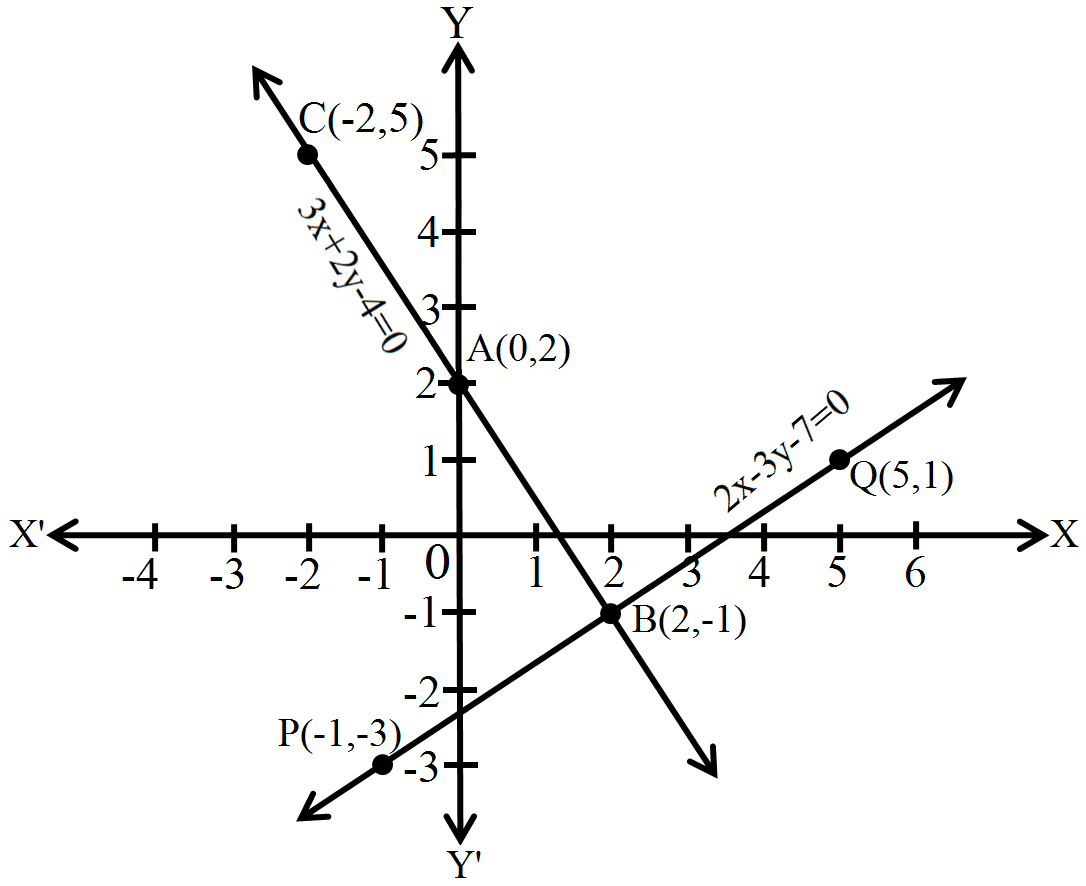
Solve the following system of equations graphically:
3x + 2y = 4,
2x - 3y = 7
Answer
On a graph paper, draw a horizontal line X'OX and a vertical line YOY' representing the x-axis and y-axis, respectively. Graph of 3x + 2y = 4: 3x + 2y = 4 $\Rightarrow\text{y}=\frac{4-\text{3x}}{2}$ Thus we have the following table for 3x + 2y = 4
x:
0
2
-2
y:
2
-1
5
Plot the points A(0, 2), B(2, -1) and C(-2, 5) on the graph paper. Join AB and AC to get the graph line BC. Extend it on both ways. Thus, the line BC is the graph of 3x + 2y = 4. Graph of 2x - 3y = 7: $\Rightarrow\text{y}=\frac{\text{2x}-7}{3}$ Thus, we have the following table for 2x - 3y = 7 is
x:
2
-1
5
y:
-1
-3
1
Now, on the same graph paper plot the points P(-1, -3) and Q(5, 1). The point B(2, -1) has already been plotted. Join PB and QB and extend it on both ways. Thus, line PQ is the graph of 2x - 3y = 7.
The two graph lines intersect at B(2, -1). $\therefore$ x = 2, y = -1 is the solution of the given system of equations.
View full question & answer
Question 455 Marks
A chemist has one solution containing 50% acid and a second one containing 25% acid. How much of each should be used to make 10 litres of a 40% acid solution?
Answer
Let x litres of 50% solution be mixed with y litres of 25% solution.
Accroding to the given condition,
50% of x + 25% of y = 40% of 10
$\Rightarrow\frac{50}{100}\text{x}+\frac{25}{100}\text{y}=\frac{40}{100}(10)$
50x + 25y = 40(10)
2x + y = 16 ...(i)
Since the amount of each solutions adds to 10 litres,
x + y = 10 ...(ii)
Subtract (ii) from (i).
x = 6
Substituting x = 6 in (ii), we get
y = 4.
Hence, 6 liters of 50% solution is to be mixed with 4 litres of 25% solution.
View full question & answer
Question 465 Marks
The length of a room exceeds its breadth by 3 metres. If the length in increased by 3 metres and the breadth is decreased by 2 metres, the area remains the same. Find the length and the breadth of the room.
Answer
Let the length = x meters and breadth = y meters Then, x = y + 3 ⇒ x - y = 3 ...(1)Also
(x + 3)(y - 2) = xy
⇒ 3y - 2x = 6 ...(2) Multiplying (1) by 2 and (2) by 1 ⇒ -2y + 2x = 6 ...(3) ⇒ 3y - 2x = 6 ...(4) Adding (3) and (4), we get ⇒ y = 12 Putting y = 12 in (1), we get x - 12 = 3 ⇒ x= 15 $\therefore$ x = 15, y = 12 Hence length = 15 metres and breadth = 12 metres
View full question & answer
Question 475 Marks
The area of a rectangle gets reduced by $8m^2$, when its length is reduced by 5m and its breadth is increased by $3m$. If we increase the length by 3m and breadth by 2m, the area is increased by $74m^2​​​​​​​$​​​​​​​. Find the length and the breadth of the rectangle.
Answer
Let the length of a rectangle be x meters and breadth be y meters.
Then, area = xy sq.m
Now,
$xy - (x - 5)(y + 3) = 8$
$\Rightarrow xy - [xy - 5y + 3x - 15] = 8$
$\Rightarrow xy - xy + 5y - 3x + 15 = 8$
$\Rightarrow 3x - 5y = 7 ...(1)$
And
$(x + 3)(y + 2) - xy = 74$
$\Rightarrow xy + 3y +2x + 6 - xy = 74$
$\Rightarrow 2x + 3y = 68 ...(2)$
Multiplying (1) by 3 and (2) by 5, we get
$9x - 15y = 21 ...(3)$
$10x + 15y = 340 ...(4)$
Adding (3) and (4), we get
$\text{19x}=361$
$\Rightarrow\text{x}=\frac{361}{19}=19$
Putting $x = 19$ in (3), we get
$9 \times 19 - 15y = 21$
$\Rightarrow 171 - 15y = 21$
$\Rightarrow\text{y}=\frac{150}{15}=10$
$\therefore$ $x = 19$ meters, $y = 10$ meters
Hence, length = 19m and breadth $= 10m$
View full question & answer
Question 485 Marks
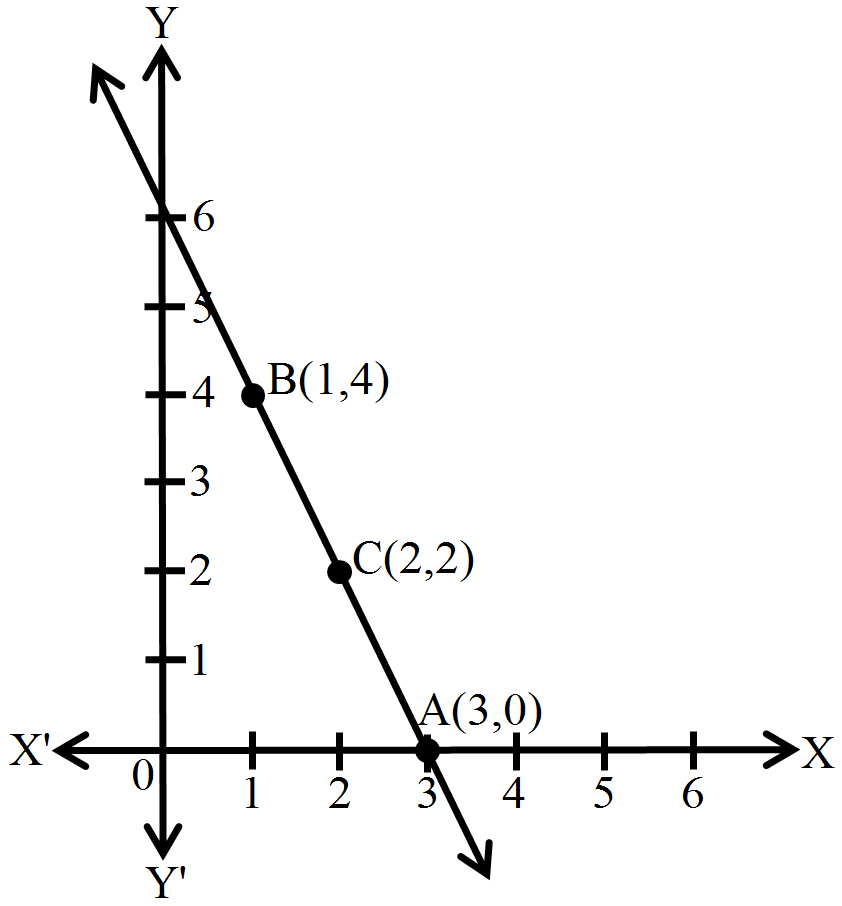
Show graphically that each of the following given systems of equations has infinitely many solutions:
2x + y = 6, 6x + 3y = 18
Answer
On a graph paper, draw a horizontal line X'OX and a vertical line YOY' representing the x-axis and y-axis, respectively. The given system equations is 2x + y = 6, 6x + 3y = 18 Graph of 2x + y = 6: 2x + y = 6 ⇒ y = -2x + 6 ...(1) Thus, we have the following table for equation (1)
x:
3
1
2
y:
0
4
2
On the graph paper plot the points A(3, 0), B(1, 4) and C(2, 2). Join AC and BC to get the graph line AB. Thus, the line AB is the graph of the equation of 2x + y = 6. Graph of 6x - 2y = 10: For graph of 6x + 3y = 18 $\Rightarrow\text{y}=\frac{-\text{6x}+18}{3}\ \dots(2)$ Thus, we have the following table for equation (2)
x:
3
1
2
y:
0
4
2
These points, A(3, 0), B(1, 4) and C(2, 2) are the same as obtained above.
Thus, we find that the two line graphs coincide. Hence the given system of equations has infinitely many solutions.
View full question & answer
Question 495 Marks
Find two numbers such that the sum of thrice the first and the second is 142, and four times the first exceeds the second by 138.
Answer
Let the first and second numbers be x and y resoectively.
According to the question:
3x + y = 142 ...(i)
4x - y = 138 ...(ii)
Adding (i) and (ii), we get
7x = 280
$\Rightarrow\text{x}=\frac{280}{7}=40$
Putting x = 40 in (i), we get
3 × 40 + y = 142
y = 142 - 120
y = 22
Hence, the first second numbers are 40 and 22
View full question & answer
Question 505 Marks
Solve for x and y:
$\frac{\text{x}-\text{y}-8}{2}=\frac{\text{x}+\text{2y}-14}{3}=\frac{\text{3x}+\text{y}-12}{11}$
Hint: a = b = c ⇒ a = b and b = c.
Answer
The given equations are: $\frac{\text{x}-\text{y}-8}{2}=\frac{\text{x}+\text{2y}-14}{3}=\frac{\text{3x}+\text{y}-12}{11}$ Therefore, we have $\frac{\text{x}-\text{y}-8}{2}=\frac{\text{3x}+\text{y}-12}{11}$By cross multiplication, we get
11x + 11y - 88 = 6x + 2y - 24
11x - 6x + 11y - 2y = -24 + 88
5x + 9y = 64 ...(1)
$\frac{\text{x}+\text{2y}-14}{3}=\frac{\text{3x}+\text{y}-12}{11}$
By cross multiplication, we get
11x + 22y - 154 = 9x + 3y - 36
11x - 9x + 22y - 3y = -36 + 154
2x + 19y = 118 ...(2)
By Multiplication (1) by 19 and (2) by 9
95x + 171y = 1216 ...(3)
18x + 171y = 1062 ...(4)
Subtracting (4) from (3), we get
77x = 154
⇒ x = 2
Substituting x = 2 in (1), we get
5 × 2 + 9y = 64
⇒ 9y = 54
⇒ y = 6
$\therefore$ Solution is x = 2 and y = 6
View full question & answer