Question
Solve the following system of equations graphically:
x + 2y + 2 = 0,
3x + 2y - 2 = 0

Answer

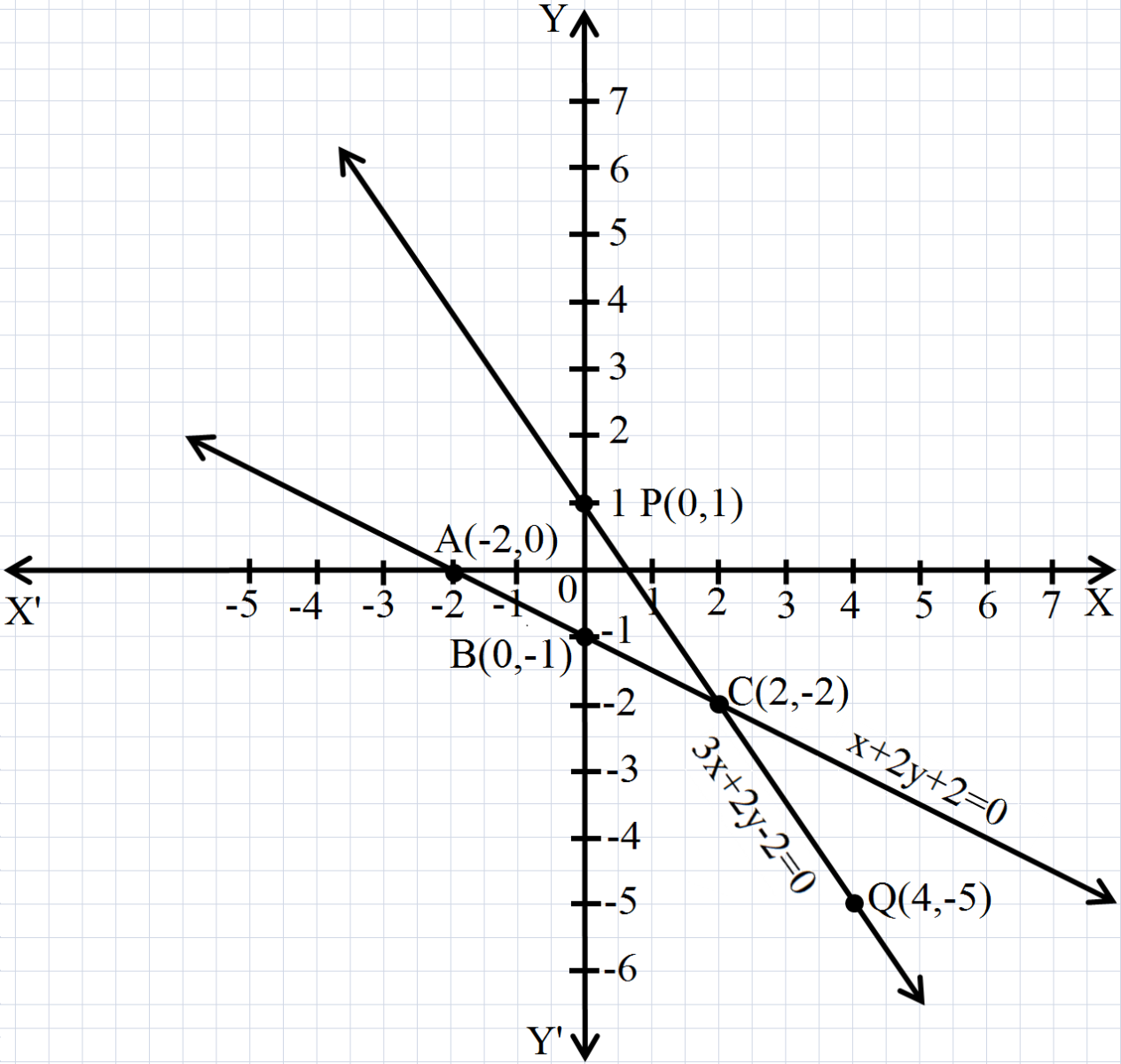
On a graph paper, draw a horizontal line X'OX and a vertical line YOY' representing the x-axis and y-axis, respectively. Given equations are x + 2y + 2 = 0 and 3x + 2y - 2 = 0 Graph of x + 2y + 2 = 0: x + 2y + 2 = 0 $\Rightarrow\text{y}=\frac{-\text{x}-2}{2}\ \dots(1)$ Thus, we have the following table for x + 2y + 2 = 0
x:
-2
0
2
y:
0
-1
-2
On the graph paper plot the points A(-2, 0), B(0, -1) and C(2, -2). Join AB and BC to get the graph line AC. Thus, the line AC is the graph of the equation of x + 2y + 2 = 0. Graph of 3x + 2y - 2 = 0: For graph of 3x + 2y - 2 = 0 $\Rightarrow\text{y}=\frac{-\text{3x}+2}{2}\ \dots(2)$ Thus, we have the following table for 3x + 2y - 2 = 0
x:
0
2
4
y:
1
-2
-5
Now, on the same graph paper plot the points P(0, 1) and Q(4, -5). The third point C(2, -2) has already been plotted. Join PC and QC to get the line PQ. Thus, line PQ is the graph of the equation 3x + 2y - 2 = 0.
The two graph lines intersect at C(2, -2). $\therefore$ x = 2, y = -2 is the solution of the given system of equations.

Need a full question paper?

Generate a complete, print-ready paper with questions like this in minutes — across 16+ boards, with answer keys.
Start Generating Free

Similar questions

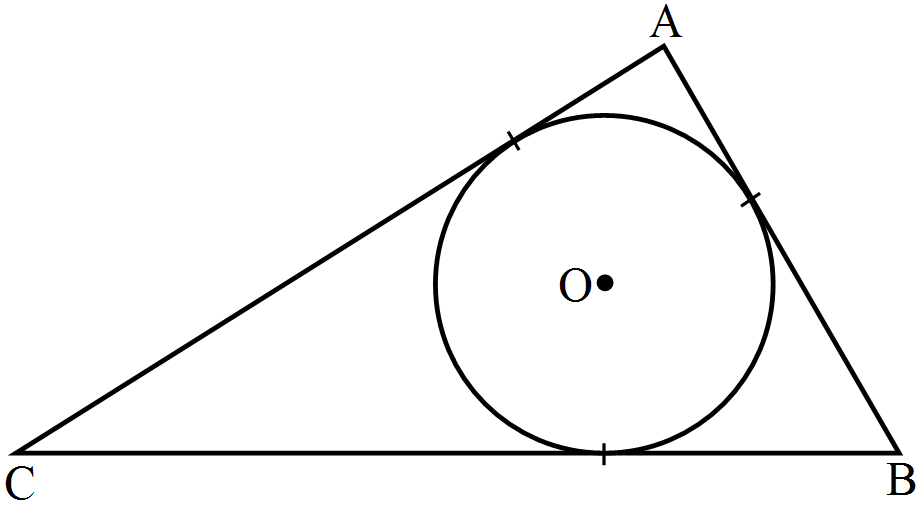
In the given figure, $\triangle\text{ABC}$ is right-angled at A. Find the area of the shaded region if AB = 6cm, BC = 10cm and O is the centre of the incircle of $\triangle\text{ABC}.\ \big[\text{Take }\pi=3.14\big]$
The adjacent sides of a parallelogram are $32\ cm$ and $24\ cm.$ If the distance between the longer sides is $17.4\ cm$, find hte distance between the shorter sides.
The dimensions of a room are $14m \times 10m \times 6.5m.$ There are two doors and $4$ windows in the room. Each door measures $2.5m \times 1.2m$ and each window measures $1.5m \times 1m.$ Find the cost of painting the four walls of the room at $₹\ 35\ per\ m^2.$
Solve the following quadratic equation:
$\frac{\text{a}}{(\text{x}-\text{b})}+\frac{\text{b}}{(\text{x}-\text{a})}=2,$ $\text{x}\neq-\text{b},\ \text{a}$
Prove the following identities:
$\frac{\sec\theta+\tan\theta}{\sec\theta-\tan\theta}=(\sec\theta+\tan\theta)^2$
$=1+2\tan^2\theta+2\sec\theta\tan\theta$
Solve the following quadratic equation:
$\frac{\text{x}+3}{\text{x}-2}-\frac{1-\text{x}}{\text{x}}=4\frac{1}{4},$ $\text{x}\neq2,\ 0$
If $\cos\theta+\sin\theta)=\sqrt{2}\sin\theta,$ show that $\sin\theta-\cos\theta=\sqrt{2}\cos\theta.$
Prove that $\frac{\tan\text{A}}{(1-\cot\text{A})}+\frac{\cot\text{A}}{(1-\tan\text{A})}=(1+\tan\text{A}+\cot\text{A}).$
A contract on constrution job specifies a penalty for delay of completion beyond a certain date as follows: ₹ 200 for the first day, ₹ 250 for the second day, ₹ 300 for the third day, etc, the penalty for each succeeding day being ₹ 50 more than for the preceding day. How much money the contractor has to pay as penalty, if he has delayed the work by 30 days?
Draw a circle of radius 3.5cm. Draw a pair of tangent to this circle which are inclined to each other at an angle of 60°. Write the steps of construction.