Question
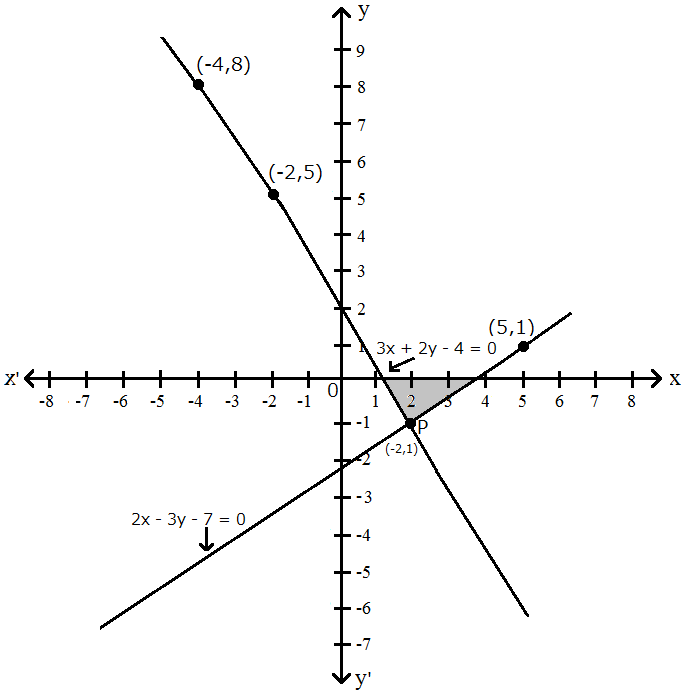
Solve the following system of linear equation graphically and shade the region between the two lines and x-axis:
3x + 2y -4 = 0
2x - 3y -7 = 0.

Answer

The system of given equations is,
3x + 2y -4 = 0
2x - 3y -7 = 0
Now, 3x + 2y -4 = 0
⇒ 3x = 4 - 2y
$\Rightarrow\text{x}=\frac{4-2\text{y}}{3}$
When y = 5, we have,
$\text{x}=\frac{4-2\times5}{3}=-2$
When y = 8, we have,
$\text{x}=\frac{4-2\times8}{3}=-4$
Thus, we have the following table,
x
-2
-4
y
5
8
We have, 2x - 3y -7 = 0
⇒ 2x = 3y + 7
$\Rightarrow\text{x}=\frac{3\text{y}+7}{2}$
When y = 1, we have,
$\text{x}=\frac{3\times1+7}{2}=5$
When y = -1, we have,
$\text{x}=\frac{3\times(-1)+7}{2}=2$
Thus, we have the following table,
x
5
2
y
1
-1
Graph of the given system of equations.

Clearly, the two lines intersect at P(2, -1).
Hence, x = 2, y = -1 is the solution of the given system of equations.

Need a full question paper?

Generate a complete, print-ready paper with questions like this in minutes — across 16+ boards, with answer keys.
Start Generating Free

Similar questions

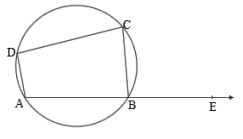
In the figure $\square ​​​​ABCD$ is a cyclic quadrilateral. If $m($arc $ABC) = 230^\circ.$ then find $\angle ABC ,\angle CDA ,\angle CBE$
Image
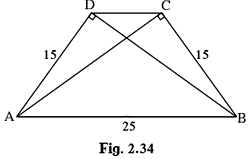
In a trapezium $A B C D$, seg $A B \| \operatorname{seg} D C$ seg $B D \perp \operatorname{seg} A D$, seg $A C \perp \operatorname{seg} B C$, If $A D=15, B C=15$ and $A B=25$. Find $A (\square ABCD )$
The numerator of a fraction is 3 less than the denominator. If 2 is added to both the numerator and the denominator, then the sum of the new fraction and the original fraction is $\frac{29}{20}.$ Find the original fraction.
Find the missing frequencies in the following frequency distribution if it is known that the mean of the distribution is $50$.
x $10$ $30$ $50$ $70$ $90$  
f $17$ $f_1$ $32$ $f_2$ $19$ Total $120$
Solve the following system of equations by the method of cross-multiplication:
$(a + 2b)x + (2a − b)y = 2,$
$(a - 2b)x + (2a + b)y = 3.$
From a cubical piece of wood of side $21\ cm,$ a hemisphere is carved out in such a way that the diameter of the hemisphere is equal to the side of the cubical piece. Find the surface area and volume of the remaining piece.
If $P(9a - 2, -b)$ divides the line segment joining $A(3a + 1, -3)$ and $B(8a, 5)$ in the ratio $3 : 1$, find the values of a and b.
For the following statments state whether true (T) or false(F):
The length of the line segment joining the midpoint of any two sides of a triangle is equal to half the length of the third side.
The length of an arc of a circle, subteding an angle of 54° at the centre is 16.5cm. Calculate the radius, circumference and area of the circle. $\Big[\text{Use }\pi=\frac{22}{7}\Big]$
Solve the following systems of equations:
$\frac{1}{5\text{x}}+\frac{1}{6\text{y}}=12,$
$\frac{1}{3\text{x}}-\frac{3}{7\text{y}}=8,\text{x}\neq0,\text{y}\neq0.$