Question
Solve the following systems of equations by using the method of cross multiplication:
$\frac{5}{(\text{x}+\text{y})}-\frac{2}{(\text{x}-\text{y})}+1=0,$
$\frac{15}{(\text{x}+\text{y})}+\frac{7}{(\text{x}-\text{y})}-10=0$ $(\text{x}\neq\text{y},\ \text{x}\neq-\text{y}).$
Answer

Taking $\frac{1}{\text{x}+\text{y}}=\text{u}$ and $\frac{1}{\text{x}-\text{y}}=\text{v},$ the given equations become:
$5u - 2v + 1 = 0 ...(i) 15u + 7v - 10 = 0 ...(ii)$
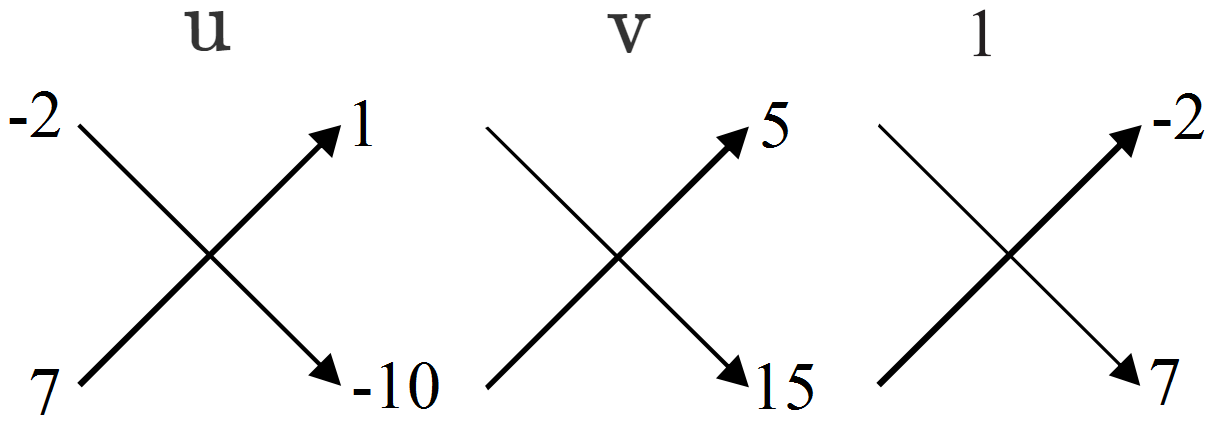
Here, $a_1 = 5, b_1 = -2, c_1 = 1, a_2 = 15, b_2 = -7$ and $c_2 = -10$ By cross multiplication, we have:


$\therefore\frac{\text{u}}{[-2\times(-10)-1\times7]}=\frac{\text{v}}{[1\times15-(-10)\times5]}=\frac{1}{[35+30]}$
$\Rightarrow\frac{\text{u}}{20-7}=\frac{\text{v}}{15+50}=\frac{1}{65}$
$\Rightarrow\frac{\text{u}}{13}=\frac{\text{v}}{65}=\frac{1}{65}$
$\Rightarrow\text{u}=\frac{13}{65}=\frac{1}{5},\ \text{v}=\frac{65}{65}=1$
$\Rightarrow\frac{1}{\text{x}+\text{y}}=\frac{1}{5},\ \frac{1}{\text{x}-\text{y}}=1$
So, $(x + y) = 5 ...(iii)$ and $(x - y) = 1 ...(iv)$
Again, the above equations (iii) and (iv) may be written as: $x + y - 5 = 0 ...(v) x - y - 1 = 0 ...(vi)$
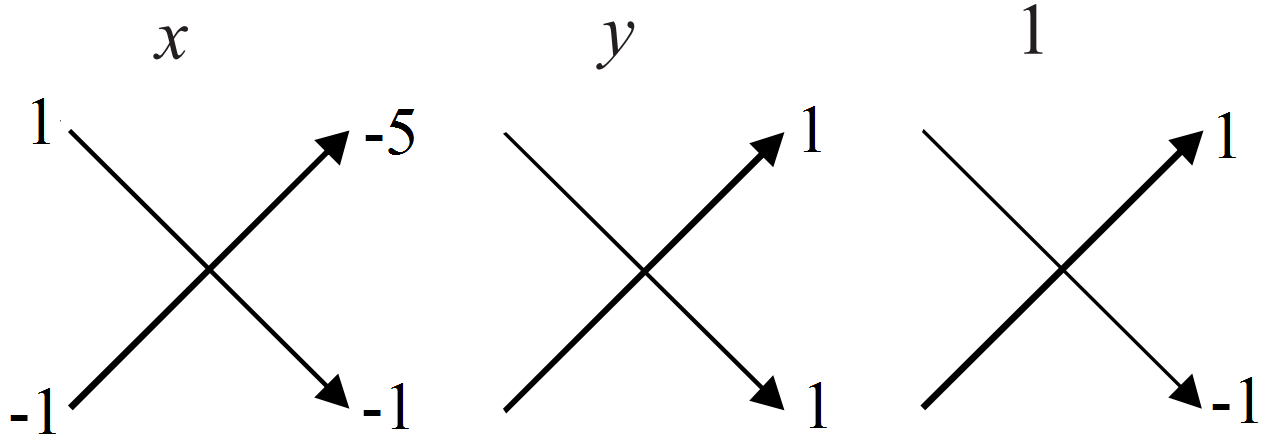
Here, $a_1 = 1, b_1 = 1, c_1 = -5, a_2 = 1, b_2 = -1$ and $c_2 = -1$ By cross multiplication, we have:

$\therefore\frac{\text{x}}{[1\times(-1)-(-5)\times(-1)]}=\frac{\text{y}}{(-5)\times1-(-1)\times1}=\frac{1}{[1\times(-1)-1\times1]}$
$\Rightarrow\frac{\text{x}}{(-1-5)}=\frac{\text{y}}{(-5+1)}=\frac{1}{(-1-1)}$
$\Rightarrow\frac{\text{x}}{-6}=\frac{\text{y}}{-4}=\frac{1}{-2}$
$\Rightarrow\text{u}=\frac{-6}{-2}=3,\ \text{y}=\frac{-4}{-2}=2$
Hence, $x = 3$ and $y = 2$ is the required solution.

Need a full question paper?

Generate a complete, print-ready paper with questions like this in minutes — across 16+ boards, with answer keys.

Start Generating Free

Similar questions

Solve for x and y:
$\frac{2}{(3\text{x}+\text{2y)}}+\frac{3}{(3\text{x}-\text{2y)}}=\frac{17}{5},$
$\frac{5}{(3\text{x}+\text{2y)}}+\frac{1}{(3\text{x}-\text{2y)}}=2$
In the given figure, from a rectangular region $ABCD$ with $AB = 20cm$, a right triangle $AED$ with $AE = 9cm$ and $DE = 12cm$, is cut off. On the other end, taking $BC$ as diameter, a semicircle is added on outside the region. Find the area of the shaded region. $\big[\text{Use }\pi=3.14\big]$
Draw the graphs of the following equations on the same graph paper:
2x + y = 2, 2x + y = 6
Find the coordinates of the vertices of the trapezium formed by these lines. Also, find the area of the trapezium so formed.
Hint: The line 2x + y = 2 cuts the x-axis at A(1, 0) and the y-axis at B(0, 2).
The line 2x + y = 6 cuts the x-axis at C(3, 0) and the y-axis at D(0, 6).
Area of trap. ABCD $=\text{ar}(\triangle\text{OCD})-\text{ar}(\triangle\text{OAB})$
$=\Big(\frac{1}{2}\times3\times6\Big)-\Big(\frac{1}{2}\times1\times2\Big)$
$=8\ \text{sq. units}$
Solve the following system of equations graphically:
2x - 5y + 4 = 0,
2x + y - 8 = 0
Prove that $\sqrt3$ is an irrational number.
Construct an isosceles triangle whose base is 8cm and altitude 4cm and then another triangle whose sides are $1\frac12\text{times}$ the corresponding sides of the isosceles triangle.
If twice the son's age in years is added to the father's age, the sum is 70 years. But, if twice the father's age is added to the son's age, the sum is 95 years. Find the age of the father and son.
Find the median wages for the following frequencies distribution:
Wages per day (in Rs).
61-70
71-80
81-90
91-100
101-110
111-120
No. of women workers.
5
15
20
30
20
8
The present age of a woman is 3 years more than three times the ages of her daughter. Three years hence, the woman's age will be 10 years more than twice the age of her daughter. Find their present ages.
Solve the following quadratic equation: $a^2b^2x^2 + b^2x - a^2x - 1= 0$