Question
Solve the previous problem if the coefficient of restitution is e. Use $\theta=45^\circ,\ \text{e}=\frac{3}{4}$ and h = 5m

Answer

$\text{h}=5\text{m},\ \theta=45^\circ,\ \text{e}=\Big(\frac{3}4{}\Big)$Here the velocity with which it would strike $=\text{v}=\sqrt{\text{2g}\times5}=10\text{m/sec}$
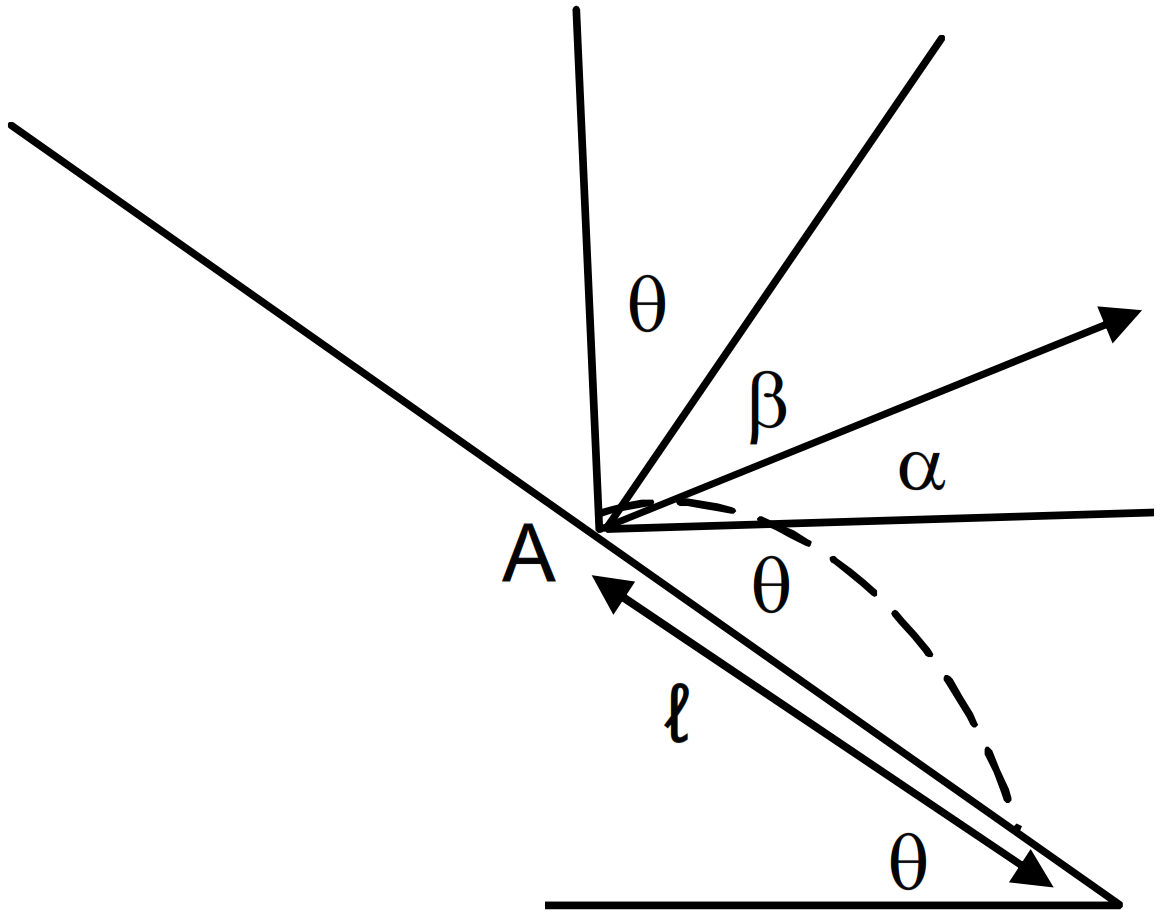
After collision, let it make an angle $\beta$ with horizontal. The horizontal component of velocity $10\cos45^\circ$ will remain unchanged and the velocity in the perpendicular direction to the plane after wllisine.

$\Rightarrow\text{V}_{\text{y}}=\text{e}\times10\sin45^\circ$
$=\Big(\frac{3}{4}\Big)\times10\times\frac{1}{\sqrt2}=(3.75)\sqrt2\text{m/sec}$
$\Rightarrow\text{V}_{\text{x}}=10\cos45^\circ=5\sqrt2\text{m/sec}$
So, $\text{u}=\sqrt{\text{V}_{\text{x}}^2+\text{V}_{\text{y}}^2}$
$=\sqrt{50+28.125}=\sqrt{78.125}=8.83\text{m/sec}$
Angle of reflection from the wall $\beta=\tan^{-1}\Big(\frac{3.75\sqrt2}{5\sqrt2}\Big)=\tan^{-1}\Big(\frac{3}{4}\Big)=37^\circ$
⇒ Angle of projection $\alpha=90-(\theta+\beta)=90-(45^\circ+37^\circ)=8^\circ$
Let the distance where it falls = L
$\Rightarrow\text{x}=\text{L}\cos\theta,\ \text{y}=-\text{L}\sin\theta$
Angle of projection $(\alpha)=-8^\circ$
Using equation of trajectory, $\text{y}=\text{x}\tan\alpha-\frac{\text{gx}^2\sec^2\alpha}{2\text{u}^2}$
$\Rightarrow-\ell\sin\theta=\ell\cos\theta-\tan8^\circ-\frac{\text{g}}{2}\times\frac{\ell\cos^2\theta\sec^28^\circ}{\text{u}^2}$
$\Rightarrow-\sin45^\circ=\cos45^\circ-\tan8^\circ-\frac{10\cos^245^\circ\sec8^\circ}{(8.83)^2}(\ell)$
Solving the above equation we get,
$\ell=18.5\text{m}$

Need a full question paper?

Generate a complete, print-ready paper with questions like this in minutes — across 16+ boards, with answer keys.
Start Generating Free

Similar questions

Consider an electron in front of metallic surface at a distance $d \ ($treated as an infinite plane surface$)$. Assume the force of attraction by the plate is given as $\frac{1}{2}\frac{\text{q}^2}{4\pi\epsilon_0\text{d}^2}$
Calculate work in taking the charge to an infinite distance from the plate. Taking $d = 0.1\ nm,$ find the work done in electron volts. $[$Such a force law is not valid for $d < 0.1nm]$.
If the tension in the cable supporting an elevator is equal to the weight of the elevator, the elevator may be:
  1. Going up with increasing speed.
  2. Going down with increasing speed.
  3. Going up with uniform speed.
  4. Going down with uniform speed.
How would you set up a circuit to obtain $\text{NOT}$ gate using a transistor?
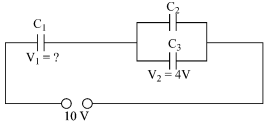
Define capacitor. Obtain the relation of equivalence in series combination of capacitors by making a circuit diagram. Write the value of voltage $V_1$ in the given circuit.
Image
$i. A$ coin is placed inside a denser medium. Why does it appear to be raised? Obtain an expression for the height through which the object appears to be raised in terms of refractive index of the medium and real depth.
$ii. A$ compound microscope consists of an objective lens of focal length $2 \ cm$ and an eyepiece of focal length $6.25 \ cm$ separated by a distance of $15 \ cm.$ How far from the objective should an object be placed in order to obtain the final image at the least distance of distinct vision $(25 \ cm)$ ? Calculate the magnifying power of the microscope.
Four long, straight wires, each carrying a current of $5.0A,$ are placed in a plane as shown in figure. The points of intersection form a square of side $5.0\ cm.$
  1. Find the magnetic field at the centre $P$ of the square.
  2. $Q_1, Q_2, Q_3,$ and $Q_4$ are points situated on the diagonals of the liquare and at a distance from $P$ that is equal to the length of the diagonal of the square. Find the magnetic fields at these points.
Estimating the following two numbers should be interesting. The first number will tell you why radio engineers do not need to worry much about photons! The second number tells you why our eye can never ‘count photons’, even in barely detectable light.
  1. The number of photons emitted per second by a Medium wave transmitter of $10 kW$ power, emitting radiowaves of wavelength $500 m.$
  2. The number of photons entering the pupil of our eye per second corresponding to the minimum intensity of white light that we humans can perceive $(\sim 10^{–10} W m^{–2}).$ Take the area of the pupil to be about $0.4 \ cm^2,$ and the average frequency of white light to be about $6 \times 10^{14} Hz.$
It is found that yellow light does not eject photoelectrons from a metal. Is it advisable to try with orange light? With green light?
A solid aluminium sphere and a solid copper sphere of twice the radius are heated to the same temperature and are allowed to cool under identical surrounding temperatures. Assume that the emissivity of both the spheres is the same. Find the ratio of:
  1. The rate of heat loss from the aluminium sphere to the rate of heat loss from the copper sphere.
  2. The rate of fall of temperature of the aluminium sphere to the rate of fall of temperature of the copper sphere. The specific heat capacity of aluminium $= 900Jkg^{-1^\circ }C^{-1}$ and that of copper $= 390Jkg^{-1^\circ }C^{-1}$. The density of copper $= 3.4$ times the density of aluminium.
A horizontal cesium plate ($\phi$ = l.9 eV) is moved vertically downward at a constant speed u in a room full of radiation of wavelength 250 run and above. What should be the minimum value of u so that the vertically upward component of velocity is nonpositive for each photoelectron?