Question
A solid aluminium sphere and a solid copper sphere of twice the radius are heated to the same temperature and are allowed to cool under identical surrounding temperatures. Assume that the emissivity of both the spheres is the same. Find the ratio of:
  1. The rate of heat loss from the aluminium sphere to the rate of heat loss from the copper sphere.
  2. The rate of fall of temperature of the aluminium sphere to the rate of fall of temperature of the copper sphere. The specific heat capacity of aluminium $= 900Jkg^{-1^\circ }C^{-1}$ and that of copper $= 390Jkg^{-1^\circ }C^{-1}$. The density of copper $= 3.4$ times the density of aluminium.
Answer

$E \rightarrow $ Energy radiated per unit area per unit time Rate of heat flow $\rightarrow $ Energy radiated
  1. Per time $=\text{E}\times\text{A}$
So, $\text{E}_\text{Al}=\frac{\text{e}\sigma\text{T}^4\times\text{A}}{\text{e}\sigma\text{T}^4\times\text{A}}$
$=\frac{4\pi\text{r}^2}{4\pi(2\text{r})^2}$
$=\frac{1}{4}$ $\big[\therefore1:4\big]$
  1. Emissivity of both are same
$=\frac{\text{m}_1\text{S}_1\text{dT}_1}{\text{m}_2\text{S}_2\text{dT}_2}=1$
$\Rightarrow\frac{\text{dT}_1}{\text{dT}_2}=\frac{\text{m}_2\text{S}_2}{\text{m}_1\text{S}_1}$
$=\frac{\text{s}_14\pi\text{r}_1^3\times\text{S}_2}{\text{s}_24\pi\text{r}_2^3\times\text{S}_1}$
$=\frac{1\times\pi\times900}{3.4\times8\pi\times390}$
$=1:2:9$

Need a full question paper?

Generate a complete, print-ready paper with questions like this in minutes — across 16+ boards, with answer keys.

Start Generating Free

Similar questions

Define diamagnetic, paramagnetic and ferromagnetic substance with examples. Explaining the meaning of domain explain ferromagnetism.
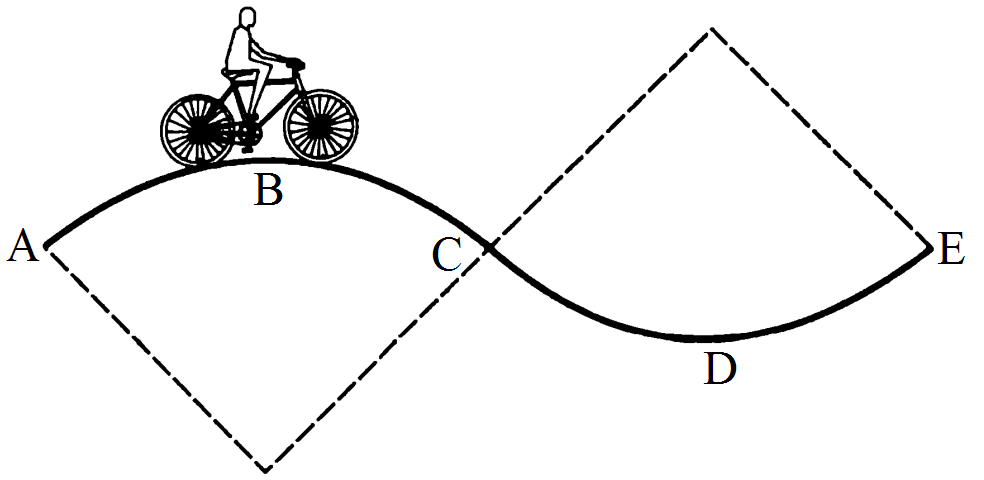
A track consists of two circular parts $\text{ABC}$ and $\text{CDE}$ of equal radius $100m$ and joined smoothly as shown in figure. Each part subtends a right angle at its centre. A cycle weighing $100 \ kg$ together with the rider travels at a constant speed of $18\ km/h$ on the track.
  1. Find the normal contact force by the road on the cycle when it is at $B$ and at $D.$
  2. Find the force of friction exerted by the track on the tyres when the cycle is at $B, C$ and $D.$
  3. Find the normal force between the road and the cycle just before and just after the cycle crosses $C.$
  4. What should be the minimum friction coefficient between the road and the tyre, which will ensure that the cyclist can move with constant speed? Take $g= 10m/s^2.$
A capacitor having a capacitance of $100\mu\text{F}$ is charged to a potential difference of $50V$.
  1. What is the magnitude of the charge on each plate?
  2. The charging battery is disconnected and a dielectric of dielectric constant $2.5$ is inserted. Calculate the new potential difference between the plates.
  3. What charge would have produced this potential difference in absence of the dielectric slab.
  4. Find the charge induced at a surface of the dielectric slab.
A charge Q is placed at the centre of an uncharged, hollow metallic sphere of radius a:
  1. Find the surface charge density on the inner surface and on the outer surface.
  2. If a charge q is put on the sphere, what would be the surface charge densities on the inner and the outer surfaces?
  3. Find the electric field inside the sphere at a distance x from the centre in the situations (a) and (b).
Suppose the entire system of the previous question is kept inside an elevator which is coming down with an acceleration $a < g.$ Repeat parts $(a)$ and $(b).$
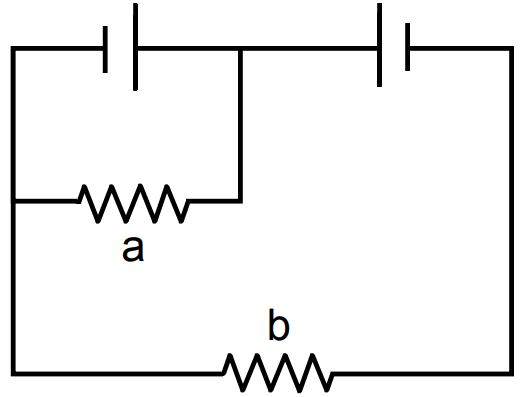
Each of the resistors shown in figure. has a resistance of $10\Omega$ and each of the batteries has an emf of 10V. Find the currents through the resistors a and b in the two circuits.

A parallel plate capacitor is to be designed with a voltage rating $1kV,$ using a material of dielectric constant $3$ and dielectric strength about $10^7Vm^{–1}.\  ($Dielectric strength is the maximum electric field a material can tolerate without breakdown, i.e., without starting to conduct electricity through partial ionisation.$)$ For safety, we should like the field never to exceed, say $10\%$ of the dielectric strength. What minimum area of the plates is required to have a capacitance of $50pF$ ?
Find the speed of an electron with kinetic energy:
  1.  1eV
  2. 10keV
  3. 10MeV
A rod, when suspended in a magnetic field, stays in the east-west direction. Can we be sure that the field is in the east-west direction? Can it be in the north-south direction?
Figure. shows a cylindrical tube of radius 5cm and length 20cm. It is closed by a tight-fitting cork. The friction coefficient between the cork and the tube is 0.20. The tube contains an ideal gas at a pressure of 1 atm and a temperature of 300K. The tube is slowly heated and it is found that the cork pops out when the temperature reaches 600K Let dN denote the magnitude of the normal contact force exerted by a small length dl of the cork along the periphery (see the figure). Assuming that the temperature of the gas is uniform at any instant, calculate $\frac{\text{dN}}{\text{dl}}.$