Question
A proton and an $\alpha -$particle are accelerated, using the same potential difference. How are the de$-$Broglie wavelengths $\lambda _p$ and $\lambda _a$ related to each other?

Answer

Key concept:
Hence de$-$Broglie wavelength : $\lambda=\frac{\text{h}}{\text{p}}=\frac{\text{h}}{\sqrt{2\text{mE}}}=\frac{\text{h}}{\sqrt{2\text{mqV}}}$
In this problrm since both proton and $\alpha-$ particle are accelerated through same potential difference,
We know that, $\lambda=\frac{\text{h}}{\sqrt{2\text{mqv}}}$
$\therefore\ \lambda\propto\frac{1}{\sqrt{\text{mq}}}$
$\frac{\lambda_\text{p}}{\lambda_\alpha}=\frac{\sqrt{\text{m}_\alpha\text{q}_\alpha}}{\text{m}_\text{p}\text{q}_\text{p}}$
$=\frac{\sqrt{4\text{m}_\text{p}\times2\text{e}}}{\sqrt{\text{m}_\text{p}\times\text{e}}}$
​​​​​​​$=\sqrt{8}$
$\therefore\ \lambda_\text{p}=\sqrt{8}\lambda_\alpha$
i.e., wavelength of proton is times wavelength of $\alpha-$particle.
Important point:
De$-$Broglie wavelength associated with the charged particles:
The energy of a charged particle acceletated through potential difference $V$ is $\text{E}=\frac{1}{2}\text{mv}^2=\text{qV}$
Hence de$-$Broglie wavelength $\lambda=\frac{\text{h}}{\text{p}}=\frac{\text{h}}{\sqrt{2\text{mE}}}=\frac{\text{h}}{\sqrt{2\text{mqV}}}$
$\lambda_\text{Electron}=\frac{12.27}{\sqrt{\text{V}}}\mathring{\text{A}},\lambda_\text{Proton}=\frac{0.286}{\sqrt{\text{V}}}\mathring{\text{A}}$
$\lambda_\text{Deutron}=\frac{0.200}{\sqrt{\text{V}}}\mathring{\text{A}},\lambda_{\alpha-\text{particle}}=\frac{0.101}{\sqrt{\text{V}}}\mathring{\text{A}}$

Need a full question paper?

Generate a complete, print-ready paper with questions like this in minutes — across 16+ boards, with answer keys.
Start Generating Free

Similar questions

A solenoid of length $20\ cm$, area of cross-section $4.0\ cm^2$ and having $4000$ turns is placed inside another solenoid of $2000$ turns having a cross$-$sectional area $8.0\ cm^2$ and length $10\ cm$. Find the mutual inductance between the solenoids.
Two charges $2.0 \times 10^{-6}C$ and $1.0 \times 10^{-6}C$ are placed at a separation of $10\ cm$. Where should a third charge be placed such that it experiences no net force due to these charges?
A $600pF$ capacitor is charged by a $200V$ supply. It is then disconnected from the supply and is connected to another uncharged $600 pF$ capacitor. How much electrostatic energy is lost in the process?
One mole of an ideal gas undergoes a process $\text{p}=\frac{\text{p}_0}{1+\Big(\frac{\text{V}}{\text{V}_0}\Big)^2}$ where $P_0$ and $V_0$ are constants. Find the temperature of the gas when $V = V_0$.
Define the terms (i) capacitance of a capacitor (ii) dielectric strength of a dielectric. When a dielectric is inserted between the plates of a charged parallel plate capacitor, fully occupying the intervening region, how does the polarization of the dielectric medium affect the net electric field? For linear dielectrics, show that the introduction of a dielectric increases its capacitance by a factor $\kappa$, characteristic of the dielectric.
The half-life of $^{199}Au$ is $2.7$ days.
  1. Find the activity of a sample containing $1.00\mu\text{g}$ of $^{198}Au.$
  2. What will be the activity after $7$ days? Take the atomic weight of $^{198}Au$ to be $198\ g/mol.$
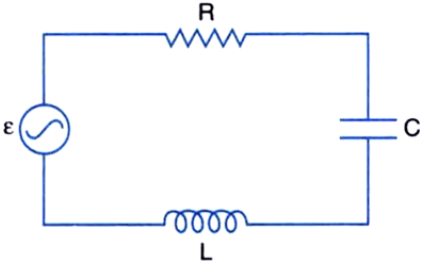
Figure shows a series $\text{LCR}$ circuit connected to a variable frequency $230V$ source. $L = 5.0H, C = 80\ \mu F, R = 40\Omega .$
  1. Determine the source frequency which drives the circuit in resonance
  2. Obtain the impedance of the circuit and the amplitude of current at the resonating frequency.
  3. Determine the rms potential drops across the three elements of the circuit. Show that the potential drop across the $\text{LC}$ combination is zero at the resonating frequency.
What is the difference between cathode rays and beta rays? When the two are travelling in space, can you make out which is the cathode ray and which is the beta ray?
State Gauss theorem in electrostatics. Apply this theorem to obtain the expression for the electric field at a point due to an infinitely long, thin, uniformly charged straight wire of linear charge density $\lambda\text{Cm}^{-1}.$
The door of an almirah is $6\ ft$ high, $1.5\ ft$ wide and weighs $8\ kg.$ The door is supported by two hinges situated at a distance of $1\ ft$ from the ends. If the magnitudes of the forces exerted by the hinges on the door are equal, find this magnitude.