Question
Solve :
$(x^2 - 3x)^2 - 16(x^2 - 3x) - 36 =0$

Answer

$(x^2 - 3x)^2 - 16(x^2 - 3x) - 36 =0$ Let $x^2 - 3x = y$
then $y^2 - 16y - 36 = 0$
$\Rightarrow y^2 - 18y + 2y - 36 = 0$
$\Rightarrow y(y - 18) + 2(y - 18) = 0$
$\Rightarrow ( y - 18) (y + 2) = 0$
If $y -18=0$ or $y +2=0$
$\Rightarrow x^2 - 3x - 18 = 0$ or $x^2 - 3x + 2 = 0$
$\Rightarrow x^2 - 6x + 3x - 18 = 0 or x^2 -2x x + 2 = 0$
$\Rightarrow x( x -6) + 3(x - 6) = 0 or x( x -2) -1 (x -2) = 0$
$\Rightarrow (x -6) ( x + 3) = 0 or (x -2)(x -1) = 0$
If $x-6=0$ or $x+3=0$ or $x-2=0$ or $x-1=0$
then $x=6$ or $x=-3$ or $x=2$ or $x=1$

Need a full question paper?

Generate a complete, print-ready paper with questions like this in minutes — across 16+ boards, with answer keys.
Start Generating Free

Similar questions

Vandana has a recurring time deposit account of ₹ $340$ per month at $6 \%$ p.a. If she gets ₹ $ 7157$ at the time of maturity, find the total time for which the account was held.
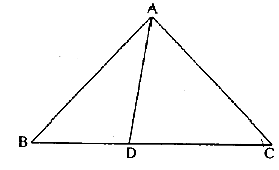
In $\triangle ABC, \angle ABC = \angle DAC. AB = 8 \ cm, AC = 4 \ cm, AD = 5 \ cm.$
$(1)$ Prove that $\triangle ACD$ is similar to $\triangle BCA$.
$(2)$ Find $BC$ and $CD$
$(3)$ Find area of $\triangle ACD$: area of $\triangle BCA$
​​​​​​​
QUESTION $A B$ and $C D$ are two chords of a circle such that $A B=6 cm, C D=12 cm$ and $A B \| C D$. If the distance between $A B$ and $C D$ is 3 cm , find the radius of the circle.
If Δ PQR is isosceles with PQ = PR and a circle with centre O and radius r is the incircle of the Δ PQR touching QR at T, prove that the point T bisects QR.
Draw a histogram for the following distribution and estimate the mode: 
I.Q. Score 80-100 100-120 120-140 140-160 160-180 180-200
No. of Students 6 9 16 13 4 2
$\text{ABCD}$ is a cyclic quadrilateral. Sides $AB $ and $DC$ produced meet at point $E$ ; whereas sides $BC$ and $AD$ produced meet at point $F$. If $\angle DCF : \angle F : \angle E = 3 : 5 : 4,$ Find the angles of the cyclic quadrilateral $\text{ABCD}.$
By using step-deviation method, compute the arithmetic mean for the following data:
Marks obtainedLess than 10Less than 20Less than 30Less than 40Less than 50Less than 60
Number of students142237586775
Prove the following identitie:$\frac{1-\cos A}{\sin A}+\frac{\sin A}{1-\cos A}=2 \operatorname{cosec} A$
Show that $A(3, 2), B (6, −2)$ and $C (2, −5)$ can be the vertices of a square.
$(i)$ Find the co-ordinates of its fourth vertex $D, $ if $\text{ABCD}$ is a square
$(ii)$ Without using the co$-$ordinates of vertex $D,$ find the equation of side $AD$ of the square and
also the equation of diagonal $BD.$
Bisectors of vertex angles $A, B$, and $C$ of a triangle $A B C$ intersect its circumcircle at the points $D, E$ and $F$ respectively. Prove that angle EDF $=90^{\circ}-\frac{1}{2} \angle A$