MCQ
Speed of electromagnetic waves is the same:
  • A
    For all wavelengths.
  • B
    In all media.
  • For all intensities.
  • D
    For all frequencies.

Answer

Correct option: C.
For all intensities.

For any given medium, the speed $(c)$ of an electromagnetic wave is given by,
$\text{C}=\text{v}\lambda$
Where,
$V =$ Frequency of the electromagnetic wave.
$\lambda=$ wavelength of the electromagnetic wave.
As the frequency and wavelength are changed, the speed of the electromagnetic wave changes. So, the speed of an electromagnetic wave is not same for all wavelengths and all frequencies in any medium. The velocity of an electromagnetic wave changes with change in medium. Also, the speed of an electromagnetic wave is same for all the intensities in any medium.

Need a full question paper?

Generate a complete, print-ready paper with questions like this in minutes — across 16+ boards, with answer keys.
Start Generating Free

Similar questions

Gauss’s law should be invalid if
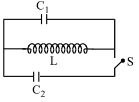
At a moment $(t = 0)$ when charge on capacitor $C_1$ is zero, the switch is closed. If $I_0$ be the current through inductor at that instant, for $t > 0,$
Light considering of wavelengths $6000\,\mathop A\limits^o $ and $5500\,\mathop A\limits^o $ falls on the double slits in $YDSE$ . $n^{th}$ order bright fringe of $\lambda = 6000\,\mathop A\limits^o $  is found to coincide with the $m^{th}$ order bright fringe of $\lambda = 5500\,\mathop A\limits^o $ . Smallest values of $n$ and $m$ are respectively
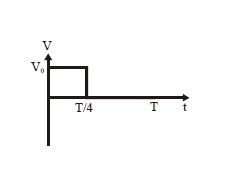
A periodic voltage $V$ varies with time $t$ as shown in the figure. $T$ is the time period. The $r.m.s$. value of the voltage is :-
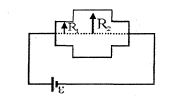
A cylindrical resistance is connected across battery $\varepsilon $ . Cylinder has uniform free electron density, mid part of cylinder has larger radius as shown in figure. Then $V_d$  (drift velocity) $V/S$ (distance across the length of the resistance)
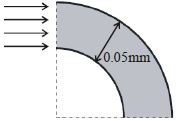
What is the least radius through which an optical fiber of core diameter $0.05\, mm$ may be bent (as shown in figure) without serious loss of light ? The refractive index of the core is $1.6$ and that of cladding is $1.5.$.....$mm$
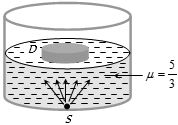
A point source of light $S$ is placed at the bottom of a vessel containing a liquid of refractive index $5/3$. A person is viewing the source from above the surface. There is an opaque disc $D$ of radius $1\, cm$ floating on the surface of the liquid. The centre of the disc lies vertically above the source $S$. The liquid from the vessel is gradually drained out through a tap. The maximum height of the liquid for which the source cannot be seen at all from above is......$cm$
A circular disc of radius $R$ carries surface charge density $\sigma(r)=\sigma_0\left(1-\frac{r}{R}\right)$, where $\sigma_0$ is a constant and $r$ is the distance from the center of the disc. Electric flux through a large spherical surface that encloses the charged disc completely is $\phi_0$. Electric flux through another spherical surface of radius $\frac{R}{4}$ and concentric with the disc is $\phi$. Then the ratio $\frac{\phi_0}{\phi}$ is. . . . . .
Which of the following unit is not free from error?
A double convex lens $({R_1} = {R_2} = 10\,cm)$$(\mu = 1.5)$ having focal length equal to the focal length of a concave mirror. The radius of curvature of the concave mirror is.......$cm$