MCQ
Which of the following unit is not free from error?
  • A
    $\frac{ Wb }{ A }$
  • $\frac{V-s}{A^2}$
  • C
    $\frac{ J }{ A ^2}$
  • D
    $\Omega- s$

Answer

Correct option: B.
$\frac{V-s}{A^2}$
(b)$\frac{V-s}{A^2}$

Need a full question paper?

Generate a complete, print-ready paper with questions like this in minutes — across 16+ boards, with answer keys.
Start Generating Free

Similar questions

An $AC$ circuit has $R =100 \Omega, C =2\, \mu F$ and $L =80\, mH ,$ connected in series. The quality factor of the circuit is$.......$
Two lithium nuclei in a lithium vapour at room temperature do not combine to form a carbon nucleus because:
In case of electrons and photons having the same wavelength. What is same for them?
Three resistors each of $4\,\Omega $ are connected together to form a network. The equivalent resistance of the network cannot be ............ $\Omega$
An amplitude modulated wave is modulated to $50\%$. What is the saving in power if carrier as well as one of the side bands are suppressed........$\%$
Assertion : Bohr had to postulate that the electrons in stationary orbits around the nucleus do not radiate.
Reason : According to classical physics all moving electrons radiate
A particle which has zero rest mass and non-zero energy and momentum must travel with a speed
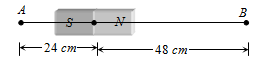
A bar magnet of length 3 cm has points A and B along its axis at distances of 24 cm and 48 cm on the opposite sides. Ratio of magnetic fields at these points will be
A bar magnet is released from rest along the axis of a very long, vertical copper tube. After some time the magnet:
A student studying the similarities and differences between a camera and the human eye makes the following observations:

$I$. Both the eye and the camera have convex lenses.

$II$. In order to focus, the eye lens expands or contracts while the camera lens moves forward or backward.

$III$. The camera lens produces upside down real images while the eye lens produces only upright real images.

$IV$. A screen in camera is equivalent to the retina in the eyes.

$V$. A camera adjusts the amount of light entering in it by adjusting the aperture of the lens. In the eye, the cornea controls the amount of light. Which of the above statements are correct?