MCQ
Spot the wrong statement :The acceleration due to gravity $‘g’$ decreases if
  • A
    We go down from the surface of the earth towards its centre
  • B
    We go up from the surface of the earth
  • We go from the equator towards the poles on the surface of the earth
  • D
    The rotational velocity of the earth is increased
Answer

Correct option: C.
We go from the equator towards the poles on the surface of the earth
c
(c) Value of $g$ decreases when we go from poles to equator.

Need a full question paper?

Generate a complete, print-ready paper with questions like this in minutes — across 16+ boards, with answer keys.

Start Generating Free

Similar questions

When a metal wire is stretched by a load, the fractional change in its volume $\frac{\triangle\text{V}}{\text{V}}$ is proportional to.

  1. $\frac{\triangle\text{l}}{\text{l}}$

  2. $\Big(\frac{\triangle\text{l}}{\text{l}}\Big)^2$

  3. $\sqrt{\frac{\triangle\text{l}}{\text{l}}}$

  4. None of these.

$A$ body kept on a smooth horizontal surface is pulled by a constant horizontal force applied at the top point of the body. If the body rolls purely on the surface, its shape can be : 
A constant power is supplied to a rotating disc. Angular velocity $\left( \omega  \right)$ of disc varies with number of rotations $(n)$ made by the disc as
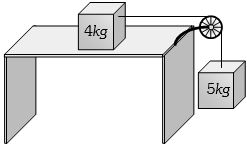
Two masses of $4\, kg$ and $5 \,kg$ are connected by a string passing through a frictionless pulley and are kept on a frictionless table as shown in the figure. The acceleration of $5\, kg$ mass is  ........... $m/s^2$
A flywheel can rotate in order to store kinetic energy. The flywheel is a uniform disk made of a material with a density $\rho $ and tensile strength $\sigma $ (measured in Pascals), a radius $r$ , and a thickness $h$ . The flywheel is rotating at the maximum possible angular velocity so that it does not break. Which of the following expression correctly gives the maximum kinetic energy per kilogram that can be stored in the flywheel ? Assume that $\alpha $ is a dimensionless constant
When the temperature of an ideal gas is increased by $600 K$, the velocity of sound in the gas becomes $\sqrt 3 $ times the initial velocity in it. The initial temperature of the gas is   .... $^oC$
A bar of iron is 10cm at 20°C. At 19°C, it will be:
$(\alpha$ of iron $=11\times10^{-6}\ ^\circ\text{C}-)$
A container is divided into two equal parts $I$ and $II$ by a partition with a small hole of diameter $d$. The two partitions are filled with same ideal gas, but held at temperatures $T_{ I }=150 \,K$ and $T_{ II }=300 \,K$ by connecting to heat reservoirs. Let $\lambda_{1}$ and $\lambda_{1 I}$ be the mean free paths of the gas particles in the two parts, such that $d >> \lambda_{ I }$ and $d >> \lambda_{ II }$. Then, the $\lambda_{ I } / \lambda_{ II }$ is close to
A mass of 5kg is moving along a circular path of radius 1m. If the mass moves with 300 revolutions per minute, its kinetic energy would be:
An observer starts moving with uniform acceleration $'a'$ towards a stationary sound source of frequency $f.$ As the observer approaches the source, the apparent frequency $f'$ heard by the observer varies with time $t$ as: