MCQ
Stars are twinkling due to
  • A
    Diffraction
  • B
    Reflection
  • Refraction
  • D
    Scattering

Answer

Correct option: C.
Refraction
c
( c)Stars twinkle due to variation in $R.I.$ of atmosphere.

Need a full question paper?

Generate a complete, print-ready paper with questions like this in minutes — across 16+ boards, with answer keys.

Start Generating Free

Similar questions

Which of following can not be polarised
The figure showing the correct relationship between the stopping potential $V_0$ and the frequency $v$ of light for potassium and tungsten is
The electrical conductivity of a semiconductor increases when electromagnetic radiation of wavelength shorter than $2480 \;nm$ is incident on it. The band gap in $(eV)$ for the semiconductor is
Radiation of two photon energies twice and five times the work function of metal are incident sucessively on the metal surface. The ratio of the maximum velocity of photoelectrons emitted is the two cases will be
The radiation corresponding to $3 \rightarrow 2$ transition of a hydrogen atom falls on a gold surface to generate photoelectrons. These electrons are passed through a magnetic field of $5 \times 10^{-4} \,{T}$. Assume that the radius of the largest circular path followed by these electrons is $7\, {mm}$, the work function of the metal is $.....\,{eV}$

(Mass of electron $=9.1 \times 10^{-31} \,{kg}$ )
Which of the following is not an application of eddy currents
In a certain charge distribution, all points having zero potential can be joined by a circle S. Points inside S have positive potential and points outside S have negative potential. A positive charge, which is free to move, is placed inside S
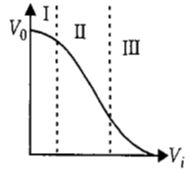
Transfer characteristics $[$ output voltage $(V_o)$ vs input voltage $(V_i)]$ for a base biased transistor in $CE$ configuration is as shown in the figure. For using transistor as a switch, it is used 
A convex lens of focal length $15 \,cm$ is placed in front of a plane mirror at a distance $25 cm$ from the mirror. Where on the optical axis and from the centre of the lens should a small object be placed such that the final image coincides with the object?
A calcite crystal is placed over a dot on a piece of paper and rotated, on seeing through the calcite one will be see