Question
State and explain Maxwell’s right-hand thumb rule.

Answer

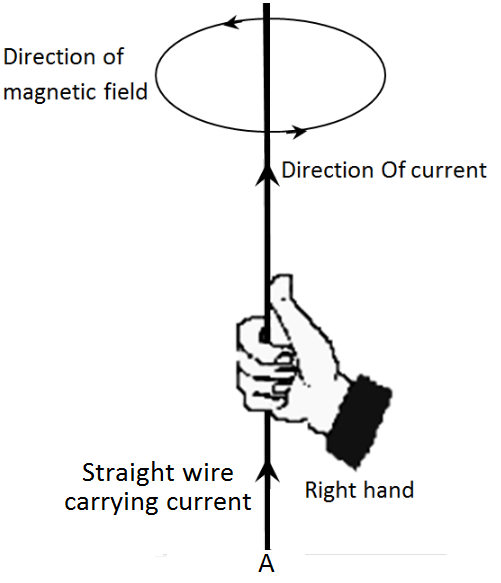
According to Maxwell’s right hand thumb rule: Imagine that you are grasping the currentcarrying wire in your right hand so that your thumb points in the direction of current, then the direction in which your fingers encircle the wire will give the direction of magnetic field lines around the wire.
Let AB be the straight wire carrying current in the vertically upward direction from A to B. To find out the direction of the magnetic field lines produced by this current, we imagine that we are grasping the current carrying wire in our right hand as shown in fig. so that our thumb points in the direction of current towards B. Now, the direction in which our fingers are folded gives the direction of magnetic field lines. In this case, the direction of magnetic field lines is in the anticlockwise direction.

Need a full question paper?

Generate a complete, print-ready paper with questions like this in minutes — across 16+ boards, with answer keys.
Start Generating Free

Similar questions

Explain with diagram step-by-step energy conversion in Power plant based on natural gas.
The masses of the earth and moon are $6 \times 10^{24} kg$ and $7.4 \times 10^{22} kg$, respectively. The distance between them is 3.8 $\times 10^5 km$. Calculate the gravitational force of attraction between the two? Use G $=6.7 \times 10^{-11} N m ^2 kg^{-2}$
Explain: Saving energy is the need of the hour.
Write a note on Salam Mumbai Foundation.
 Explain the Krebs cycle with reaction.
What is the valency of elements with atomic number 8, 14, 17 and 20?
State the rules used for drawing ray diagrams for the formation of an image by a convex lens.
An organism X having breathing organs A lives on land. When organism X goes under water, it cannot survive for a long time unless carrying an oxygen cylinder. On the other hand, the organism Y having breathing organs B always lives in water and if taken out of water, it dies after a short while. A third organism Z having breathing organs C and D which lives on the banks of ponds, lakes and rivers can survive on land as well as in water equally well.
  1. What could organism X be? Name the breathing organs A.
  2. What could organism Y be? Name the breathing organs B.
  3. What could organism Z be? Name the breathing organs C and D.
  4. Out of X, Y and Z, which organism is.
  1. Amphibian,
  2. Aquatic,
  3. Terrestrial?
State five uses of metals and five of non-metals.
An X element with atomic number 11 and Y element with atomic number 13 belongs to the third period in the modern periodic table. With this information, give the answers of the below questions.
  1. Which element has more metallic character from these two elements?
  2. What is the valency of each X and Y elements?
  3. Atom size of Y element is smaller than atom size of X element. Explain.