Question
State and explain Newton’s second law of motion.

Answer

According to Newton's second law of motion: The rate of change of momentum of a body is directly proportional to the applied force, and takes place in the direction in which the force acts.
Consider a body of mass m having initial velocity u. the initial momentum of this body will be mu. Suppose a force F acts on this body for time t causing the final velocity to be v. The final momentum of the body will be mv. Now the change in momentum is mv → mu and the time taken for this change is t. So according to Newton's second law of motion,
$\text{F}\propto\frac{\text{mv}-\text{mu}}{\text{t}}$
$\text{F}\propto\frac{\text{m}(\text{v}-\text{u})}{\text{t}}$
But $\frac{(\text{v}-\text{u})}{\text{t}}$ represents change in velocity with time i.e. ascceleration 'a'. So br replacing $\frac{(\text{v}-\text{u})}{\text{t}}$ with a in the above relation, we get
$\text{F}\propto\text{m}\times\text{a}$
Thus, the force acting on a body is directly proportional to the product of mass and acceleration produced in the body by the action of the force. Thus, Newton's second law gives the relationship between force and acceleration.

Need a full question paper?

Generate a complete, print-ready paper with questions like this in minutes — across 16+ boards, with answer keys.

Start Generating Free

Similar questions

With the help of a labelled diagram, describe the method of separating ammonium chloride from a mixture of ammonium chloride and common salt. Mention the difference in the properties of ammonium chloride and sodium chloride which has made this separations possible.

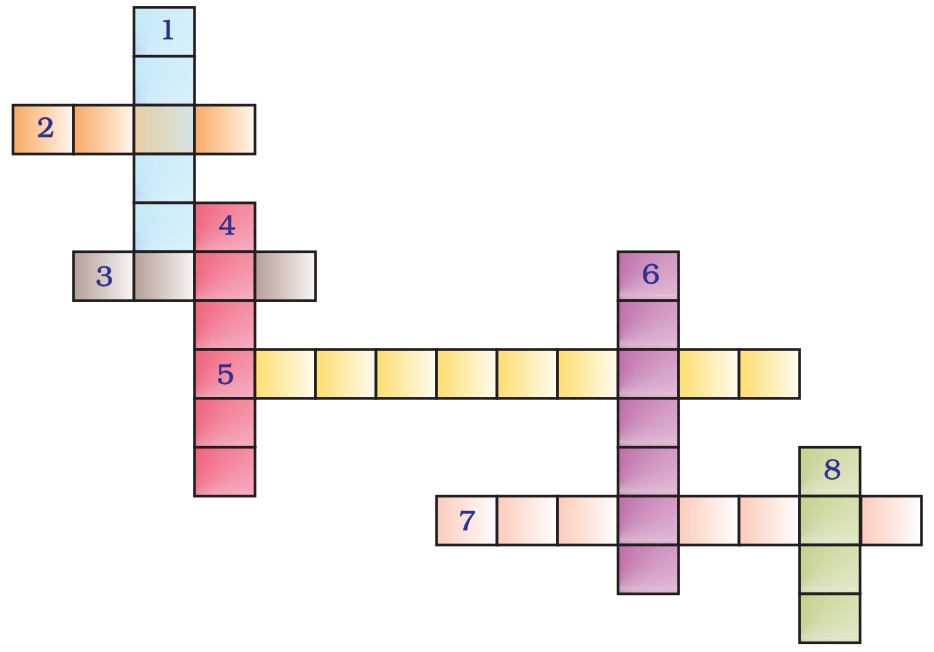
Complete the following crossword puzzle (Figure) by using the name of the chemical elements. Use the data given in the table following.
Across
Down
2.
The element used by Rutherford during his $\alpha$–scattering experiment.
1.
A white lustrous metal used for making ornaments and which tends to get tarnished black in the presence of moist air.
3.
An element which forms rust on exposure to moist air.
4.
Both brass and bronze are alloys of the element.
5.
A very reactive non–metal stored under water.
6.
The metal which exists in the liquid state at room temperature.
7.
Zinc metal when treated with dilute hydrochloric acid produces a gas of this element which when tested with burning splinter produces a pop sound.
8.
An element with symbol Pb.
A body starting from rest travels with uniform acceleration. If it travels 100m in 5s, what is the value of acceleration?
State and explain Kepler’s laws of planetary motion. Draw diagrams to illustrate these laws.
What do you mean by passive and active transport? Write a note on diffusion.
Describe with a diagram the fluid mosaic organisation of the plasma membrane.
  1.  
  1.  
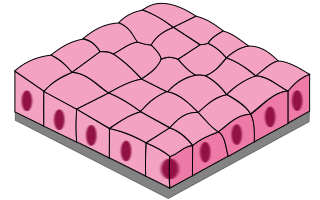
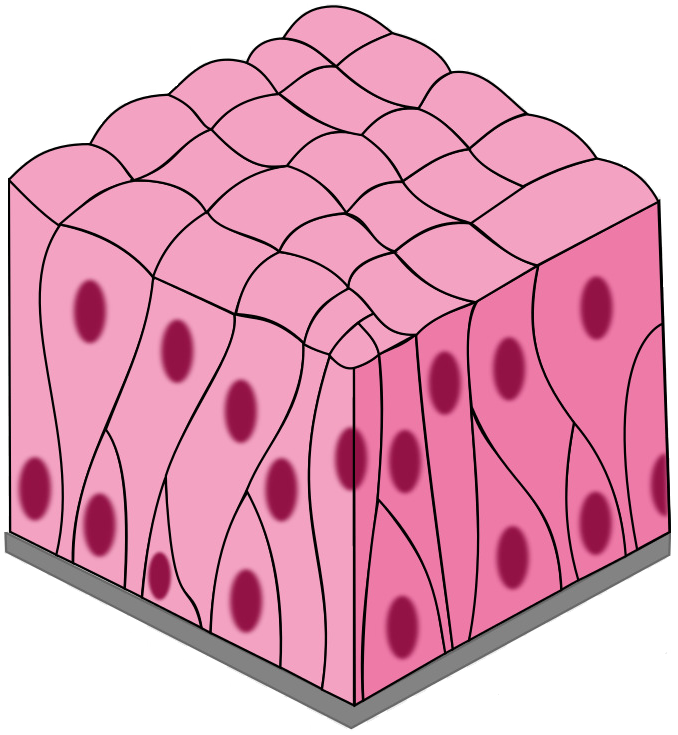
  1. Identify figures A and B.
  2. Which is called tesselated and payement epitheliurn?
  3. Which one lines the gastrointestinal tract and epiglottis?
  4. Which one allows diffusion of substances?
Describe an experiment to show that sound cannot pass through vacuum.
How will you separate a mixture of mercury, oil and water?
The following data was obtained for a body of mass $1\ kg$ dropped from a height of $5$ metres:
 
Distance above ground
Velocity
$i.$ $5m$ $0m/s$
$ii.$ $3.2m$ $6m/s$
$iii.$ $0m$ $10m/s$
Show by calculations that the above data verifies the law of conservation of energy $($Neglect air resistance$).$ $(g = 10\ m/s^2).$