Question
State any four difficulties in constructing index numbers.

Answer

The problems/ difficulties faced while constructing an index number are:
  1. Purpose of the index: Calculation of a volume index will be appropriate when one needs a value index. The selection of items, their prices etc. depend on the purpose of index numbers which should be clear.
  2. Selection of the items: The total number of items selected for the index should be neither too small nor too large. Items should be relevant to the purpose of the index. The items should be standardised and representative of the whole group for which index number is to be constructed.
  3. Price quotation: We know that price of many commodities vary from place to place and even from shop to shop in the same market. A selection must also be made as to whether the wholesale price or retail price are required. The choice would depend upon the purpose of index number.
  4. Selection of base year: Base year is the reference year from which comparisons are made. The base year should be a normal year. It should be free from abnormalities like wars, earthquakes etc. Moreover, it should not be from distant past. It should be a year of recent past. It should neither be too far nor too near.
  5. Selection of weights: In fact, all commodities included do not have equal importance. Therefore, to have accurate results, commodities are assigned weights according to their importance. There are two ways of assigning weights, i.e., quantity weights and value weights.
  6. Choice of an average: Mostly choice is to be made between arithmetic mean and geometric mean. Though geometric mean is considered best in theory as this is the most suitable average for measuring relative changes, yet arithmetic mean is more popularly used while constructing index numbers.
  7. Choice of an appropriate formula: Various formulae can be used in the construction of index numbers but it is very essential to select the most suitable out of them. The selection of the formulae depends upon the purpose of index number and availability of data.

Need a full question paper?

Generate a complete, print-ready paper with questions like this in minutes — across 16+ boards, with answer keys.
Start Generating Free

Similar questions

Explain with the help of diagrams, the effect of the following on demand for a good:
(i) Rise in income of its buyers.
(ii) Fall in income of its buyers.
(i) A consumer buys 18 units of a good at a price of Rs 9 per unit. The price elasticity of demand for the good is (-)1. How many units the consumer will buy at a price of Rs 10 per unit. Calculate.
(ii) Price elasticity of demand of goods is (-) 4. When price of the goods falls, its demand rises by 24 percentage. Calculate percentage change in price
Suppose the demand and supply curves of salt are given by:
$Q_d=1,000-p, Q_S=700+2 p$
$(a)$ Find the equilibrium price and quantity.
$(b)$ Now suppose that the price of an input used to produce salt has increased so that the new supply curve is:
$Q_S=400+2 p$
How does the equilibrium price and quantity change? Does the change conform to your expectation?
$(c)$ Suppose the government has imposed a tax of $₹ 3$ per unit of sale of salt. How does it affect the equilibrium price and quantity?
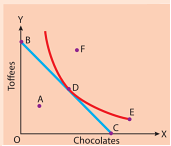
Rohan is choosing how to allocate this spending between chocolates and toffees. The figure alongside shows his budget line and indifference curve. Identify the point as mentioned in the diagram and match it with the appropriate statement given below:
(i) The point at which Rohan maximises his satisfaction.
(ii) The point at which he buys only chocolates and no toffees.
(iii) A consumption bundle which would not exhaust his budget for these goods.
(iv) A point yielding the same satisfaction as at 'D' but which Rohan's budget can't afford.
(v) The point at which he buys only toffees and no chocolates.
(vi) A consumption bundle preferred to point 'D' but which Rohan can't afford.
Image
Find the standard deviation from the following data:
Marks: $0-10$ $10-20$ $20-30$ $30-40$ $40-50$
No. of Students: $10$ $15$ $10$ $10$ $5$
What do you understand by consumer's equilibrium? Explain consumer's equilibrium in case of a single commodity.
The yield of wheat and rice per acre for 10 districts of a state is as under:
District
1
2
3
4
5
6
7
8
9
10
Wheat
12
10
15
19
21
16
18
9
25
10
Rice
22
29
12
23
18
15
12
34
18
12
Calculate for crop.
Mean deviation about Mean.
Explain the conditions of producer's equilibrium with the help of a diagram.
The yield of wheat and rice per acre for 10 districts of a state is as under:
District
1
2
3
4
5
6
7
8
9
10
Wheat
12
10
15
19
21
16
18
9
25
10
Rice
22
29
12
23
18
15
12
34
18
12
Calculate for crop.
Mean deviation about Median.
What are the limitations of index numbers?