Question
State any three characteristics of sexual reproduction.

Answer

  • Two different sexes i.e., male and female take part in the process.
  • Testis in male produces the male gametes or sperms and the ovary in female produces female gametes or ova.
  • Gametes are formed by meiosis or reduction division and so are haploid in nature.
  • Sperms are motile and move towards ovum for fertilisation.
  • Sperms and ova come into contact with each other and fuse to form a zygote or egg by a process called fertilisation.
  • It involves slow multiplication.
  • Variations appear due to new combinations of genes during crossing over.
  • Daughter organisms or offsprings are genetically different from the parents.
  • The diploid zygote then divides by mitosis and passes through different develomental phases to transform into a multicellular individual.

Need a full question paper?

Generate a complete, print-ready paper with questions like this in minutes — across 16+ boards, with answer keys.
Start Generating Free

Similar questions

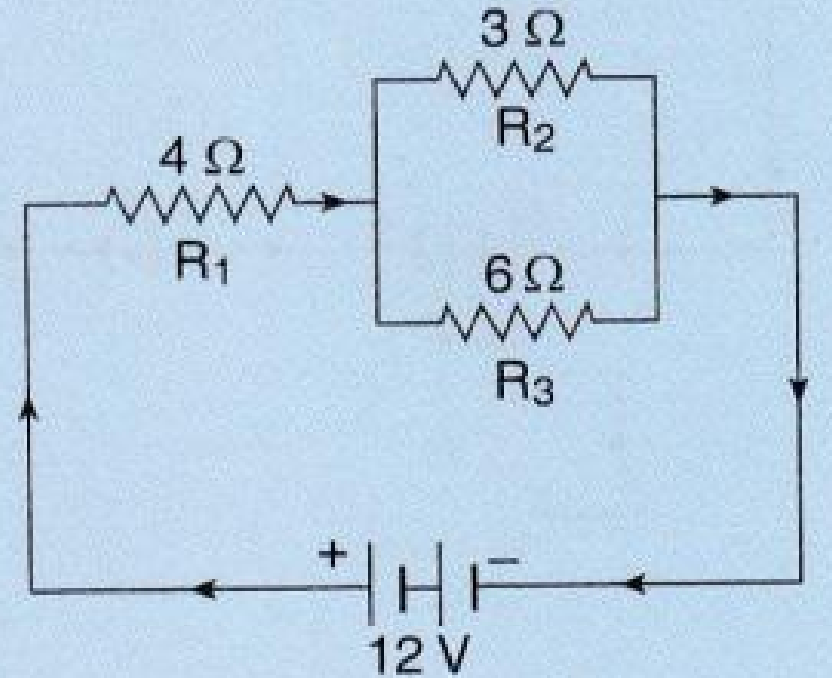
The circuit diagram given below shows the combination of three resistors $R_1 R_2$ and $R_3$ :

Find:
  1. Total resistance of the circuit.
  2. Total current flowing in the circuit.
  3. The potential difference across R.
Describe the exchange of gases which takes place in the leaves of a plant:
  1. During daytime.
  2. At night.
A small part of the shoot of a plant is removed with a sharp knife. When the lower end of this small part of the shoot is buried in moist soil, it gradually develops roots and shoots and grows to become a new plant.
  1. What is the name of this method of propagating plants?
  2. What care should be taken while removing a small part of the shoot from the parent plant with a knife?
  3. Name any two plants which provide us with food directly or indirectly and are grown by this method.
  4. Give one advantage of this method of producing new plants.
  5. State whether it is a sexual method of reproduction or an asexual method. Why?
  6. What special name can be given to the genetically identical new plants produced by this technique?
The metal M reacts vigorously with water to form a solution S and a gas G. The solution S turns red litmus to blue whereas gas G, which is lighter than air, burns with a pop sound. Metal M has a low melting point and it is used as a coolant in nuclear reactors.
  1. What is metal M?
  2. What is solution S? Is it acidic or alkaline?
  3. What is gas G?
  4. Write a balanced chemical equation for the reaction which takes place when metal M reacts with water.
  5. Is this reaction exothermic or endothermic?
An object is placed 15cm from (a) a converging mirror, and (b) a diverging mirror, of radius of curvature 20cm. Calculate the image position and magnification in each case.
  1. State the laws of refraction of light. Give an expression to relate the absolute refractive index of a medium with speed of light in vacuum.
  2. The refractive indices of water and glass with respect to air are 4/3 and 3/2 respectively. If the speed of light in glass is $2\times 10^8 \text{ ms}^{-1},$ find the speed of light in (i) air, (ii) water.
List the new Cartesian sign convention for reflection of light by spherical mirrors. Draw a diagram and apply these conventions for calculating the focal length and nature of a spherical mirror which forms $\frac{1}{3}$ times magnified virtual image of an object placed 18cm if front of it.
Consider the following food chains:
  1. Plants → Mice → Snakes → Hawks
  2. Plants → Mice → Hawks
If energy available at the producer level in both the food chains is 100J, in which case will hawks get more energy as food and by how much? Justify your answer.
Define atomic size. Give its unit of measurement. In the modem periodic table what trend is observed in the atomic radius in a group and a period and why is it so?
Draw an appropriate schematic diagram showing common domestic circuits and discuss the importance of fuse. Why is it that a burnt out fuse should be replaced by another fuse of identical rating?