Question
State Bernoulli's theorem. Using it how can you explain the functioning of a venturimeter to find velocity of flow of liquid through a tube?
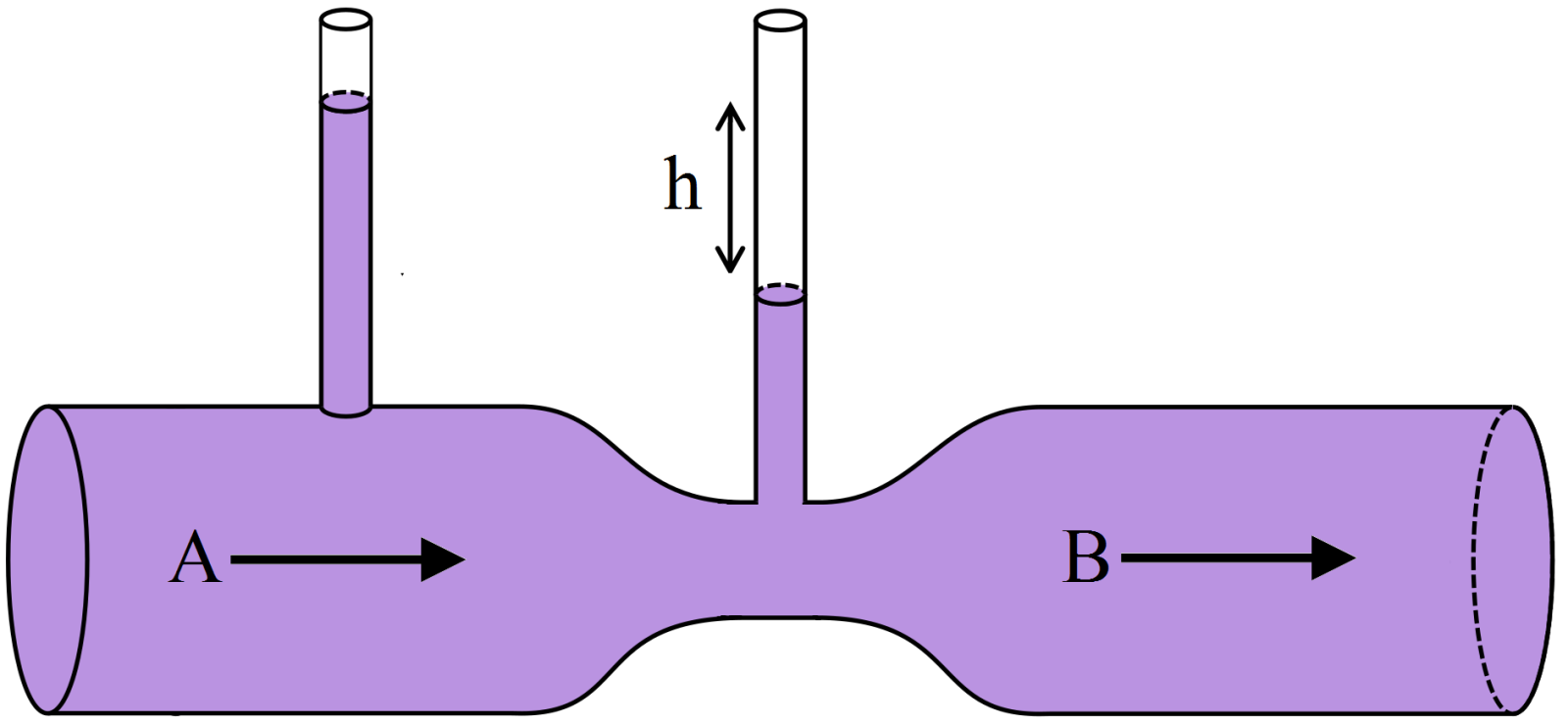 Given: $\text{a}_1=0.36\pi\text{cm}^2,\text{a}_2=0.04\pi\text{m}^2,\text{h}=1\text{m}.$ Since, c.s.a. at B is less velocity will be more and pressure will be less. The difference in pressure is $\text{P}_1-\text{P}_2=\text{h}\rho\text{g}.$ Applying Bernoulli's theorem,$\frac{\text{P}_1}{\rho\text{g}}+\frac{\text{v}^2_1}{\text{ 2}\text{g}}=\frac{\text{P}_2}{\rho\text{g}}+\frac{\text{v}^2_2}{\text{2g}}$
Generate a complete, print-ready paper with questions like this in minutes — across 16+ boards, with answer keys.
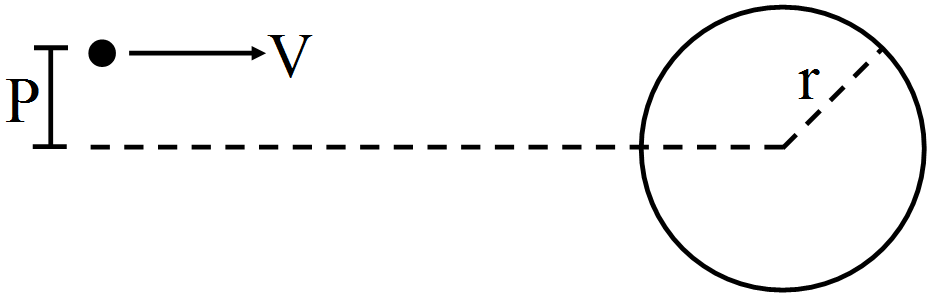 [Hint: The force acts along the normal to the sphere through the contact. Treat the collision as onedimensional for this direction. In the tangential direction no force acts and the velocities do not change].