Question
  1. State how the constant internal environment is beneficial to organisms.
  2. Explain any two alternatives by which organisms can overcome stressful external conditions.

Answer

  1. Constant internal environment Permits all biochemical reactions and physiological functions to proceed with maximal efficiency and thus, enhance the overall fitness of the species.'
  2. These organisms suspend their metabolic functions during the stressful period and resume their functions at the return of favourable conditions. For example, bear undergoes winter sleep called hibernation and certain animals like snails and fish undergo summer sleep known as aestivation.

Need a full question paper?

Generate a complete, print-ready paper with questions like this in minutes — across 16+ boards, with answer keys.

Start Generating Free

Similar questions

The study of:
  1. Fossils of dinosaurs.
  2. Forelimbs of cheetah, bat and human.
  3. Thorns of Bougainvillea and tendril of Cucurbita.
Show that evolution of life forms has indeed taken place on earth. Explain.
Draw a schematic sketch of pBR 322 plasmid and label the following in it:
  1. Any two restriction sites.
  2. Ori and rop genes.
  3. An antibiotic resistant gene.
List the changes that the primary ooctye undergoes in the tertiary follicular stage in the human ovary.
How did the process of RNA interference help to control the nematode from infecting the roots of tobacco plants?

Or

How has RNAi technique helped to prevent the infestation of roots in tobacco plants by a nematode Meloidogyne incognita?
DNA polymerase and RNA polymerase differ in their requirement while functioning. Explain.
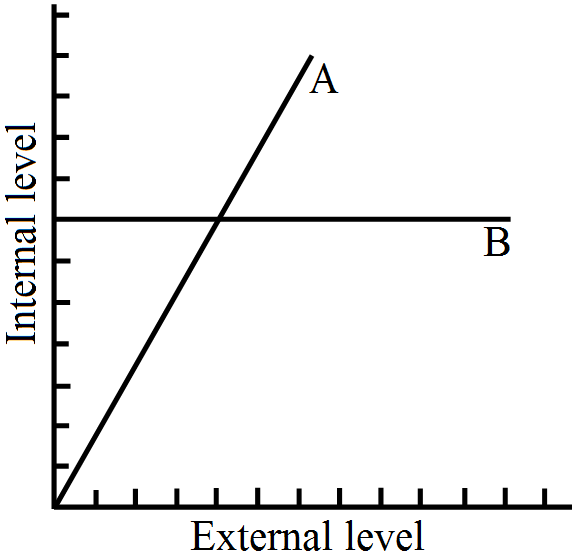
Given below is a graph depicting organismic response to changing external conditions. According to their response the organisms are grouped into two types. Name the type which will show (i) Pattern A (ii) Pattern B.

Discuss briefly about seed viability.
The base sequence on one of the strands of DNA is ATGTCTATA.
  1. Give the base sequence of its complementary strand.
  2. If an RNA strand is transcribed by this strand, what would be the base sequence of RNA?
  3. In what other respect, an RNA molecule differs from a DNA molecule?
How is the entry of only one sperm and not many ensured into an ovum during fertilisation in humans?
In the majority of angiosperms, the zygote divides by an asymmetric mitotic division and generates two cells. Discuss the fates of these cells.