Question
State Impulse-momentum theorem.

Answer

The change in momentum associated with a body can be produced by a large force for small time or a small force for large time.

Need a full question paper?

Generate a complete, print-ready paper with questions like this in minutes — across 16+ boards, with answer keys.
Start Generating Free

Similar questions

Which of the following processes is reversible and which is irreversible?
(i) Isothermal expansion of gas
(ii) Isothermal compression of gas
(iii) Heat flow due to friction
(iv) Heating of resistance by electric current
(v) Flow of heat from hot to cold object
(vi) Carnot engine
(vii)Burst of bicycle tube
(viii) Diffusion of gas
(ix) Slowly strectching or compressing the spring
(x) Exchange of heat between two objects at the same temperature
While gas from a cooking gas cylinder is used, the pressure does not fall appreciably till the last few minutes. Why?
If earth were to shrink suddenly (keeping the mass same), what would happen to the length of the day?
An iron needle is attracted to the ends of a bar magnet but not to the middle region of the magnet. Is the material making up the ends of a bar magnet different from that of the middle region?
A sphere starts rolling down an incline of inclination $\theta.$ Find the speed of its centre when it has covered a distance l.
The particle position in one-dimensional motion is
$
x=\left(3+4 t-t^2\right) \text { meter }
$
Draw the displacement velocity diagram for this motion from the time interval $t=0 sec$ to $t=4 sec$.
In a resonance column experiment, a tuning fork of frequency 400Hz is used. The first resonance is observed when the air column has a length of 20.0cm and the second resonance is observed when the air column has a length of 62.0cm.
  1. Find the speed of sound in air.
  2. How much distance above the open end does the pressure node form?
Explain the difference between two- dimensional and three-dimensional motion by giving examples.
Necessary condition for sustained interference write down.
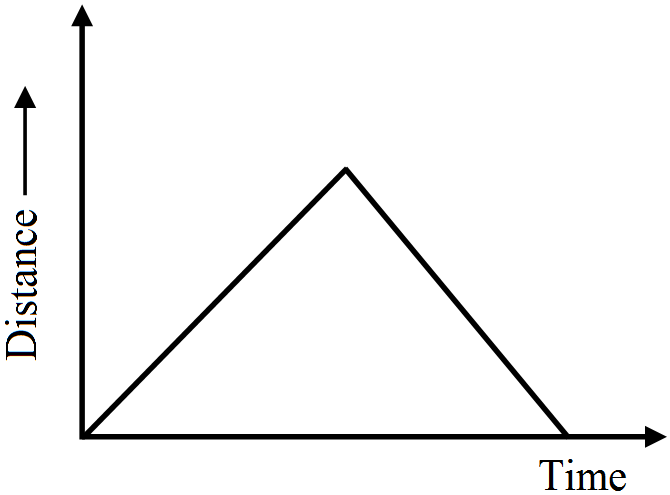
The graph between total path length and time for a particle moving along a straight line as shown in figure is not possible. Explain why?