Question
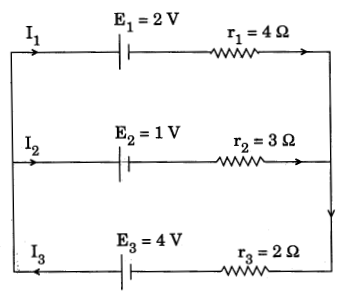
State Kirchhoff’s rules. Use these rules to write the expressions for the currents I1, I2 and I3 in the circuit diagram shown.
Answer

  1. Junction rule: At any junction, the sum of the currents entering the junction is equal to the sum of currents leaving the junction.
  2. Loop rule: The algebraic sum of changes in potential, around any closed loop, involving resistors and cells in the loop, is zero.

Expressions for the currents I1, I2 and I3 using given loop.

  1. I3 = I2 + I1
  2. 4I1 – 3I2 + 1 = 0
  3. 3I2 + 2I3 – 3 = 0.

Need a full question paper?

Generate a complete, print-ready paper with questions like this in minutes — across 16+ boards, with answer keys.
Start Generating Free

Similar questions

Sketch a graph showing the variation of fringe width versus the distance of the screen from the plane of the slits (keeping other parameters same) in Young’s double slit experiment. What information can one obtain from the slope of this graph?
Suppose white light falls on a double slit but one slit is covered by a violet filter (allowing $\lambda=400\text{nm}$). Describe the nature of the fringe pattern observed.
A closely wound solenoid 80 cm long has 5 layers of windings of 400 turns each. The diameter of the solenoid is 1.8 cm. If the current carried is 8.0 A, estimate the magnitude of B inside the solenoid near its centre.
A charged capacitor of capacitance C is discharged through a resistance R. A radioactive sample decays with an average-life $\tau.$ Find the value of R for which the ratio of the electrostatic field energy stored in the capacitor to the activity of the radioactive sample remains constant in time.
Which wavelengths will be emitted by a sample of atomic hydrogen gas (in ground state) if electrons of energy 12.2eV collide with the atoms of the gas?
On the basis of the charging of capacitor, clarify that there is something missing in the Ampere circuital law.
An object is placed at (i) $10 cm$, (ii) $5 cm$ in front of a concave mirror of radius of curvature $15 cm$. Find the position, nature, and magnification of the image in each case.
The two graphs are drawn below, show the variations of electrostatic potential (V) $\frac{1}{\text{r}}$ (r being the distance of field point from the point charge) for two point charges q1 and q2.
  1. What are the signs of the two charges?
  2. Which of the two charges has the larger magnitude and why?
​​​​​​​​​​​​​​
A charge q is placed at the centre of the line joining two equal charges Q.
Show that the system of three charges will be in equilibrium if $\text{q}=-\frac{\text{Q}}{4}.$
A circular copper-ring of radius r translates in its plane with a constant velocity v. A uniform magnetic field B exists in the space in a direction perpendicular to the plane of the ring. Consider different pairs of diametrically opposite points on the ring.
  1. Between which pair of points is the emf maximum? What is the value of this maximum emf?
  2. Between which pair of points is the emf minimum? What is the value of this minimum emf?