Question
State Newton's law of Gravitation. Find the percentage decrease in the weight of the body when taken to a height of 16km. above the surface of the earth. Radius of the earth is 6400km.

Answer

It states that every body in the universe attracts every other body with a force which is directly propotional to the product of their masses and inversely propotional to square of distance between them.
$\text{F}=\frac{\text{Gm}_1\text{m}_2}{\text{r}^2}$
m1 and m2 → mass of two bodies
r → distance between two bodies.
The acceleration due to gravity at a height 'h' above the surface of the earth is
$\text{g}'=\text{g}\Big(1-\frac{2\text{h}}{\text{R}}\Big)$
$\text{g}-\text{g}'=\Big(\frac{2\text{hg}}{\text{R}}\Big)$
$\frac{\text{mg}-\text{mg}'}{\text{mg}}\times100=\frac{\text{g}-\text{g}'}{\text{g}}\times100$
$=\frac{2\text{h}}{\text{R}}\times100$
$=\frac{2\times16}{6400}\times100=0.5\%$

Need a full question paper?

Generate a complete, print-ready paper with questions like this in minutes — across 16+ boards, with answer keys.
Start Generating Free

Similar questions

The acceleration due to gravity on the surface of moon is 1.7m s-2. What is the time period of a simple pendulum on the surface of moon if its time period on the surface of earth is 3.5 s? (g on the surface of earth is 9.8m s-2)
The wave pattern on a stretched string is shown in Interpret what kind of wave this is and find its wavelength.

In a refrigerator one removes heat from a lower temperature and deposits to the surroundings at a higher temperature. In this process, mechanical work has to be done which is provided by an electric motor. If the motor is of 1KW power, and heat is transferred from –3°C to 27°C, find the heat taken out of the refrigerator per second assuming its efficiency is 50% of a perfect engine.
A star 2.5 times the mass of the sun and collapsed to a size of 12km rotates with a speed of 1.2 rev. per second. (Extremely compact stars of this kind are known as neutron stars. Certain stellar objects called pulsars belong to this category). Will an object placed on its equator remain stuck to its surface due to gravity? (mass of the sun = 2 × 1030kg).
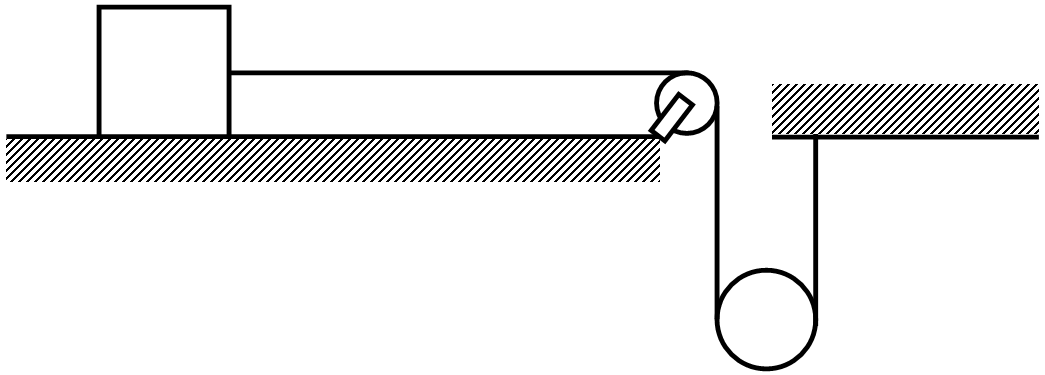
The descending pulley shown in figure has a radius 20cm and moment of inertia 0.20kg-m2. The fixed pulley is light and the horizontal plane frictionless. Find the acceleration of the block if its mass is 1.0kg.

A quarterback, standing on his opponents 35-yard line, throws a football directly down field, releasing the ball at a height of 2.00m above the ground with an initial velocity of 20.0m/ s, directed 30.0° above the horizontal.
  1. How long does it take for the ball to cross the goal line, 32.0m from the point of release?
  2. The ball is thrown too hard and so passes over the head of the intended receiver at the goal line. What is the ball's height above the ground as it crosses the goal line?
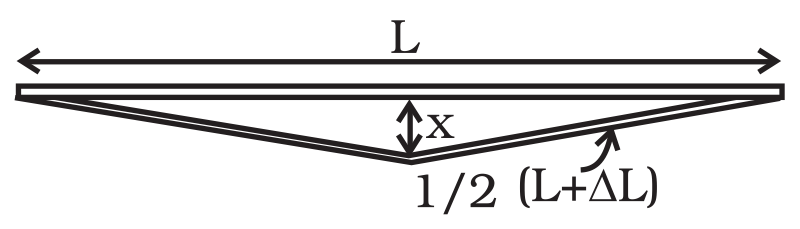
A rail track made of steel having length 10m is clamped on a raillway line at its two ends. On a summer day due to rise in temperature by 20°C , it is deformed as shown in figure. Find x(displacement of the centre) if $\alpha_\text{steel}=1.2\times10^{-5}/{^\circ\text{C}}.$

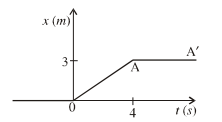
Shows the position-time graph of a particle of mass 4 kg. What is the (a) force on the particle for $t<0, t>4 s, 0<t<4 s$ ? (b) impulse at $t=0$ and $t=4 s$ ? (Consider one-dimensional motion only).
Image
A body cools from 60°C to 50°C in 10 minutes. Find its temperature at the end of the next 10 minutes if the room temperature is 25 °C. Assume Newton's law of cooling.
$\hat{\text{i}}$ and $\hat{\text{j}}$ are unit vectors along x- and y- axis respectively. What is the magnitude and direction of the vectors $\hat{\text{i}}+\hat{\text{j}},$ and $\hat{\text{i}}-\hat{\text{j}}$? What are the components of a vector $\text{A}=2\hat{\text{i}}+3\hat{\text{j}}$ along the directions of $\hat{\text{i}}+\hat{\text{j}}$ and $\hat{\text{i}}-\hat{\text{j}}$? [You may use graphical method]