Question
State Ohm's law. Write the necessary conditions for its validity. How is this law verified experimentally? What will be the nature of graph between potential difference and current for a
conductor? Name the physical quantity that can be obtained from this graph.
Answer

Ohm's law: The potential difference across the ends of a resistor is directly proportional to the current through it, provided it's temperature remains the same.
The conditions for its validity is temperature and all other parameters should be constant.
The nature of the graph is a straight line passing through the origin.
Resistance is the physical quantity that can be determined from the graph.

Need a full question paper?

Generate a complete, print-ready paper with questions like this in minutes — across 16+ boards, with answer keys.

Start Generating Free

Similar questions

In the artificial kidneys, the tubes are all with semi-permeable lining. Why?

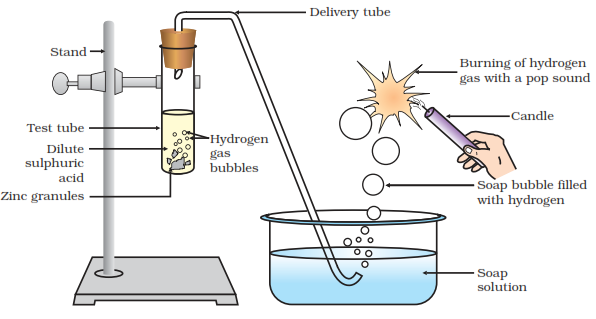
In the following schematic diagram for the preparation of hydrogen gas as shown in Figure, what would happen if following changes are made?
  1. In place of zinc granules, same amount of zinc dust is taken in the test tube.
  2. Instead of dilute sulphuric acid, dilute hydrochloric acid is taken.
  3. In place of zinc, copper turnings are taken.
  4. Sodium hydroxide is taken in place of dilute sulphuric acid and the tube is heated.
What is meant by speciation? List four factors that could lead to speciation. Which of these cannot be a major factor in the speciation of a self-pollinating plant species. Give reason to justify your answer.
With the help of one example for each, distinguish between the acquired traits and the inherited traits. Why are the traits/ experiences acquired during the entire lifetime of an individual not inherited in the next generation? Explain the reason of this fact with an example.
Write laws of refraction. Explain the same with the help of ray diagram, when a ray of light passes through a rectangular glass slab.
At what distance from a concave mirror of focal length 10cm should an object be placed so that:
  1. Its real image is formed 20cm from the mirror?
  2. Its virtual image is formed 20cm from the mirror?
A scientist removed some cells from the growing point of a plant and placed it in a suitable medium leading to the formation of a shapeless lump of mass X. X is then transferred to another medium which stimulates it to develop roots. When X with developed roots is placed in a yet another medium, then it develops shoots to form tiny plantlets. These plantlets can then be transplanted in pots or soil where they can grow to form mature plants.
  1. What is the shapeless lump of mass X known as?
  2. What name is given to this method of producing new plants?
  3. The growth medium used in this method contains plant nutrients in the form of a 'jelly'. Name this jelly.
  4. What is the general name of chemicals used to stimulate the growth of plant cells and development of roots and shoots?
  5. Name any two plants which are produced by this method.
  6. State any two advantages of this method of producing plants.
  7. What is the other name of this method [other then that given in (b) above]?
X, Y, and Z are three animals. The animal X can fly but animal Y can only run on ground or walls. The forelimbs of animals X and Y have the same basic design but they are used for different purposes such as flying and running respectively. The animal Z became extinct an long time ago. The study of fossils of Z tells us that it had some features like those of X and some like those of Y. In fact, Z is said to form a connecting link in the evolutionary chain of X and Y.
  1. What could the animals X, Y and Z be?
  2. What name is given to the forelimbs like those of X and Y which have the same basic design but different functions?
  3. Name one feature in which Z resembled X.
  4. Name one feature in which Z resembled Y.
  5. Which is the correct evolutionary chain involving X, Y and Z : X → Z → Y or Y → Z → X?
Draw the electron-dot structures of the following compounds and state the type of bonding in each case:
i. KCl
ii. $NH _3$
iii. CaO
iv. $N _2$
v. $CaCl _2$
The organs P and Q of two animals have different structures but similar functions. On the other hand, the two organs R and S of two other animals have the same basic structure but different functions.
  1. What are the organs like P and Q known as?
  2. Name the organs like P and Q. Also name the animals which have such organs.
  3. What are the organs like R and S called?
  4. Name the organs like R and S. Also name the animals which have such organs.