Question
State Raoult’s law for a solution containing non-volatile solute. What type of deviation from Raoult’s law is shown by a solution of chloroform and acetone and why?

Answer

The relative lowering of vapour pressure of a solution is equal to the mole fraction of the solute. / The vapour pressure of a solution of a non- volatile solute is equal to the vapour pressure of the pure solvent at that temperature multiplied by its mole fraction.
Negative deviation due to formation of Hydrogen bond between chloroform and acetone.

Need a full question paper?

Generate a complete, print-ready paper with questions like this in minutes — across 16+ boards, with answer keys.

Start Generating Free

Similar questions

Explain the preparation of ketone from benzene or substituted benzenes.
Write down Faradays law
Which forces are involved in holding the drugs to the active site of enzymes?
How will you convert: Propaonic acid into ethanoic acid?
A compound ‘A’ having molecular formula $C_4H_{10}O$ is found to be soluble in concentrated sulphuric acid. It does not react with sodium metal or potassium permanganate. On heating with excess of HI, it gives a single alkyl halide. Deduce the structure of compound A and explain all the reactions.
Write the equations of the following changes :
(i) $C _2 H _5 I$ to $C H _3 C H _2 C O O H$
(ii) $C H _3 Cl$ to $C H _3 C O N H _2$
(iii) $CH _3- CH _2- Cl$ to $CH _3- CH _2- CH _2- NH _2$
(iv) $CH _3 Cl$ to $CH _3 CHO$

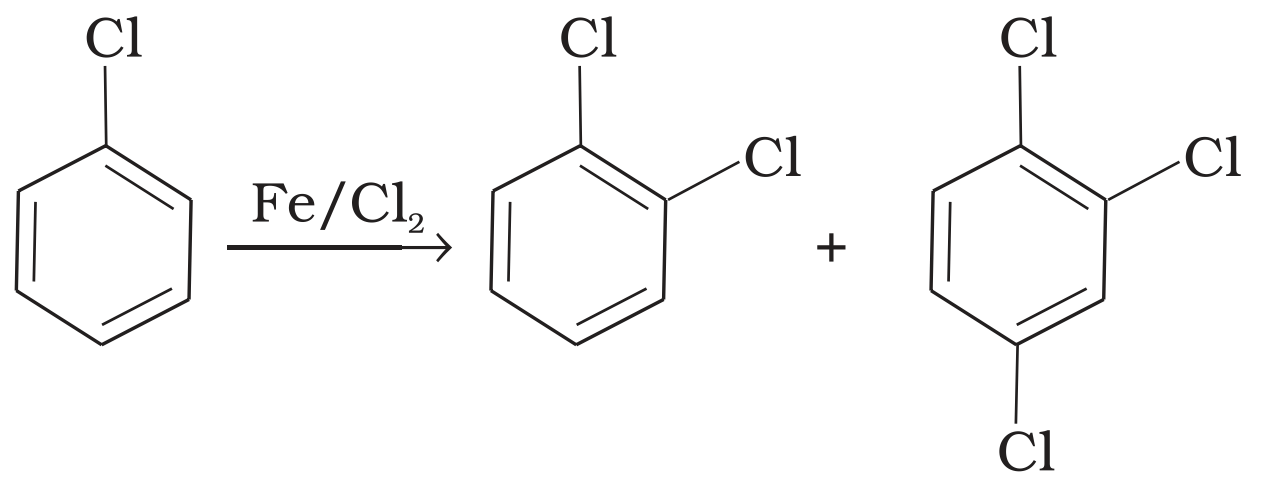
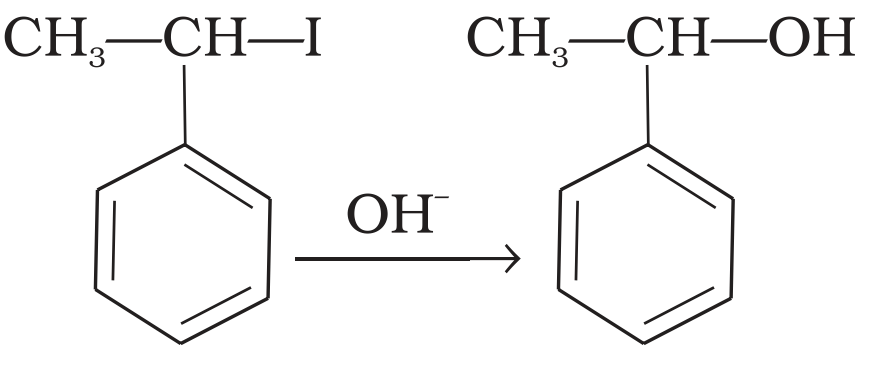
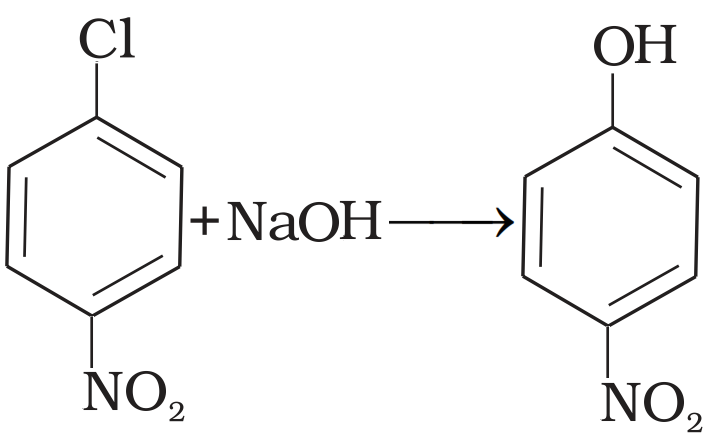
Match the reactions given in Column I with the names given in Column II.
  Column I   Column II
(i) (a) Nucleophilic aromatic substitution
(ii) $\text{CH}_3-\text{CH}==\text{CH}_2+\text{HBr}\xrightarrow{ \ \ \ \ \ }\text{CH}_3-\text{CH}-\text{CH}_3\ \ \ \ \ \ \ \ \ \ \ \ \ \ \ \ \ \ \ \ \ \ \ \ \ \ \ \ \ \ \ \ \ \ \ \ | \ \ \ \ \ \ \ \ \ \ \ \text{Br}$ (b) Electrophilic aromatic substitution
(iii) (c) Saytzeff elimination
(iv) (d) Electrophilic addition
(v) $\text{CH}_3\text{CH}_2\text{CH}\text{CH}_3\xrightarrow{\text{alc.KOH}}\text{CH}_3\text{CH}==\text{CH}\text{CH}_3\ \ \ \ \ \ \ |\ \ \ \ \ \ \ \ \ \ \ \ \ \ \ \ \text{Br}$ (e) Nucleophilic substitution $(S_N1)$
Note: In the following questions a statement of assertion followed by a statement of reason is given. Choose the correct answer out of the following choices.
Assertion: An ordinary filter paper impregnated with collodion solution stops the flow of colloidal particles.
Reason: Pore size of the filter paper becomes more than the size of colloidal particle.
Calculate the mole fraction of benzene in solution containing $30\%$ by mass in carbon tetrachloride.
Differentiate between "minerals" and "ores".