Question
State the kinematic equations for uniformly accelerated motion.
Answer

For uniformly accelerated motion, we can derive some simple equations that relate displacement $(x)$, time taken $(t)$, Initial velocity $(u)$, final velocity $(v)$ and acceleration $(a)$.
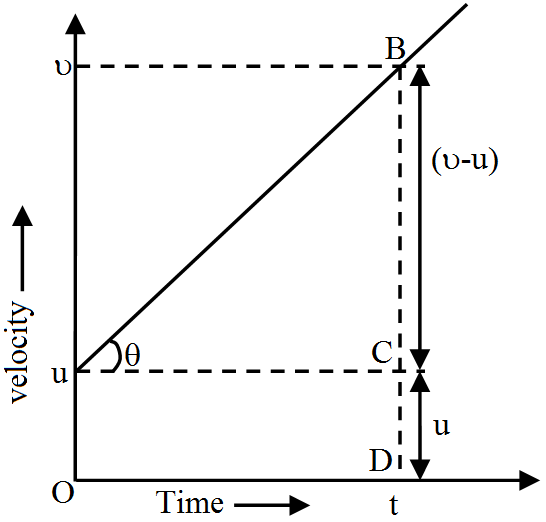
  1. Velocity attained after time $t$: The velocity$-$time graph for positive constant acceleration of a particle is shown in the figure.

Let $u$ be the initial velocity of the particle at $t = 0$ and $v$ is the final velocity of the particle after time $t$. Consider two points $A$ and $B$ on the curve corresponding to $t = 0$ and $t = t$ respectively.
Draw $BD$ perpendicular to time axis. Also draw $AC$ perpendicular to $BD$.
$\therefore OA = CD = u;$
$BC = (v - u)$ and $OD = t$
Now slope of $v-t$ graph $=$ acceleration $(a)$
$\therefore a =$ slope of $v-t$ graph $=\tan\theta=\frac{\text{BC}}{\text{AC}}=\frac{\text{BC}}{\text{OD}} [\because AC= OD]$
$\therefore \text{a}=\frac{\text{v}-\text{u}}{\text{t}}$
$\text{v}-\text{u}=\text{at}$
or $\text{v}=\text{u}+\text{at}$
  1. Distance travelled in time $t$:
Let, $x_0 =$ position of the particle at $t = 0$ from the origin.
$x =$ position of the particle at $t = t$ from the origin.
$\therefore (x - x_0) = S =$ distance travelled by the particle in the time interval $(t - 0) = t$
We know, distance travelled by a particle in the given time
Interval $=$ area under velocity$-$time graph
$\therefore (x – x_0) =$ Area $\text{OABD} ($see fig, above$) =$ Area of trapezium $\text{OABD}$
$=\frac{1}{2}[$ Sum of parallel sides$ \times$ perpendicular distance between parallel sides$]$
$=\frac{1}{2}(\text{OA}+\text{BD})\times\text{AC}=\frac{1}{2}(\text{u}+\text{v})\times\text{t}$
Since $\text{v}=\text{u}+\text{at}$
$\therefore(\text{x}-\text{x}_0)=\frac{1}{2}(\text{u}+\text{u}+\text{at})\times\text{t}$
$=\frac{1}{2}(2\text{u}+\text{at})\times\text{t}=\text{ut}+\frac{1}{2}\text{at}^2$
Since $\text{x}-\text{x}_0=\text{S}$
$\therefore \text{S}=\text{ut}+\frac{1}{2}\text{at}^2$
  1. Velocity attained after travelling a distance $S$: We know, distance travelled by a particle in time $t$ is equal to the area under velocity$-$time graph. Therefore, the distance $(s)$ travelled by a particle during time interval $t$ is given by
$S =$ Area under $v-t$ graph $($see fig.$)$ or
$S =$ area of trapenium $\text{OABD}$
$=\frac{1}{2} ($sum of parallel sides$) \times$  perpendicular distance between these para
$\text{S}=\frac{1}{2}(\text{OA}+\text{BD})\times\text{ACs}\ \dots(\text{i})$
Now, acceleratiory $a =$ slope of $v- t$ graph
$\text{a}=\frac{\text{BC}}{\text{AC}}=\frac{\text{BD}-\text{CD}}{\text{AC}}=\frac{\text{v}-\text{u}}{\text{AC}}$
$\text{AC}=\Big(\frac{\text{v}-\text{u}}{\text{a}}\Big)\text{s}$
Also, $OA = u$ and $BD = v$
Using equations $(ii)$ and $(iii)$ in equation $(i)$, we get
$\text{S}=\frac{1}{2}(\text{v}+\text{u})\frac{(\text{v}-\text{u})}{\text{a}}=\frac{\text{v}^2-\text{u}^2}{2\text{a}}$
$\text{v}^2-\text{u}^2=2\text{as}$

Need a full question paper?

Generate a complete, print-ready paper with questions like this in minutes — across 16+ boards, with answer keys.

Start Generating Free

Similar questions

In an experiment on photoelectric effect, the stopping potential is measured for monochromatic light beams corresponding to different wavelengths. The data collected are 11s follows:
wavelength (nm) 350 400 450 500 550
stopping potential(V): 1.45 1.00 0.66 0.38 0.16
Plot the stopping potential against inverse of wavelength $\big(\frac{1}{\lambda}\big) $ on a graph paper and find
  1. The Planck constant,
  2. The work function of the emitter and.
  3. The threshold wavelength.
A disc revolves with a speed of $33\frac{1}{3}\text{rev/min},$ and has a radius of $15cm$. Two coins are placed at $4cm$ and $14cm$ away from the centre of the record. If the co-efficient of friction between the coins and the record is $0.15$, which of the coins will revolve with the record?
Continuous X-rays are made to strike a tissue paper soaked with polluted water. The incoming X-rays excite the atoms of the sample by knocking out the electrons from the inner shells. Characteristic X-rays are analysed and the intensity is plotted against the wavelength. Assuming that only $\text{K}_\alpha$ intensities are detected, list the elements present in the sample from the plot. Use Moseley's equation $v - (25 \times 10^{14}Hz)(Z - 1)^2.$
A glass tube, sealed at both ends, is 100cm long. It lies horizontally with the middle 10cm containing mercury. The two ends of the tube contain air at 27°C and at a pressure 76cm of mercury. The air column on one side is maintained at 0°C and the other side is maintained at 127°C. Calculate the length of the air column on the cooler side. Neglect the changes in the volume of mercury and of the glass.
Find the currents through the resistances in the circuits shown in figure.
$4\times10^{23}$ tritium atoms are contained in a vessel. The half-life of decay tritium nuclei is 12.3y. Find:
  1. The activity of the sample.
  2. The number of decay in the next 10 hours.
  3. The number of decays in the next 6.15y.
A source of sound emitting a 1200Hz note travelg along a straight line at a speed of 170m/s. A detector is placed at a distance of 200m from the line of motion of the source.
  1. Find the frequency of sound received by the detector at the instant when the source gets closest to it.
  2. Find the distance between the source and the detector at the instant it detects the frequency 1200Hz. Velocity of sound in air = 340m/s.
Six point masses of mass m each are at the vertices of a regular hexagon of side l. Calculate the force on any of the masses.
A wave $\text{Y} = \text{A}\sin(\omega\text{t} - \text{kx})$ allowed through a string gets reflected from a rigid support and forms stationary wave. Derive the expression for the standing wave.
(i) Whatement is position vector $\cos ^2 \alpha+\cos ^2 \beta+\cos ^2 \gamma=1$(ii) Explain the displacvector