Question
State the limitations of Ohm’s law.

Answer

There are two main limitations:
(i) Temperature,
(ii) Physical condition of the conductor.

It is found that the ratio V/I is mo longer constant when the temperature is not kept constant. Generally, resistance increases with the rise in the temperature of the conductor.
Physical conditions of any conductor mainly include:
(i) Its length,
(ii) Its cross-sectional area,
(iii) The kind of material.

If there is no change in any of the above three conditions and also other condition like temperature remains constant, then Ohm’s law holds good, i.e., the ratio V/I remains constant.

Need a full question paper?

Generate a complete, print-ready paper with questions like this in minutes — across 16+ boards, with answer keys.
Start Generating Free

Similar questions

List the names of three electrical gadgets used in your house. Write their power, voltage rating and approximate time for which each one is used in a day. Hence find the electrical energy consumed by each in day.
The pulley system shown in the figure is to be used to lift a load W. If the man applying the effort cannot apply a force exceeding 1000 N, what is the maximum load that can be lifted?
The actual load that the man is finally able to lift turns out to be 2700 N. What are the values of the actual M.A., obtained, and the efficiency of the actual set-up?
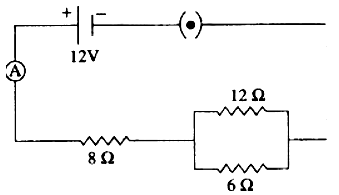
Three resistors are connected to a $12 \ V$ battery as shown in the figure given below:

(i) What is the current through the $8$ ohm resistor?
(ii) What is the potential difference across the parallel combination of $6$ ohm and $12$ ohm resistor?
(iii) What is the current through the $6$ ohm resistor?
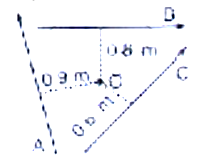
A, B and C are the three forces each of magnitude 4 n acting in the plane of the paper as shown in
Figure. The point O lies in the same plane.

(1) Which force has the least moment about O? Give a reason.
(2) which force has the greatest moment about O? Give a reason.
(3) Name the forces producing (a) Clockwise (b) anticlockwise moments.
(4) what is the resultant torque about the point O?
What is an electromagnet? List any two uses.
Write three conditions necessary to obtain a pure spectrum on a screen. Name the instrument in which the conditions stated by you are fulfilled.
Steam at 100°C is passed over 1000 g of ice at 0°C. After some time, 600 g of ice at 0°C is left and 450 g of water at 0°C is formed. Calculate the specific latent heat of vaporization of steam (Given: specific heat capacity of water = 4200 J/kg°C, specific latent heat of fusion of ice = 336,000 J/kg.)
What is the equivalent resistance between the points $X$ and $Y$ for the given network?
A ray of monochromatic light is incident from the air on a glass slab:
(i) Draw a labelled ray diagram showing the change in the path of the ray till it emerges from the glass slab.
(ii) Name the two rays that are parallel to each other.
(iii) Mark the lateral displacement in your diagram.
What are damped vibrations? How do they differ from free vibrations? Give one example of each.