Question
State the most important coal fields of India.

Need a full question paper?

Generate a complete, print-ready paper with questions like this in minutes — across 16+ boards, with answer keys.

Start Generating Free

Similar questions

Explain the stages involved in secondary treatment of water.
Explains the role of an individual in maintaining environmental standards.
On the outline map of India provided:
(a) Mark and name Kochi.
(b) Label the river Krishna.
(c) Shade and label the Malwa Plateau.
(d) Mark and label the Konkan Coast.
(e) Shade and label the Gulf of Mannar.
(f) Shade and label an alluvial soil area in Peninsular India.
(g) Mark with arrows the direction of the Arabian Sea branch of South West Monsoon Winds.
(h) Shade and label the Western Ghats.
(i) Mark the Jharia coal field.
(j) Shade and name a densely populated area.
Name the Current Expressways.
On the outline map of India provided:
(a) Draw, name and number the Standard Meridian.
(b) Label the river Yamuna.
(c) Shade and name the Gulf of Khambhat.
(d) Mark and name the Nathu-La Pass.
(e) Mark and name the Karakoram Range.
(f) Shade and name a sparsely populated State in Northeast India.
(g) Shade a region with laterite soil in Eastern India.
(h) Mark with a dot and name Vishakhapatnam.
(i) Mark and name the winds that bring rain to West Bengal in summer.
(j) Print S on the iron mines in Singhbhum.
(a) Mark and name Chennai
Explain the role of government in waste management.
Name some important iron-ore producing centres in India.
Name four advantages and three disadvantages of Railways?
Study the extract of the Survey of India Map sheet No. 45D/10 and answer the following questions:
(a) 
Give the six figure grid reference of:
(i) Triangulated height 307.
(ii) The spot height 196.
(b) 
Give the four figure grid reference of each of the following:
(i) The confluence of the Sipu River and the Mahadeviyo Nala.
(ii) Sheet rock.
(c) Measure the shortest distance in kilometres between the temple in, grid square 8192, and the perennial lined well at Bhakodar 8188.
(d) 
What do the following represent?
(i) Black curved lines in 7788.
(ii) The blue line in the bed of the Sipu River.
(e) 
(i) What is the general pattern of settlements in the region shown on the map?
(ii) Give a reason for your answer.
(f) Which is the chief form of irrigation shown in the map extract? Why is it necessary?
(g) 
(i) What is the main form of transport in this region?
(ii) Give the map evidence for your answer.
(h) 
(i) What is the compass direction of Dantiwada, 8582, fromBhadli Kotha, 7886?
(ii) What is the general direction of flow of the Arado. N?
(i) 
(i) Name the type of drainage pattern found in grid square 8584.
(ii) What do you mean by 25r in grid square 8286?
(j) 
(i) What is meant by ‘R.F.’?
(ii) What is the R.F. shown on this map extract?
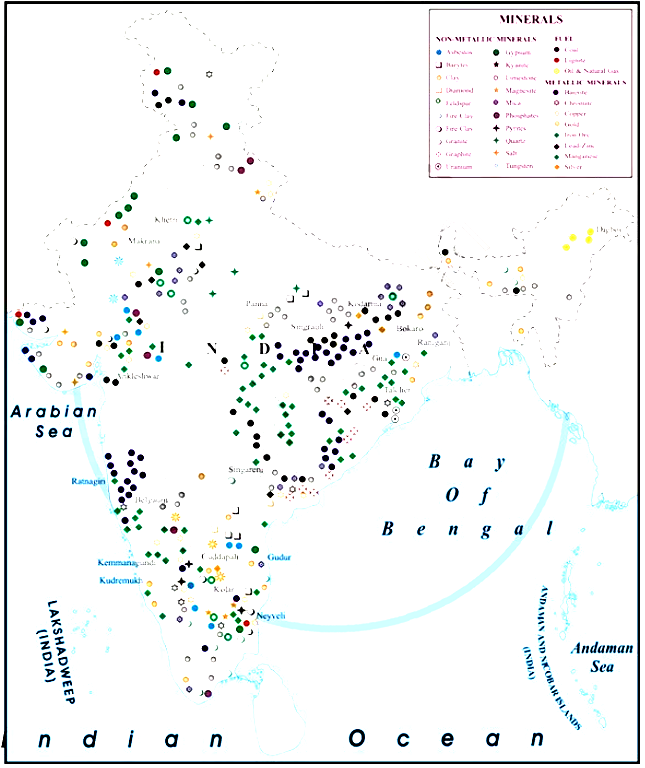
Show the following on the outline map provided:

(a) Shade and label the Satpura Range.
(b) Label the River Krishna.
(c) Label the River Ravi.
(d) Shade and label the Khasi Hills.
(e) Mark with arrows the direction of the North-East Monsoon winds over the Bay of Bengal.
(f) Mark and label the Malabar coast.
(g) Shade and label an area of Laterite soil in India.
(h) Shade and label an area of Limestone in India.