Question
State two advantages and two disadvantages of using hydro-energy for producing electricity.

Answer

Advantages:
(i) When electricity is generated, no greenhouse gases are made.
(ii) It is an inexhaustible source of energy.
Disadvantages:
(i) The dam is expensive to build.
(ii) By building a dam, the nearby area has to be flooded and this could affect nearby wildlife and Plants.

Need a full question paper?

Generate a complete, print-ready paper with questions like this in minutes — across 16+ boards, with answer keys.

Start Generating Free

Similar questions

Explain the meaning of the term refraction. A ray of monochromatic light is incident from air on a glass slab. Draw a ray diagram indicating the change in its path till it emerges out of the slab.
State the limitations of Ohm’s law.
How do you tune your radio set to a particular station?
A cell of e.m.f. $1.5 V$ and internal resistance $1.0 W$ is connected to two resistors of $4.0 W$ and $20.0$ in series as shown in the figure: Calculate the:(i) Current in the circuit.
(ii) Potential difference across the $4.0$ ohm resistor.
(iii) Voltage drop when the current is flowing.
(iv) Potential difference across the cell.
What is nuclear energy? Explain the principle of producing electricity using nuclear energy is a nuclear reactor.
Why does the sun appear red at sunrises and sunset?
(i) (a) Define volt.
(b) A wire of uniform thickness with a resistance of $27 \Omega$ is cut into three equal pieces and they are joined in parallel. Find the resistance of the parallel combination.
(ii) (a) What do you understand by the term internal resistance of cell?
(b) Which of the two cables, one of 10 A and other of 20 A will be thicker? Give one reason for your answer.
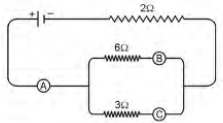
(iii) In the given figure, $A , B$ and C are three ammeters. The ammeter B reads 0.5 A (All the ammeters have negligible resistance.)
ImageCalculate:
(a) the readings in the ammeters A and C .
(b) the total resistance of the circuit.
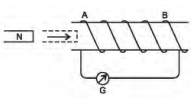
(i) The diagram shows an insulated copper coil wound over a thin cardboard tube and connected to centre zero galvanometer G. It is noticed that the galvanometer needle shows deflection towards the right when the powerful magnet is moved towards the coil as shown in the diagram.
Image
Now, answer the following questions:
(a) Explain why there is a deflection in the galyanometer.
(b) When viewed from end A , what is the direction of current in the coil (clockwise/anticlockwise)?
(c) What is your observation when the magnet is suddenly pulled away from the coil?
(d) What is your observation in the galvanometer when both the magnet and the coil are mounted on trolley and then moved towards the right with the same speed?
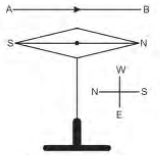
(ii) Diagram given shows a freely suspended magnetic needle.
(a) Why does the needle move in the above situations?
(b) Name and state the law which will determine the direction of motion of magnetic needle.
Image
(iii) (a) Copy the diagram given and draw the lines of the magnetic field produced due to the flow of current.
(b) State one way of increasing the magnetic strength of the coil.
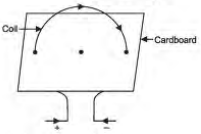
(c) Give three characteristics of magnetic lines of force in (a).
Image
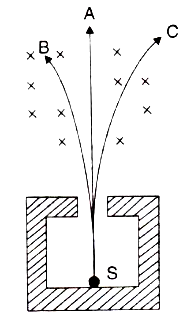
The diagram in figure shows a radioactive source S placed in a thick lead walled container. The radiations given off are allowed to pass through a magnetic field. The magnetic field (shown as x) acts perpendicular to the plane of paper inwards. Arrows shows the paths of the radiation A, B and C.


(a) Name the radiations labelled A, B and C.
(b) Explain clearly how you used the diagram to arrive at the answer in part(a).
Suppose there are three resistors $A, B,$ and $C$ having resistances $r_1, r_{2,}$ and $r_3$ respectively. If $R$ represents their equivalent resistance, establish the following relation $R = r_1 + r_2+ r_3$ when joined in series.