Question
State whether an electric heater will consume more electrical energy or less electrical energy per second when the length of its heating element is reduced. Give reasons for your answer.

Answer

By reducing the length of element the resistance will decrease. Power is inversely proportional to resistance. So, this will result in more consumption of energy.

Need a full question paper?

Generate a complete, print-ready paper with questions like this in minutes — across 16+ boards, with answer keys.
Start Generating Free

Similar questions

How can solar energy be harnessed? Mention any two limitations in using solar energy. How are these limitations overcome?
a) A doctor has advised Sameer to reduce sugar intake in his diet and do regular exercise after checking his blood test reports. Which disease do you think Sameer is suffering from? Name the hormone responsible for this disease and the organ producing the hormone.
b) Which hormone is present in the areas of rapid cell division in a plant and which hormone inhibits the growth?
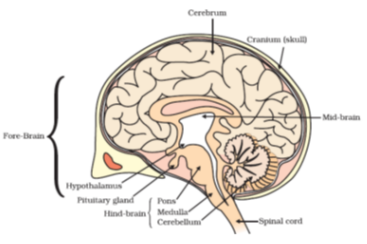
Given below is a labelled diagram of the human brain.

Image

Using the given diagram, answer the following questions:
i. Which part of the brain controls reflex movements of the head, neck, and trunk?
ii. Name the part of the human brain which contains a vital centre for controlling blood pressure.
iii. Which part of the hindbrain regulates respiration?
iv. How is the brain protected from injuries and shock?
v. Which part of the human brain is the main thinking region?
Define the term dispersion of white light. Name the colour of light which bends (i) the most, (ii) the least, while passing through a glass prism Draw a ray diagram to Justify your answer.
Why are the Arabari forests of Bengal known to be a good example of conserved forest?
Draw the labelled diagram of an A.C. generator. With the help of this diagram, explain the construction and working of an A.C. generator.
What are the merits of the modern periodic table of elements?
Sample of five metals ‘A’, ‘B’, ‘C’, ‘D’ and ‘E’ was taken and added to the following solution one by one. The results obtained have been tabulated as follows.
Metal $FeSO _4$ $CuSO _4$ $ZnSO _4$ $AgNO _3$ $Al _2\left( SO _4\right)_3$ $MgSO _4$
A No reaction Displacement No reaction Displacement No reaction No reaction
B Displacement Displacement No reaction Displacement No reaction No reaction
C No reaction No reaction No reaction Displacement No reaction No reaction
D No reaction No reaction No reaction No reaction No reaction No reaction
E Displacement Displacement Displacement Displacement No reaction No reaction
Use the above table to answer the following questions about the given metals.
  1. Which of them is most reactive and why?
  2. What would you observe if ‘B’ is added to $CuSO_4$?
  3. Arrange ‘A’, ‘B’, ‘C’, ‘D’ and ‘E’ in the increasing order of reactivity.
  4. Container of which metal can store zinc sulphate and silver nitrate solution?
  5. Which of the above solution(s) can be stored in a container made of any of these metals and why?
A solid substance P which is very hard is used in the construction of many buildings, especially flooring. When substance P is heated strongly, it decomposes to form another solid Q and a gas R is given out. Solid Q reacts with water with the release of a lot of heat to form a substance S. When gas R is passed into a clear solution of substance S, then a white precipitate of substance T is formed. The substance T has the same chemical composition as starting substance P.
  1. What is substance P? Write its common name as well as chemical formula.
  2. What is substance Q?
  3. What is gas R?
  4. What is substance S? What is its clear solution known as?
  5. What is substance T? Name any two natural forms in which substance T occurs in nature.
A non-metal A which is the largest constituent of air, when heated with $H _2$ in $1: 3$ ratio in the presence of catalyst (Fe) gives a gas B . On heating with $O _2$ it gives an oxide C . If this oxide is passed into water in the presence of air it gives an acid $D$ which acts as a strong oxidising agent.
1. Identify A, B, C and D.
2. To which group of periodic table does this non-metal belong?