MCQ
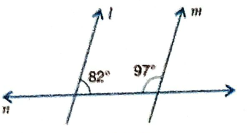
Statement-1 (A): In Fig., line lis paralld to liter m.
Statement-2 (R): If a transversal intersects two lines in such a way that a pair of consecutive interior angles are supplementary, then the two lines are parallel.
Image
  • A
    Statement-1 and Statement-2 are true; Statement-2 is a correct explanation for Statement-2
  • B
    Statement-1 and Statement-2 is true; Statement-2 is not a correct explanation for Statement-1.
  • C
    Statement-1 is true, Statement-2 is false.
  • Statement-1 is false, Statement-2 is true.
Answer

Correct option: D.
Statement-1 is false, Statement-2 is true.
(d)
Statement-2 is true.
In Fig., we find that $82^{\circ}+97^{\circ}=179^{\circ} \neq 180^{\circ}$ i.e. pair of consecutive interior angles are not supplementary. Therefore, line l is not parallel to tine m.
Thus, statement-2 is true and statement-1 is not true. Hence, option (d) is correct.

Need a full question paper?

Generate a complete, print-ready paper with questions like this in minutes — across 16+ boards, with answer keys.

Start Generating Free

Similar questions

Statement-1 (A): If the ratio of volumes of two spheres is 27 : 64, then the ratio of their surface areas is 9 : 16.
Statement-2 (R): If $V_1, V_2$ are volumes and $S_1, S_2$ are surface areas of two spheres, then
$\frac{S_1}{S_2}=\left(\frac{V_1}{V_2}\right)^{2 / 3}$
Statement-1 (A): The point P(-7, 0) lies on x-axis.
Statement-2 (R): The ordinate of every point on y-axis is positive.
Directions: In the following questions, the Assertions (A) and Reason(s) (R) have been put forward. Read both the statements carefully and choose the correct alternative from the following:
Assertion: Every rational number is an integer.
Reason: $\frac{3}{5}$ is not an integer.
  1. Both Assertion and Reason are correct and Reason is the correct explanation for Assertion.
  2. Both Assertion and Reason are correct and Reason is not the correct explanation for Assertion.
  3. Assertion is true but the reason is false.
  4. Both assertion and reason are false.
Statement-1 (A): The perpendicular distance of the point $(3,-7)$ from $x$-axis is 3 .
Statement-2 (R): The perpendicular distance of the point $(x, y)$ from $x$-axis $|y|$.
Statement-1 (A): Point $(-3,-3)$ lies on the angle bisectors of first and third quadrant angles.
Statement-2 (R): The numeric value of ordinate and abscissa of every point on the bisectors of first and third quadrant angles are equal.
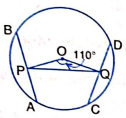
Statement-1 (A): In Fig. AB and CD are two equal chords of a circle with centre O. If $O P \perp A B$ and $O Q \perp C D$ and $\angle P O Q=110^{\circ}$, then $\angle A P Q=35^{\circ}$.
Statement-2 (R): Chords on the opposite side of the centre of a circle are equal.
Image
Directions: In the following questions, the Assertions (A) and Reason(s) (R) have been put forward. Read both the statements carefully and choose the correct alternative from the following:
Assertion: $\sqrt2$ is an irrational number.
Reason: A number is called irrational, if it cannot be written in the form $\frac{\text{q}}{\text{p}},$ where p and q are integers and $\text{q}\neq0.$
  1. Assertion and Reason both are correct statements and Reason is the correct explanation of Assertion.
  2. Assertion and Reason both are correct statements but Reason is not the correct explanation of Assertion.
  3. Assertion is correct statement but Reason is wrong statement.
  4. Assertion is wrong statement but Reason is correct statement.
Directions: In the following questions, the Assertions (A) and Reason(s) (R) have been put forward. Read both the statements carefully and choose the correct alternative from the following:
Assertion: The difference of rational and irrational number is irrational.
Reason: Product of rational and irrational is irrational.
  1. Both Assertion and Reason are correct and Reason is the correct explanation for Assertion.
  2. Both Assertion and Reason are correct and Reason is not the correct explanation for Assertion.
  3. Assertion is true but the reason is false.
  4. Both assertion and reason are false.
Statement-1 $(A): a^2+b^2+c^2-a b-b c-c a=0$ if and only if $a=b=c$.
Statement-2 (R):$(a+b+c)^2=a^2+b^2+c^2+2 a b+2 b c+2 c a$
Directions: In the following questions, the Assertions (A) and Reason(s) (R) have been put forward. Read both the statements carefully and choose the correct alternative from the following:
Assertion: $\text{x}^4=\frac{\text{X}^5}{\text{x}^1}.$ Reason: $ \frac{\text{a}^{\text{b}}}{\text{a}^{\text{c}}}=\text{a}^{\text{b - c}}.$
  1. Both Assertion and Reason are correct and Reason is the correct explanation for Assertion.
  2. Both Assertion and Reason are correct and Reason is not the correct explanation for Assertion.
  3. Assertion is true but the reason is false.
  4. Both assertion and reason are false.