MCQ
Statement-1 (A): There are infinitely many rational numbers between any two integers.
Statement-2 (R):The square of an irrational number is always a rational number.
  • A
    Statement-1 and Statement-2 are True; Statement-2 is a correct explanation for Statement-5
  • B
    Statement-1 and Statement-2 are True; Statement-2 is not a correct explanation for Statement-1.
  • Statement-1 is True, Statement-2 is False.
  • D
    Statement-1 is False, Statement-2 is True.
Answer

Correct option: C.
Statement-1 is True, Statement-2 is False.
(c)
Between any two integers a and b, there is a rational number $\frac{a+b}{2}$.Between a and $\frac{a+b}{2}$, there is a rational number $\frac{a+\frac{a+b}{2}}{2}$.Continuing in this manner, we can find infinitely many rational numbers between a and b. So, statement-1 is true.
Let $x=\sqrt{\sqrt{3}}$, be an irrational number, then $x^2=\sqrt{3}$ is an irrational number. So, square of an irrational number is not necessarily a. rational number. Thus, statement-2 is not true.
Hence, option (c) is correct.

Need a full question paper?

Generate a complete, print-ready paper with questions like this in minutes — across 16+ boards, with answer keys.

Start Generating Free

Similar questions

Directions: In the following questions, the Assertions $(A)$ and Reason(s) $(R)$ have been put forward. Read both the statements carefully and choose the correct alternative from the following:
Assertion: The graph of the linear equations $3x + 2y = 12$ and $5x - 2y = 4$ gives a pair of intersecting lines.
Reason: The graph of linear equations $a1x + b1y + c1 = 0$ and a2x + b2y + c2 = 0 gives a pair of intersecting lines if $\frac{\text{a}1}{\text{a}2}\neq\frac{\text{b}1}{\text{b}2}$
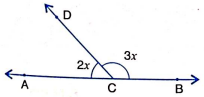
Statement-1 (A): In Fig. if ACB is a straight line, then $\angle A C D=72^{\circ}$
Statement-2 (R): If a ray stands on a line, the sum of two adjacent angles formed is 180°.
Image
Directions: In the following questions, the Assertions $(A)$ and Reason(s) $(R)$ have been put forward. Read both the statements carefully and choose the correct alternative from the following:
Assertion: It is given that $AD = BC$. Then $AC = BD$.
Reason: Above line we can prove by Euclid axiom $3$ If equals are subtracted from equals, the remainders are equal.”
Directions: In the following questions, the Assertions $(A)$ and Reason(s) $(R)$ have been put forward. Read both the statements carefully and choose the correct alternative from the following:
Assertion: The area of a triangle 8966.56 whose sides are respectively $150\ cm, 120\ cm$ and $200\ cm$​​​​​​​
Reason: Heron’s formula $=\sqrt{\text{s}(\text{s}-\text{a})(\text{s}-\text{b})(\text{s}-\text{c})}$
Directions: In the following questions, the Assertions $(A)$ and Reason(s) $(R)$ have been put forward. Read both the statements carefully and choose the correct alternative from the following:
Assertion: Rational number lying between two rational numbers $a$ and $b$ is $\frac{\text{a}+\text{b}}{2}.$
Reason: There is one rational number lying between any two rational numbers.
Statement-1 (A): If $a \neq 0$ and $a x^2+b x+a$ is exactly divisible by $(x-a)$, then $a^2+b+1=0$
Statement-2 $(R)$ : If $(x-a)$ is a factor of a polynomial $f(x)$, then $f(a)=0$.
Directions: In the following questions, the Assertions $(A)$ and Reason(s) $(R)$ have been put forward. Read both the statements carefully and choose the correct alternative from the following:
Assertion: The radius of hemispherical balloon increase from $6\ cm$ to $12\ cm$ as air is being pumped into it the ratio of the surfaces areas of balloon in two cases is $1 : 4.$
Reason: Total surface area of hemisphere $=3\pi\text{r}^2$
Directions: In the following questions, the Assertions $(A)$ and Reason(s) $(R)$ have been put forward. Read both the statements carefully and choose the correct alternative from the following:
Assertion: $(3,4)$ is the coordinates of the circum - centre of the triangle whose vertices are $(0, 0), (8, 0$) and $(0, 6)$.
Reason: The distance of the point $P(-6, 8)$ from the origin is $10$
Directions: In the following questions, the Assertions $(A)$ and Reason(s) $(R)$ have been put forward. Read both the statements carefully and choose the correct alternative from the following:
Assertion: If the area of an equilateral triangle is $81\sqrt3\text{cm}^2,$ then the semi perimeter of triangle is $20.$
Reason: Semi perimeter of a triangle is $\text{s}=\frac{(\text{a}+\text{b}+\text{c})}{2},$ where $a, b, c$ are sides of triangle.
Directions: In the following questions, the Assertions $(A)$ and Reason(s) $(R)$ have been put forward. Read both the statements carefully and choose the correct alternative from the following:
Assertion: Area of rhombus whose side is $20\ cm$ and one diagonal is $24\ cm$ is $38 \mathrm{~cm}^2$.
Reason: All sides of rhombus are equal.