MCQ
Static friction between two surfaces
  • Prevents the relative motion between them
  • B
    Opposite to the direction of motion of them
  • C
    Acts in opposite direction of applied force
  • D
    Both $(a)$ and $(b)$

Answer

Correct option: A.
Prevents the relative motion between them
a
(a)

Need a full question paper?

Generate a complete, print-ready paper with questions like this in minutes — across 16+ boards, with answer keys.
Start Generating Free

Similar questions

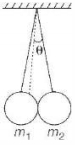
Two spherical objects each of radii $R$ and masses $m_1$ and $m_2$ are suspended using two strings of equal length $L$ as shown in the figure $(R << L)$. The angle $\theta$ which mass $m_2$ makes with the vertical is approximately
Which of the following is a slow process
A body of mass $(4m)$ is lying in $x-y$ plane at rest. It suddenly explodes into three pieces. Two pieces, each of mass $(m)$ move perpendicular to each other with equal speeds $(v).$ The total kinetic energy generated due to explosion is................. $mv^2$
Two parallel, long wires carry currents i1 and i2 with i1 > i2. When the currents are in the same direction, the magnetic field at a point midway between the wires is $10 \mu\text{T}.$ If the direction of i2 is reversed, the field becomes $30 \mu\text{T}.$ The ratio $\frac{\text{i}_1}{\text{i}_2}$ is:
  1. 4
  2. 3
  3. 2
  4. 1
The period of a satellite in a circular orbit around a planet is independent of
A particle is projected vertically upwards from $O$ with velocity $v$ and a second particle is projected at the same instant from $P$ (at a height h above $O$) with velocity $v$ at an angle of projection $\theta$ . The time when the distance between them is minimum is
The value of the acceleration due to gravity is $g _{1}$ at a height $h =\frac{ R }{2}( R =$ radius of the earth) from the surface of the earth. It is again equal to $g _{1}$ at a depth $d$ below the surface of the earth. The ratio $\left(\frac{ d }{ R }\right)$ equals
A sphere of mass $50\,gm$ and diameter $20\,cm$ rolls without slipping with a velocity of $5\,cm/sec$ . Its total kinetic energy is
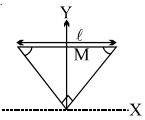
The figure shows an isosceles triangular plate of mass $M$ and base $L$. The angle at the apex is $90^o$. The apex lies at the origin and the base is parallel to $X$ -axis The moment of inertia of the plate about the $z$ -axis is
When $1\, gm$ of water at ${0^o}C$ and $1 \times {10^5}\;N/{m^2}$ pressure is converted into ice of volume $1.091\;c{m^2}$, the external work done will be