MCQ
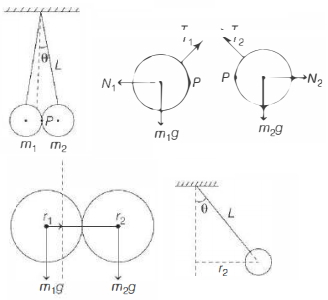
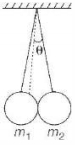
Two spherical objects each of radii $R$ and masses $m_1$ and $m_2$ are suspended using two strings of equal length $L$ as shown in the figure $(R << L)$. The angle $\theta$ which mass $m_2$ makes with the vertical is approximately
  • A
    $\frac{m_1 R}{\left(m_1+m_2\right) L}$
  • $\frac{2 m_1 R}{\left(m_1+m_2\right) L}$
  • C
    $\frac{2 m_2 h}{\left(m_1+m_2\right) L}$
  • D
    $\frac{m_2 R}{\left(m_1+m_2\right) L}$
Answer

Correct option: B.
$\frac{2 m_1 R}{\left(m_1+m_2\right) L}$
b
(b)

Given arrangement of spheres is as shown below.

Free body diagram of spheres is

As, there is no rotation about point of contact $P$.

Equating moments of weights about centre line, we get

$\quad m_1 g \times r_1=m_2 g \times r_2$

$\text { where, } r_1+r_2=2 R$

$\Rightarrow \quad \frac{m_2 r_2+r_2=2 R}{m_1}$

$\Rightarrow \quad r_2\left(\frac{m_2+m_1}{m_1}\right)=2 R \Rightarrow r_2=\frac{2 m_1 R}{m_1+m_2}$

Now, if angle made by string of $m_2$ with vertical line is $\theta$, then

$\sin \theta=\frac{r_2}{L} \Rightarrow \sin \theta=\left(\frac{2 m_1}{m_1+m_2}\right)\left(\frac{R}{L}\right)$

As $R \ll L$, angle $\theta$ is small, therefore $\sin \theta \approx \theta$.

$\therefore \quad \theta=\frac{2 m_1 R}{\left(m_1+m_2\right) L}$


Need a full question paper?

Generate a complete, print-ready paper with questions like this in minutes — across 16+ boards, with answer keys.

Start Generating Free

Similar questions

The drift current in a p-ri junction is:
  1. From the n-side to the p-side.
  2. From the p-side to the n-side.
  3. From the n-side to the p-side if the junction is forward-biased and in the opposite direction if it is reverse-biased.
  4. From the p-side to the n-side if the junction is forward-biased and in the opposite direction if it is reverse-biased.
Galileo writes that for angles of projection of a projectile at angles $(45 + \theta )$ and $(45 - \theta )$, the horizontal ranges described by the projectile are in the ratio of (if $\theta \le 45)$
For given systen ${\theta _1}$ ....... $^o$ 
A travelling wave represented by $y = A \sin (\omega t - kx )$ is susperimposed on another wave represented by $y = A$ $\sin (\omega t + kx )$. The resultant is
An aeroplane is flying with a uniform speed of $100\, m/s$ along a circular path of radius $100 m$. the angular speed of the aeroplane will be ......... $rad/sec$
A swimmer can swim with velocity of $12 \,km / h$ in still water. Water flowing in a river has velocity $6\, km / h$. The direction with respect to the direction of flow of river water he should swim in order to reach the point on the other bank just opposite to his starting point is ........$^{\circ}$. (Round off to the Nearest Integer) (find the angle in degree)
Let Fpp, Fpn and Fnn denote the magnitudes of the net force by a proton on a proton, by a proton on a neutron and by a neutron on a neutron respectively. Neglect gravitational force. When the separation is 1fm:
  1. Fpp > Fpn = Fnn
  2. Fpp = Fpn = Fnn
  3. Fpp > Fpn > Fnn
  4. Fpp < Fpn = Fnn
The units of angular momentum are
Roads are banked on curves so that
A man is riding on a cycle with velocity $7.2$  km/hr up a hill having a slope $1$ in $20. $ The total mass of the man and cycle is $100 kg.$  The power of the man is ............ $W$