MCQ
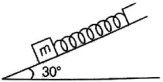
Static friction occurs.
  • always greater than kinetic friction
  • B
    equal to kinetic friction
  • C
    less than kinetic friction
  • D
    None of the above

Answer

Correct option: A.
always greater than kinetic friction
A

Need a full question paper?

Generate a complete, print-ready paper with questions like this in minutes — across 16+ boards, with answer keys.
Start Generating Free

Similar questions

If by applying a force F on an object that object gets velocity v then the value of power will be :
A projectile is thrown with some initial velocity at an angle $\alpha$ to the horizontal. Its velocity when it is at the highest point is $(2 / 5)^{1 / 2}$ times the velocity when it is at height half of the maximum height. Find the angle of projection $\alpha$ with the horizontal.
When a rubber-band is stretched by a distance $x$, it exerts restoring force of magnitude  $F=ax+bx^2$ where $a$ and $b$ areconstants. The work done in stretching the unstretched rubber-band by $L$ is
An object may have:
$i.$ varying speed without having varying velocity.
$ii.$ varying velocity without having varying speed.
$iii.$ non-zero acceleration without having varying velocity.
$iv.$ non-zero acceleration without having varying speed.
A cricketer can throw a ball to a maximum horizontal distance of $100\, m .$ The speed with which he throws the ball is (to the nearest integer)  (in $ms ^{-1}$)
When two sound waves with a phase difference of $\pi /2$, and each having amplitude $A$ and frequency $\omega $, are superimposed on each other, then the maximum amplitude and frequency of resultant wave is
Number of degrees present in one radian is
The linear density of a vibrating string is $1.3 \times 10^{-4}\, kg/m.$ A transverse wave is  propagating on the string and is described by the equation $Y = 0.021\, \sin (x + 30t)$ where $x$ and $y$ are measured in meter and $t$ in second the tension in the  string is ..... $N$
A body of mass $1\, kg$ is under a force, which causes a displacement in it is given by $x = \frac{{{t^3}}}{3}$ (in $m$). Find the work done by the force in first second ............ $\mathrm{J}$
If ${V_H},\,\,{V_N}$ and ${V_O}$ denote the root-mean square velocities of molecules of hydrogen, nitrogen and oxygen respectively at a given temperature, then