Question
Study the diagram given below and answer the questions that follow :
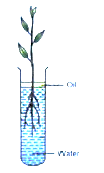
(a) Name the process being studied in the above experiment.
(b) Explain the process mentioned in (a) above
(c) Why is oil placed over water?
(d) What do we observe with regard to the level of water when this set up is placed in (1) bright sunlight (2) humid conditions (3) windy day?
(e) Mention any three adaptations found in plants to foster the process mentioned in (a) above
Answer

(a) The process of water absorption by plant roots through osmosis is being studied here. (b) A root-hair contains cell sap which contains higher concentration of salts as compared to outside soil water. This difference sets off osmosis and outside water diffuses into the root-hair. From the cell bearing root-hair, water passes into adjoining cells one after another to finally the xylem vessels. (c) The surface of water was covered with oil to prevent any loss of water by evaporation. (d) Roots absorb water and hence, the level of water in set up A falls down. Since the surface of water was covered with oil, there will be no effect of factors such as bright sunlight, humid conditions and windy day on the given set up. Hence, the level of water (e) Adaptations in plants to foster the process of absorption of water by plant roots:
  • Large surface area provided by rootlets and root hairs
  • Root hairs containing cell sap at a higher concentration than that of the surrounding water
  • Root hairs with thin walls

Need a full question paper?

Generate a complete, print-ready paper with questions like this in minutes — across 16+ boards, with answer keys.

Start Generating Free

Similar questions

List the advantages of having small families.
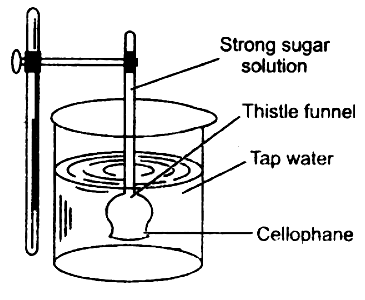
The diagram below represents an experimental set up to demonstrate a vital process. Study the same and then answer the questions that follow:


(i) Name the process.
(ii) Define the above named process.
(iii) What would you observe in the experimental setup after an hour or so?
(iv) What control experiment can be set up for the above experiment?
(v) Keeping in mind the root hair cell and its surrounding name the part that corresponds to (1) Concentrated sugar solution, (2) Parchment paper, (3) Water in the beaker.
(vi) Name any other substance that can be used instead of parchment paper in the above experiment.
(vii) Mention two advantages of this process to the plant.
Enumerate the common defects of vision, their causes and the possible methods of correcting them.
How is root hair adapted for the absorption of water from the soil?
What are the functions of the nervous system?
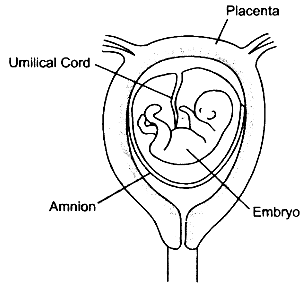
The below diagram is of a developing embryo is a mother’s womb:

(i) Write the functions of the placenta, amnion, and umbilical cord.
(ii) How are the waste products of a fetus removed?
(iii) What is the gestation period?
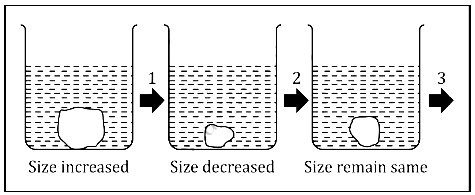
A candidate in order to study the process of osmosis has taken 3 potato cubes and put them in 3 different beakers containing 3 different solutions. After 24 hours, in the first beaker the potato cube increased in size, in the second beaker the potato cube decreased in size and in the third beaker there was no change in the size of the potato cube. The following diagram shows the result of the same experiment:

(i) Give the technical terms of the solutions used in beakers, 1, 2 and 3.
(ii) In beaker 3, the size of the potato cube remains the same. Explain the reason in brief.
(iii) Write the specific feature of the cell sap of root hairs which helps in absorption of water.
(iv) What is osmosis?
(v) How does a cell wall and a cell membrane differ in their permeability?
(i) Fill in the blanks in the following equations of two chemical reactions:
(a) $\ce{---+12H2O->[Light energy]C6H12O6 + --- + ----}$
(b) $\ce{--- 6O2->[Chlorophyll] 6 --- +6 ---- + Energy}$
(ii) Name the two processes represented by the above two reactions.
(iii) State any two differences in these processes other than those already indicated in the reactions.
(iv) Which one of these two reactions is the supporter of all life on earth?
Name the hormones secreted by the following glands:
(i) Anterior pituitary
(ii) Testes
(iii) Ovary
(iv) Adrenal cortex
(v) Pancreas
Name the two kinds of cell division found in living organisms.