Question
Study the illustration given and answer the questions that follow:
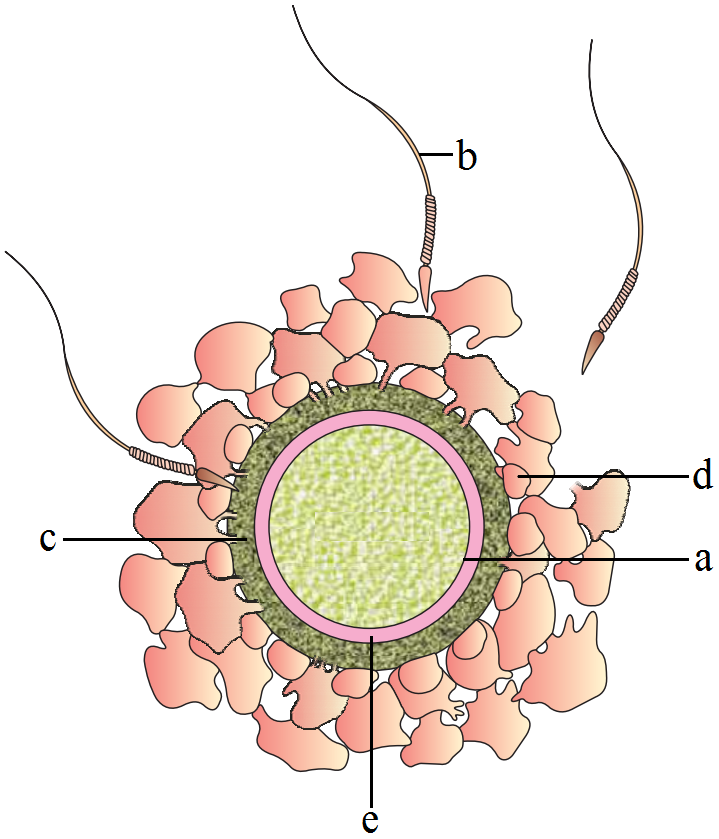
Identify ‘d’.

Answer

d – cells of corona radiata.

Need a full question paper?

Generate a complete, print-ready paper with questions like this in minutes — across 16+ boards, with answer keys.

Start Generating Free

Similar questions

Arrange the following hormones in sequence of their secretion in a pregnant woman.
hCG, LH, FSH, Relaxin.
Why is thermoregulation more effectively achieved in larger animals than in smaller ones?
Explain the development of a secondary oocyte (ovum) in a human female from the embryonic stage upto its ovulation. Name the hormones involved in this process.

OR

When does oogenesis start in humans? Name the three hormones and their sources, linked with oogenesis. How do they influence the process of oogenesis? Explain.

Given below is a table showing the genotypes and the phenotypes of blood groups in the human population.
Genotype
Phenotype
W
Y
IB IO
Z
IA IB
O
X
O
  1. Identify the genotype Wand X, and the phenotype Y and Z.
  2. Name the pattern of inheritance exhibited by the phenotypes Y and Z in the table.
What is innate immunity? How is it accomplished in a human body?
What do you mean by transcription? Explain the transcription process with a well labelled
diagram.###What is transcription? Explain the transcription process in bacteria by making a labelled diagram.###Explain the transcription process in bacteria and make a diagram.
Write short notes on :
(a) National park
(b) Sanctuary
(c) Biosphere reserves
(d) Characteristics of biogeographical area of India
With the help of one example each, provide genetic explanation for the following observations:
F1-generation resembles both the parents.
Describe biological evolution from paleontological and embryological evidences.
During the course of evolution why DNA was chosen over RNA as genetic material? Give reasons by first discussing the desired criteria in a molecule that can act as genetic material and in the light of biochemical differences between DNA and RNA.